


People don’t like changing things they get used to. We order the same dish at our favorite restaurant because we’re afraid a new one won’t be as good. Marketing plans work the same way.
Researchers call it status quo bias. It’s when we prefer to stay with the current state of affairs, whatever it happens to be.
So when marketing teams sit down to plan the next year, they do what they did the previous year. And the one before that. This process runs on autopilot. Marketers do review the numbers, but one piece at a time. If results drop, they blame the obvious suspect, usually rankings or not enough content, and move on.
The obvious suspect, though, isn’t always the guilty one. More and more B2B buyers ask ChatGPT or Gemini for a shortlist before they visit a single vendor website. If AI doesn’t understand what you do and why you’re different, those leads go to whoever it recommends instead. To find the real cause, you need to see all the pieces together. Our marketing audit template puts them on one sheet: you review each part of your marketing, from ICP to budget, and turn what you find into actions with an owner, a deadline, and a priority.
Before we get into the template, give us a minute to explain why your current marketing plan needs this audit.
Still planning marketing like it's 2020?
If your plan for next year starts with a keyword list, you’re planning for buyers who searched the way they did in 2020. Today, 51% of B2B software buyers start their research in an AI chatbot more often than in Google. That’s from a G2 report that also found nearly 7 in 10 buyers were steered by AI toward a vendor they hadn’t planned to choose. Think about it. A buyer who was ready to pick you can switch to your competitor because of one AI answer. That’s why AI needs to know who you are.
But many B2B tech companies still run on an SEO-ish mindset. When organic traffic drops and leads aren't coming in, they open good old Ahrefs and pick keywords. In our experience, that’s 90% of B2B marketing teams. Then they fill the content calendar with articles around those keywords, and that becomes the plan for the next quarter. Sometimes they add a PPC campaign, experiment with LinkedIn ads because they heard it worked for someone else, or hire a new agency and hope for a different result.
So before you add another keyword list to your 2027 plan, look at what your current marketing tells buyers. Who responds to it? Can they tell you apart from competitors? Which channels and content bring leads, and where do buyers drop off? Our digital marketing audit template walks you through these questions one row at a time and turns the answers into a plan for next quarter. Once you know where you stand, use our guide to build your 2027 AI search roadmap.
Here’s how we would use this template in your place.
How to do a marketing audit with our free template
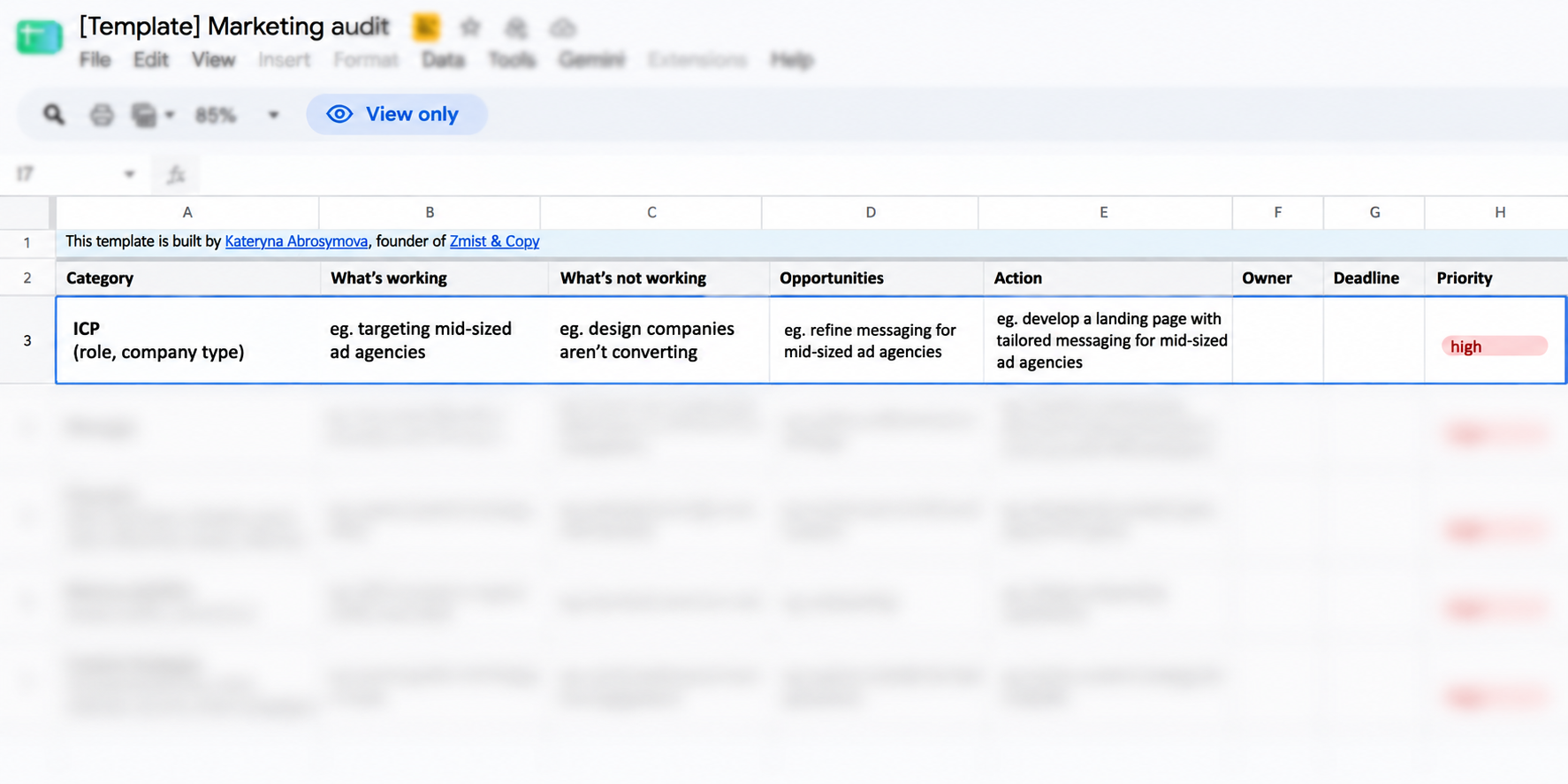
A marketing audit is a review of your whole marketing system, from the companies you target to where your budget goes, that shows what to keep and what to change next quarter. Our template is a Google Sheet where each row covers one category of your marketing. For every row, you answer three marketing audit questions: what’s working, what’s not working, and where the opportunities are. The next four columns turn your answers into a plan: what you’ll do, who owns it, when it’s due, and how urgent it is. Open the template in another tab, and follow along.
Eight categories might sound like a lot, but don’t run away. We’ll take you by the hand and walk you through the marketing audit process, step by step. The first stop is ICP.
ICP: Do you attract the right companies?
The ICP row compares the companies you want to reach with the ones that respond to your marketing.
Let’s say your report shows that mid-sized ad agencies click with your content. Great, that goes into the “What’s working” column. But you also notice that design agencies aren’t converting. Add that to “What’s not working.”
As an opportunity, you could focus more of your efforts on the audience that already shows interest: mid-sized ad agencies. Start with a dedicated landing page that addresses their specific challenges, or write a few articles on the problems these agencies face.
There you go. You’ve turned your first finding into a concrete action.
Messaging: Does your message give buyers a reason to choose you?
The messaging row checks if your message speaks to your buyers’ needs and sets you apart from competitors. Picture this: reviewing sales calls, you notice that prospects often repeat a phrase from your landing page. Let's say it's “your own R&D office.” Then, the same people also ask how you’re different from the company they spoke to last week, and you don’t have an answer. If buyers can’t tell you apart from your competitors, that goes under “What’s not working.”
Research your competitors and compare their value propositions with yours. Find something buyers value that sets you apart, then bring it into your messaging. Our guide on how to position a product walks through this step by step.
AI visibility: Does AI describe you the way you’d describe yourself?
The AI visibility row checks whether the message from the previous row has reached AI. Open ChatGPT, Perplexity, and Gemini, and ask what your company does, who it’s for, and who its competitors are. Then ask for the best companies in your category for a problem your buyers have.
Let’s say AI gets your product right but describes you with the same features it lists for every competitor, and never mentions the outcome your buyers care about. The accurate description goes under “What’s working,” the generic one under “What’s not working.” If you don’t appear in the category answers at all, add that to “not working” too.
AI repeats what it can verify about you. So the opportunity has two parts: choose the one claim you want AI to associate with you, then back it with proof in case studies, on review sites, and in industry publications. Our 10-step plan for B2B AI search walks through both.
Modeso reached a 26% AI visibility score, the highest among its competitors, after the narrower focus you saw in the ICP row. Pingle had the opposite problem. The market still saw it as a porting studio years after it started running full expansion roadmaps. In both cases, the fix started with positioning.
Channels: Where do your best leads come from?
Your best leads come from the channel with the lowest cost per qualified lead, which is rarely the one with the most traffic. To find it, list the channels you use to reach buyers. It might be SEO, YouTube, LinkedIn, email, paid ads, influencers, media, or referrals. Go through them one by one and compare their cost with the leads they bring in. Add AI search to that list. It rarely shows up cleanly in analytics, so ask new leads how they found you and whether they used ChatGPT or another AI tool along the way.
For example, organic search attracts MQLs who fit your ICP and have shown interest. So we can conclude that SEO is doing its job. Your other channel, let it be paid ads, costs a fortune and brings little in return. When one channel pays off, and another drains the budget, the opportunity is to invest in the “winner”. In our example, it’s organic search and the content behind it. Start with a Q1 content plan and cut back on paid ads.
Metrics and KPIs: Do you see the whole picture?
Traffic, leads, and conversion rates can tell you a lot, but you have to read them together.
Suppose you compare organic traffic for this quarter and the previous one and see a 20% increase. Record that under “working.” But your lead-to-customer conversion rate is low. People find you and sign up for a trial, but they don’t become paying customers. That one belongs in “not working.”
On its own, the traffic increase might convince you to invest more in SEO. Next to the conversion rate, it shows that people arrive, then stall after signing up. Maybe new users find your product confusing and give up before they see its value. Either way, your opportunity is what happens after sign-up. You could redesign the onboarding experience or add a guided product tour.
Content strategies: Does your content bring leads?
The content row shows which types of content bring business results, so you can shift your effort to the formats that work. Here’s where we’d start.
List what you produced, like thought leadership, video, webinars, ebooks, email campaigns. Next to each one, note the leads it generated and whether AI tools cite it. The best performers go to the “What’s working” column. The rest, well, you can guess.
For example, how-to guides bring in leads, quarter after quarter. But your LinkedIn posts sit calm with two likes each. Time to abandon LinkedIn? Not so fast.
If you only looked at engagement, you might write LinkedIn off. But the audit gives you another clue: your audience responds to practical content. Why not try turning your best how-to guides into useful LinkedIn posts? (If you need a starting point, here’s what we learned from posting on LinkedIn for 90 days straight.)
In the template, you’d write “explore LinkedIn for lead generation” as the opportunity and “build a content strategy for LinkedIn” as the action.
Customer journey: Where do buyers lose interest?
The customer journey row helps you find the point where buyers stop moving toward a purchase.
Let’s model one possible scenario. You open your CRM and see that demo bookings look healthy. But few move to the next stage after the call. That’s your drop-off point.
Now look at the stage that brought buyers to the demo. Ebooks, for example. They perform well during consideration because people download them and book demos. That part of the journey delivers, so ebooks go into “What’s working.”
When you put two findings together, you see that buyers are interested enough to book a call. But after the demo, something holds them back. One likely reason is that they aren’t sure you’re a good fit for them. You need to give buyers more proof from companies like theirs. You could create an industry report with quotes from customers who fit your ICP. When buyers see peers describe the problem you solve (the same problem they have), they get a reason to trust you.
In the “Action” column, plan how you’ll create the report and get it in front of buyers.
Budget: Does your money go to the right marketing activities?
Your money goes to the right activities when each channel’s share of the budget matches its share of qualified leads. By this point, you can name your best-performing channels, so the only part left is money. To fill in the final row of the template, gather last quarter’s spending by channel and compare it with the results each channel delivered. This way, you’ll see where your money works hardest.
We take one last imaginary example. Your email campaigns bring in qualified leads at a relatively low cost. YouTube, meanwhile, eats up a good chunk of your budget but delivers disappointing results. The conclusion speaks for itself: reallocate budget to high-performing channels. You also need to plan how much each channel gets next quarter.
Once you’ve filled in an action for every category, assign each one a priority, an owner, and a deadline. Filling in the sheet is not as scary as it looks. Spread it over a few days and come back to it with fresh eyes.
When you complete the template, you get a list of decisions to build your marketing plan for the next three months.
Audit your marketing before you set next quarter’s priorities
It’s hard to break old marketing habits, all the more when they used to work. The quarter ends, and you give the same activities another round of funding. But do they still deserve it?
This time, question the familiar plan and give your marketing a shake-up. Our marketing audit template can help you focus on activities that bring in leads and revenue.
If the messaging or AI visibility rows gave you the most trouble, start there. Every engagement at Zmist & Copy starts with positioning, because AI can only recommend you for what it understands about you.
Let's discuss your AI visibility strategy.


