


Our team entered 2026 with a resolution: understand LinkedIn better and become active members of this community. In the end, we wrote many posts for our clients, Kate, our founder, has a profile with ~4K followers, while the rest of the team? We stay in the dark, without anyone knowing about us or what company we work for.
So we decided to change that. We wiped the dust off our LinkedIn profiles, brainstormed the content ideas and started our 90-days LinkedIn adventure. Right off the bat, I have to say that we underestimated LinkedIn, and the days people were talking strictly business there are gone. Now it’s a vibrant community filled with memes, laughs, debates, but most importantly, opportunities and new audience to reach.
So what are we waiting for? Let’s see what LinkedIn is like in 2026.
TL;DR
Five members from Zmist and Copy joined LinkedIn for 90 days and posted what their hearts desired. Here are some of our key findings:
→ Impressions and engagement are different goals. Decide which one you're chasing before you start posting. We had both the team's highest impression count and lowest engagement rate on the same account.
→ Carousels have the best shelf life. They kept pulling in impressions three and four weeks after publishing. Nothing else in our sample did that.
→ Controversy gets the biggest spikes and the biggest problems. Both of our viral posts came from picking fights. Neither of us is recommending you do the same.
→ Comments (yours on other people's posts, and theirs on yours) matter more than likes. Most of our breakout posts only took off after a well-known account showed up in the replies.
→ AI-written posts don't hurt your reach, but they can hurt your reputation. The algorithm doesn't care. Some of your audience does.
→ Personal accounts are beating company accounts, and that gap is widening. Founder pages outperform their own companies on the same content, Gen Z is posting like it's Instagram, and the platform itself now works more like a social network.
In total, our experiment brought us 237,658 impressions, with 95,203 of users reached and 3,178 new followers gained.
Meet the contestants
Five of us, three months, very different ideas about what LinkedIn is actually for. We kept the archetype labels honest, sometimes at our own expense, because pretending everyone was running the same playbook would make the rest of this article less useful.
Anna, the micro-influencer

Anna walked into the challenge with the most built-up account on the team and a bio that says "B2B writer" with conviction. Her lane is the educational one: frameworks, recommendation lists, carousels that teach something, the occasional "I used to think X, now I think Y" post where she openly changes her mind in public. Anna's whole premise is that LinkedIn can still be a place where people learn things, and she posts like she believes it.
Yuliia, the marketing strategist without marketing strategy fluff

Yuliia could tell you the same thing a LinkedIn thought leader would tell you, but she'll do it through the Friends meme or a thing that happened to her last Tuesday. Her angle is professional content with personal texture, a positioning take framed as an everyday moment or a popular sitcom analogy. The stuff you’d read on a slow Monday but definitely when you’re in 24/7 learning mode.
Yurii, the contrarian

I'll just admit what I was doing. I posted against the things most of LinkedIn agrees about and I will keep doing it. I like AI, but not AI plagiarism detectors. I have nothing against using AI for writing, but if you’re lazy about it, I will smoke you while editing. All things considered, I’m a true AI evangelist trying to deliver the point of people not trying to delegate all the work to it.
Diana, marketing with a pitch of UGC

Roughly one post a week, almost always with an image, almost always an opinion she's willing to defend. Her content is opinion-sharing: one specific take per post, no hedging, no padding. Diana doesn't look for frequency or hypergrowth, focusing mainly on her personal storytelling and opinions.
Olesia, how Gen Z actually posts on LinkedIn

Lowercase, sardonic, image-first, a little mean in a way that reads as fun. Lesya’s angle is the narrowed personal take: she grabs something everyone's already talking about and posts the specific version of it nobody else is posting. Not the general take. The weird, locally-specific, "you had to be there" version. That's the whole strategy, and it's harder than it looks.
So what posts brought us fame?
After going through the analytics and sitting with them for a while, six patterns stood out. Ranked by how well they performed on our team, from biggest spike potential down to the slower burn.
1. The contrarian post (a.k.a. "I disagree and I'll tell you why")
What it is: You take a popular opinion, a trending tool, a common piece of advice, and you punch it in the face. Strong language, clear stance, no hedging.
This is the category that produced our two biggest impression spikes. My post calling out AI plagiarism detectors pulled 17,365 impressions and 331 engagements, the highest engagement count of any single post across the whole team.
The benefit is obvious: you get your reach fast, you pick up followers, and people start thinking of you as someone who actually says things. The downside is less obvious and more expensive. Once you stake out a radical position, you're kind of stuck defending it. If you walk it back, you lose the audience that showed up for the hot take.
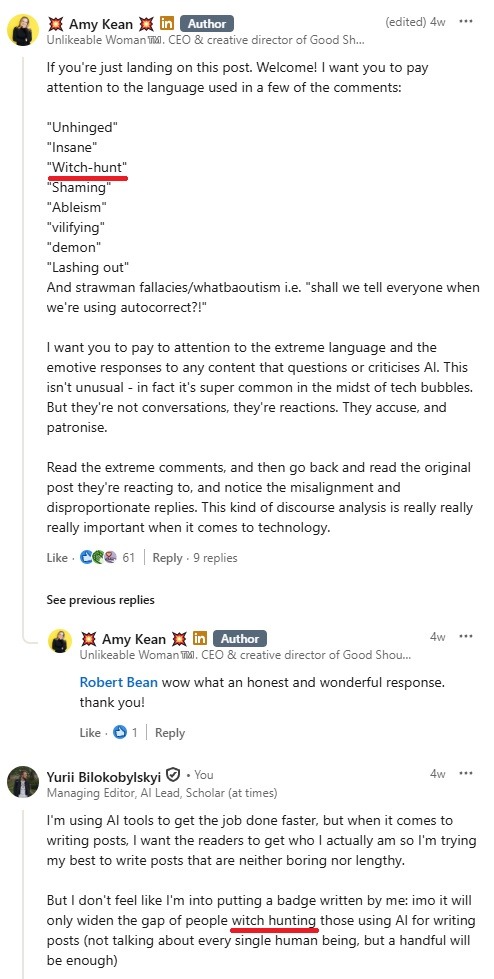
A month later, my em dash "in memoriam" post hit 27,133 impressions, which is our team’s record. What pushed it over the edge wasn’t the essence, but rather communication that came prior. I got into the debates with Amy Kean, a LinkedIn influencer with over 60K followers. The fight was civil, no one got embarrassed, but the spike came from me sharing my contrarian thoughts under her post. My profile got over a thousand views that week, the post I was talking about surged in terms of impressions.
Would I recommend you pick a public debate with a recognizable person on LinkedIn as a strategy? If you're not ready to square up and picking up a fight isn't already a part of your brand, this is the kind of thing that burns down a reputation faster than it builds one. The post worked, but I don’t encourage anyone to copy-paste this method.
2. Educational carousels (and other influencer-type posts)
What it is: A swipe-through document where you share a framework, a technique, a recommendation list, or a POV explainer. Usually tied to your professional expertise.
This was Anna's lane, and the numbers prove it. Her newsletters carousel got 18,908 impressions and 355 engagements — the highest engagement for carousels from our team. Her pushback on "write like you talk" kept generating impressions for nearly a month (6,088 total). Her New Girl sitcom analogy about being a B2B writer got 2,680 impressions and 124 engagements.
This format has the best longevity of anything we tested. Carousels kept pulling in impressions weeks after they were published, especially when they stayed close to Anna's stated professional identity (B2B writer). LinkedIn seems to actively favor this format right now.
The bottleneck: it only really works if you've already got a base. Anna started the challenge with ~1,200 followers and ended with almost 2,000. Below 1,000, carousels tend to sink. You need enough connections for the early engagement to signal the algorithm. And if you post the same kind of carousel too often (Anna had one published too close to the first, and it didn’t work that well), the impressions drop noticeably.
3. The personal photo with a narrowed angle
What it is: You, in a café take a photo, be it a selfie or work environment. One or two sentences, usually something a bit sharp or a bit funny. The thing often missed – the post is tied to a specific detail instead of a generic take.
Olesia's whole strategy basically lived here, and her best ones hit hard, both statistically and mentally. Her half-sarcastic post about working from a café due to the energy crisis pulled 8,376 impressions and 125 engagements, making it her most performing post. Her -16°C Justin Bieber meme did 683 impressions and 32 engagements.
Two things to notice. First, the format is light, selfie or on-brand image, a sentence or two of caption. It takes three minutes to produce, which means you can post consistently, and the regularity itself helps with the algorithm.
Second, and this is what gets over people’s heads: the posts mentioned were on highly specific media topics. While everyone else on LinkedIn was posting "stay strong" messages about the war, Olesia shared the specific context about dealing with the war’s reality, how she worked from a café because her home had no power. Sad to admit, but the war is the general topic, everyone knows about it already, but the energy crisis is an additional context that brought 8K impressions.
What makes the short post format winning in general: doesn’t take much time to produce, which means you can post consistently. And the regularity itself helps with the algorithm, as even her lower-effort image posts averaged 500–800 impressions.
The catch: Olesia’s posts are pure Gen Z LinkedIn energy, which obviously won’t work if you’re older. If you're a CEO with 10K followers and a senior-heavy audience, a selfie with a one-liner is going to land weird. If you're under 30 and building a personal brand from scratch, it's one of the fastest ways to stay visible.
4. Professional topic + personal allegory or visual
What it is: You talk about something expertise-related, be it positioning, content strategy, team dynamics — but you anchor it in a personal example, a metaphor, or a visual that belongs to you.
Yuliia ran on this. Her Friends-meme post about marketing teams pulled 1,230 impressions and 28 engagements at 6% engagement against her follower base — well above the 3–4% baseline she usually hit. Her AI and content teams reflection got 424 impressions and 30 engagements — lower reach, higher interaction density. When the personal angle lands, this format beats straight professional advice every time.
The benefit: it ties ideas to you specifically, not just to your account. People start associating the take with the author. Loyalty compounds.
The catch: stylistic consistency matters. If you build an account on memes and soul while remaining a professional, a sudden pivot to corporate-voice thought leadership is obvious and jarring. Your audience is here for you, so they will spot the change.
5. Half-serious experiments
What it is: A serious topic (AI, industry trends, your job) approached with zero gravity. Anything your heart desires – just be creative about it.
This is something I personally did, and it's more useful than it looks. My dog wrote my LinkedIn post experiment got 2,440 impressions and 35 engagements, which isn't a viral number, but it built character consistency because my followers started recognizing the account as the place where someone talks about AI without worshipping it.
These posts don't spike, but they help your audience learn more who you are as a person. The value is less about any single post's reach and more about the compound effect: over three months, people form an opinion about what kind of account yours is.
The challenging part, same as always: this only works if the jokes actually serve a point. If you post this type of content for the sake of content, it won't get you anywhere.
6. Keyword-intent posts on trending topics
What it is: You write about something (your own take, your own experience) but the semantic field of your post overlaps with a bigger discourse happening somewhere else online.
My AI Overviews lifehack got picked up harder than expected (2,790 impressions) mostly because the week it went out, there was a lot of AI controversy circulating generally. The post didn't reference any of that discourse directly, but LinkedIn's algorithm seems to do semantic matching, meaning that if your post's vibe aligns with negative-sentiment AI discourse, it gets surfaced more often to people who've been engaging with that content elsewhere.
This is the most opportunistic category. You can't force it, but it's worth knowing it exists, because your posts can get unexpected lift from discourse you didn't even participate in. Alt text helps here too if your post contains images: more than once we saw impression bumps on image posts from search traffic we couldn't explain otherwise.
Altogether, our team (excluding Kate) gained 237,658 impressions, reaching 95,203 of users and gaining 3,178 new followers within 90 days. Given that in January we averaged zero impressions and zero unique users reached, it’s pretty damn good, but the story won’t be full if we don’t cover what we’ve learned about LinkedIn as a platform.
What three months of posting actually taught us
Here's what I'd say if you cornered me in the dark alley and asked for an honest answer.
Impressions and engagement are not the same thing, so you should decide which one you're after
I had the most impressions on the team (115,905 over 90 days) and the lowest engagement rate (1.05%). Yuliia had less impressions (7,012) but the highest rate at 4.28%. Anna sat in the middle of both: 93K impressions, 2.58% engagement, and nearly 700 new followers.
None of these are failures or prove to perform worse when compared. They’re different objectives. If you care about awareness, you look at impressions, if you need to build new relationships, set the goal for higher engagement. Pick one before you start posting.
Carousels are the best format if you want your content to live longer than a day
Anna's best carousels, especially the newsletters one and the one that is based on New Girl, kept generating impressions three and four weeks after publishing. Nothing else in our sample did that. If longevity matters to you (and for most B2B content, it should) carousels are where to put the effort.
Side note: all the carousels mentioned have humor in them. You can chase the business format, but you don’t have to treat them as business.
Mentions and commenting on other people's posts is not optional
Several of our biggest posts only took off after a well-known account engaged in the comments. My GEO post surged impressions-wise after Ryan Law, the content marketing director at Ahrefs, reacted to it. Anna’s post on the writing advice she hates is not only very relevant, but also because she gave Rosanna Campbell a shout out.
On commenting. As I said earlier, the em dash post went viral after I got into a debate with Amy Kean. The logic is that my post matched the expertise I showed during that debate, and while my comment wasn’t appreciated by the author, I came out unscathed.
Another point: me and Anna posted our best performing posts one day apart from each other, and we both left the comments under those posts. So in the end, it seems like our audiences intertwined and brought additional impressions as a result.
The platform has changed, and it's still changing
The thing we saw in real time is that LinkedIn is no longer treated as a purely professional platform by users, especially under 30. People post like it's Instagram or Twitter, and it works for them.
The algorithm resurfaces older posts 2–3 weeks later, so engagement windows are longer than they used to be. And personal accounts now beat company accounts on almost everything. The same post from your company page will do worse than it will from your founder's page, so take a note.
AI-generated writing doesn’t hurt the numbers, but can hurt your reputation
This one comes from the community we built, we ourselves didn’t know it. While studying other people's posts, we saw many talking about using AI for writing content and having high impression rates nevertheless. While we can’t prove this method works directly, the tendency of people using AI on LinkedIn is visible and many people had their justified laugh.
Two quick notes on AI: LinkedIn is the second most cited source for AI (Semrush), but on the other hand, AI writing has surged with very popular “AI writing phrases” being in the spotlight (State of Brand). So while the algorithms won't punish the use of AI for writing posts, you won't trick people into believing you write yourself, and some people won't be happy to see your AI-generated post/comment. So the motto “In AI We Trust” doesn't work here.
Controversy works
It is also the worst thing you can build a personal brand on if you aren't ready for it. Our two biggest spikes came from posts that picked fights, true. Both of them brought followers, reach, profile views, and my favorite, non-trivial amount of backlash. Again, if provocation and debates aren't parts of your nature, the method is borrowed, and borrowed controversy ages fast.
You do need to post consistently, but consistency differs
Diana posted roughly once a week and had the smallest reach due to not being that active within the platform, while Olesia was active for two months, then stopped, and naturally, her engagement collapsed in month three. Two people who maintained both frequency and stylistic consistency (looking at Anna and myself) were most rewarded, but what also stands out is that we remained consistently engaged with people on the platform. So here, the conclusion is: post regularly if you want to see the impressions surge, but never let the algorithm and your followers forget who you are and what you sound like by just tossing in the post and signing off.
Alt text is free impressions, so USE IT
If posts with images are your thing (and it’s not just a plain selfie), there’s this magic thing called “alt text” you can add to them. It makes your posts accessible for two important entities: people with disabilities and search engines. So if you add a keyword + spot-on description that matches the image, Google will thank you with more impressions.

Some final notes
I like giving fair warnings, so I will finish the article with one, too. Three months is a short window, and our group were five people working in B2B marketing. Being creative is what helps us earn our bread and what makes our content filled with marketing takes. Four of us are Ukraine-based at the time of writing, which affects audience composition, with the core audience coming from Ukraine. To all Ukrainians reading this, припиніть, будь ласка, сліпо копіювати західний LinkedIn, це нуууудно.
If you’re just starting out, your journey will be different. You’re interested in other things and you will engage with different people, so your result will not be the same. We embarked on this journey looking to find what happens when five different people post for 90 days, and what came up is what we believe is something more interesting than another SEO-optimized "7 LinkedIn tips for 2026" blog post.
If you want to learn what works, it’s this: post the things your audience thinks you'd post, show up in other people's comments, use carousels, and don't pick fights unless you can afford the mess. Everything else is seasoning.
Want to start your own LinkedIn journey? Send us a note and we’ll be glad to join the fray.


