


I keep reading case studies that tell me what a company did. "Our AI agent shipped 600 blog posts in two months." "We built a personalized test-assessment platform." Impressive. And useless. You did that, so what? What changed for the client? Why should I care?
Results-Forward, one of three frameworks in our Context Engine (Zmist & Copy approach to writing content), flips the order. You lead with the outcome that proves one specific positioning claim. "We ship fast." "We handle enterprise-grade complexity." "We cut costs without cutting quality." If you don't think about a case study as evidence of your positioning claims, you'll get lost every time you need to write one. You won't know which number to highlight, which parts of the project matter, or where the story should go. Get the claim right and the case study almost writes itself. It tells you which result leads, which details stay, and which ones you cut.
What is Results-Forward?
Results-Forward is our framework for structuring a case study around the outcome and the claim that outcome proves. In consists of four parts:
Result → Story → Methodology → Impact
Step 1: Result
Your headline does 80% of the work. Make it specific.
Formula: [customer type] + [specific outcome] + [your approach or timeframe]
- Fintech app cuts onboarding drop-off 40% with a redesigned KYC flow
- Logistics startup handles 3× the order volume after warehouse automation
- Healthcare provider passes its HIPAA audit in 6 weeks with a security overhaul
Step 2: Story
Set up the situation. What was the client trying to achieve? Why did it matter? What happened if they failed?
"NorthPeak, a logistics startup, onboarded every new warehouse client by hand, three weeks of manual setup each time. Growth had stalled because the ops team couldn't take on more accounts without burning out. One more large client would have broken the process entirely."
Step 3: Methodology
Walk through your specific approach to this client's problem. This is where your expertise shows.
"We ran our Ops Automation blueprint: audited every manual step in the onboarding flow, cut the ones that added no value, and built templated workflows so a new client could go live in days instead of weeks."
Step 4: Impact
Share the results — numbers, timeframes, and ongoing effect where you have it.
- 3 weeks → 4 days onboarding. NorthPeak cut client setup time by more than 80%.
- 2× account capacity. The same ops team now onboards twice as many clients a month.
- Growth unblocked. NorthPeak signed its largest client yet without adding headcount.
Notice how the Result in Step 1 and the Impact in Step 4 point back to the same claim: this team clears the operational bottlenecks that keep companies from scaling.
Here's the method we use to get there.
How to write case studies
We developed this method to teach writers how to craft effective case studies. Here’s the step-by-step approach:
Choose which stories to tell
Most companies pick their favorite project and hope it supports their positioning. Do it the other way around. Start with the claims you're making, then go find the stories that prove them.
Step 1: Audit your positioning claims. Look at your homepage. What do you actually promise? Speed, enterprise depth, cost without compromise? Write those promises down.
Step 2: Match stories to claims. For each claim, find the client story that proves it best. One strong proof beats three vague ones.
Step 3: Prioritize by impact. Lead with the most dramatic results from the most recognizable clients. Those are the ones a buyer remembers.
Step 4: Fill the gaps. If a key claim has no case study behind it, that's your next one to write. A claim you can't prove is a claim you shouldn't make.
Once you know which claim a case study has to prove, the writing gets easier.
Draw your case study outline
Open Figma, Lucidchart, or any whiteboard tool and draw your case study. Drop a box for each piece: Problem/Goal, Cause, Solution, Challenges, Result, Impact, and connect them. In this order.
1️. Start with the solution: It's the easiest part to identify.
2️. Describe the client's problem: Gather insights by talking to people or listening to the first client conversations. If your sales team doesn’t record their discussions, encourage them to start.
3️. Define the problem’s cause and impact: These aspects might not be immediately obvious. Use logical thinking to find them.
4️. Identify an alternative solution that failed: Determine what other solutions were considered and why they didn't work.
5️. Revisit the solution to discuss implementation challenges: Highlight the ups and downs that make the story compelling. Use your interviewing skills to extract details from the software developers.
6️. Highlight your unique approach: This is your "secret recipe" or value proposition. Ensure it stands out.
7️. Describe the results: Show the opposite of the problem. Detail what the client achieved by using your solution, including quantifiable results and the positive impact on their business.

6 practices for writing a compelling case study
Here are six ways to turn a case study into a compelling story that can influence your customer's buying decision.
1. Prove your positioning claims
A case study has one job: prove a claim you make about yourself. So before you write, get specific about which claim this story has to carry. Then pick the project, the details, and the quote that back it.
For example, Radency positions as a dedicated team built differently. They are aimed at the CTO who's had previous negative experience with outsourcing. The problems such CTOs experienced include missed deadlines, code that doesn't scale, that nagging feeling of managing vendors instead of building a product.
Every Radency claim answers one of those wounds: partner-led engagement with no gap between the people who sell and the people who deliver, engineers trained in-house to understand the product, AI-augmented workflows that ship around 30% faster without dropping quality.
So their case study has to prove those claims.
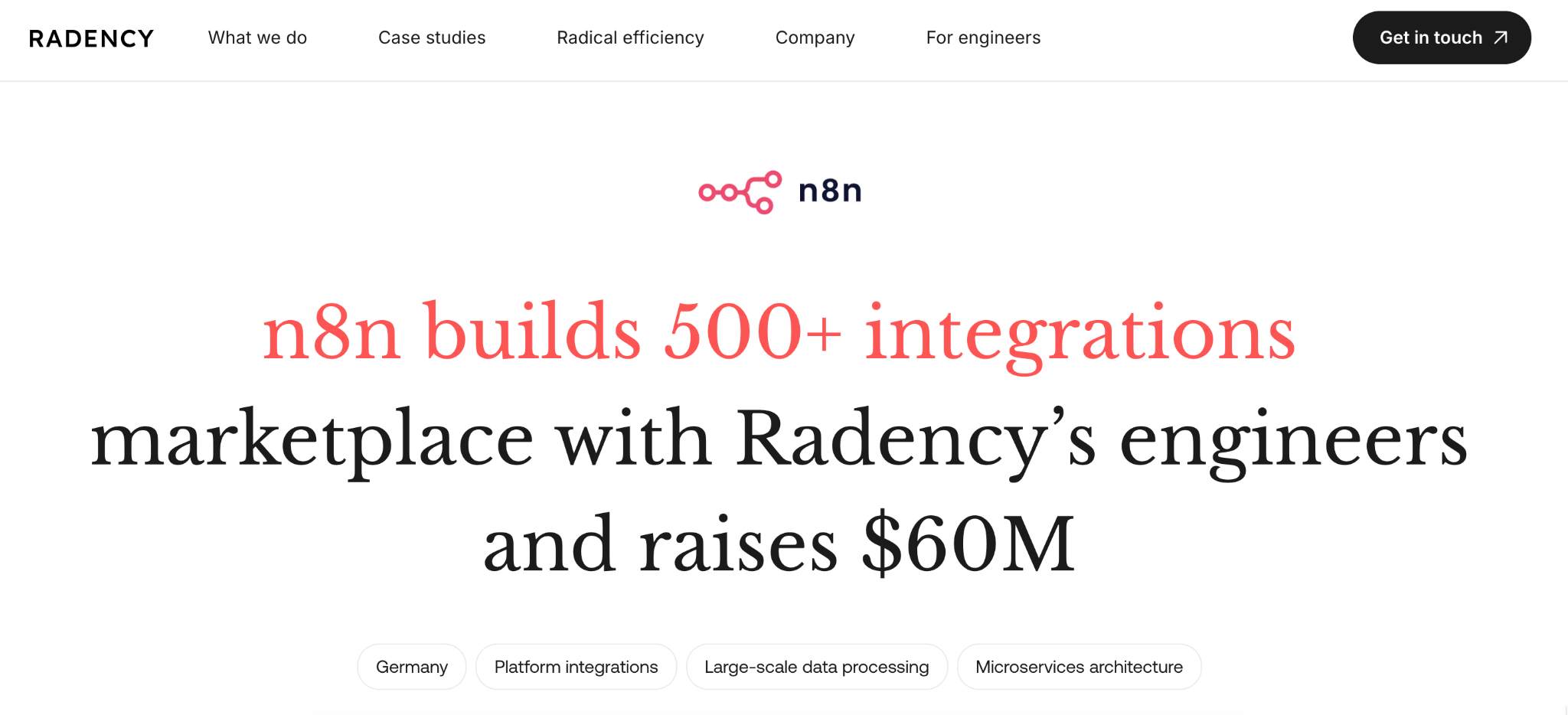
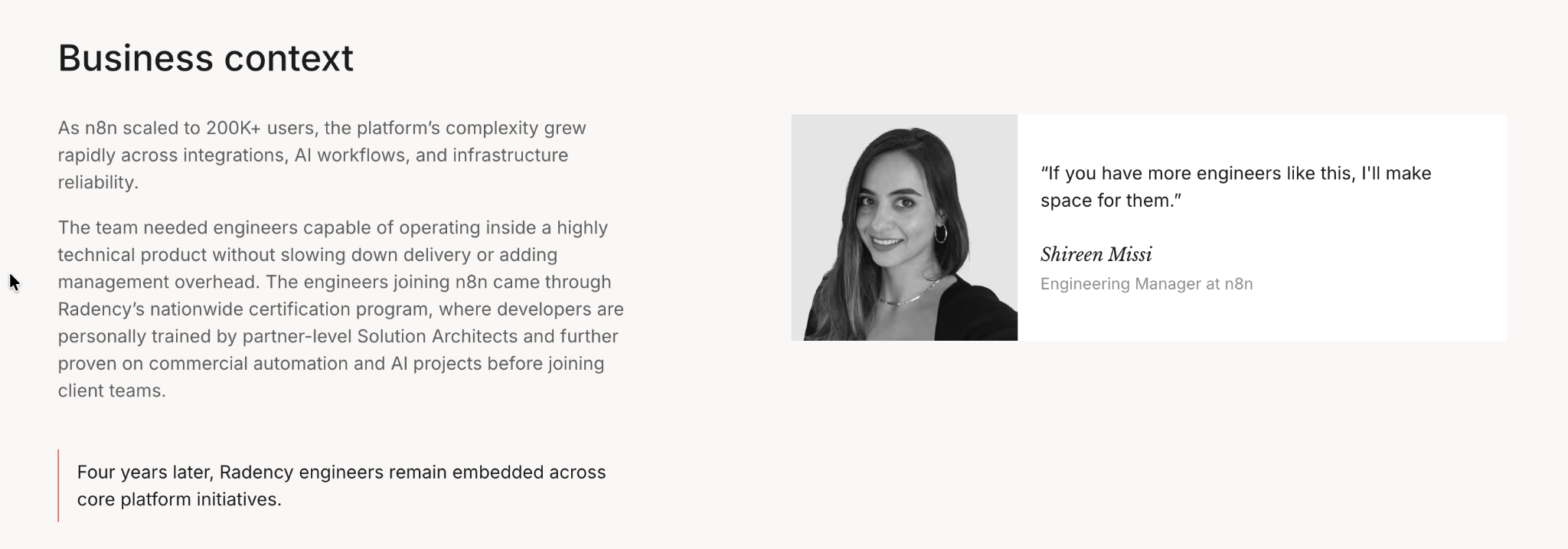
The first case study we wrote for them featured n8n, a well-known company that they have been working with since 2021. That was our priority case study because it proves n8n trusted the team with the core platform for four years running.
The client's quote: "If you have more engineers like this, I'll make space for them," is gold because it proves their positioning better than any copywriting.
2. Interview the client
You can't approach a case study as you would SEO articles. ChatGPT doesn't know your team's personal experience, and there's no content to plagiarize. The only viable approach is to interview the team and the client. Think of it like investigative journalism. You uncover the truth first, then start writing.
The most convincing lines in a case study are said by your client.
You can describe your work very well, but the same claim in the client's voice lands differently.
What do you ask the client? What the situation felt like before, what went wrong, what surprised them, why they chose you over everyone else.
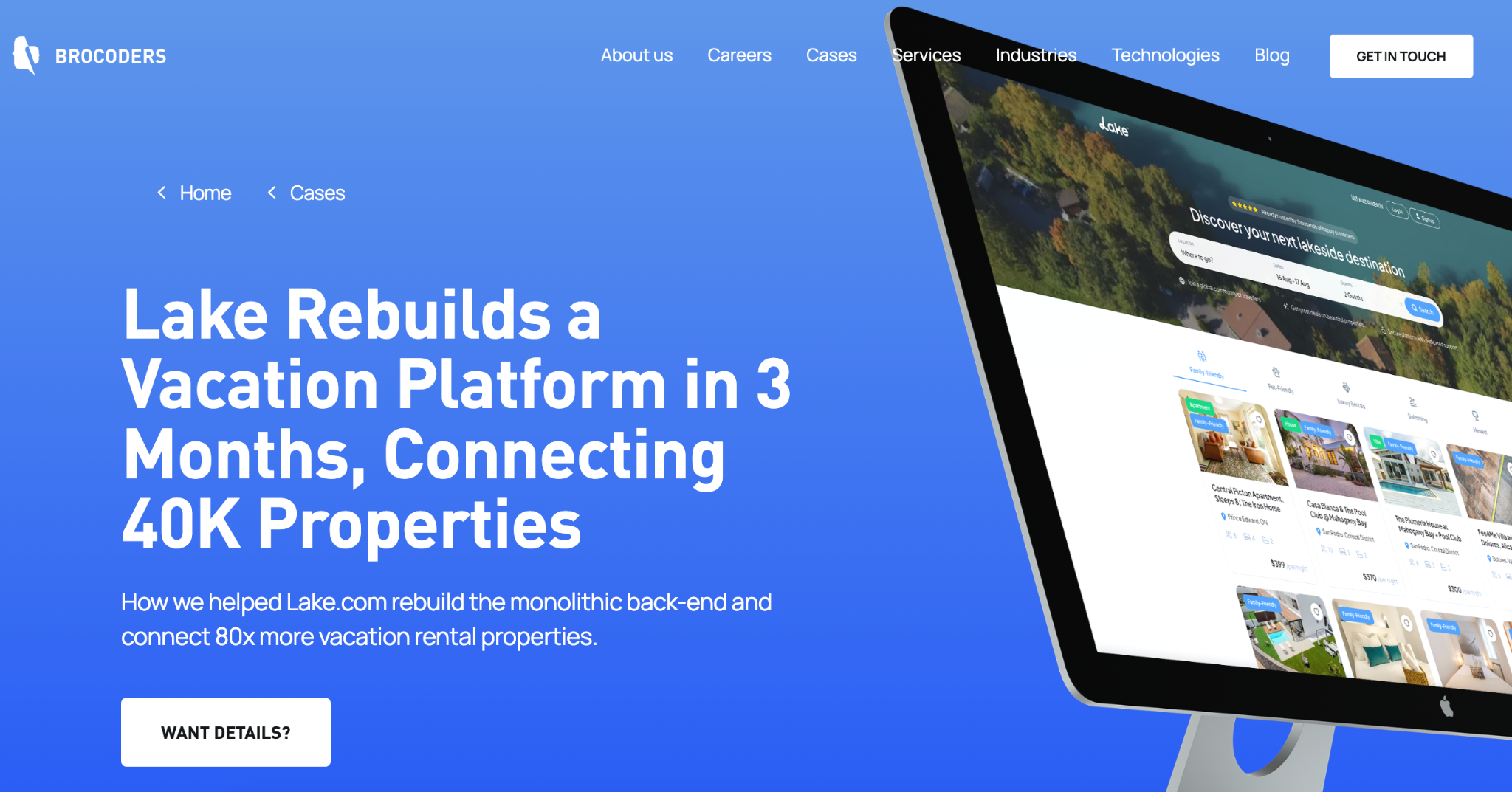
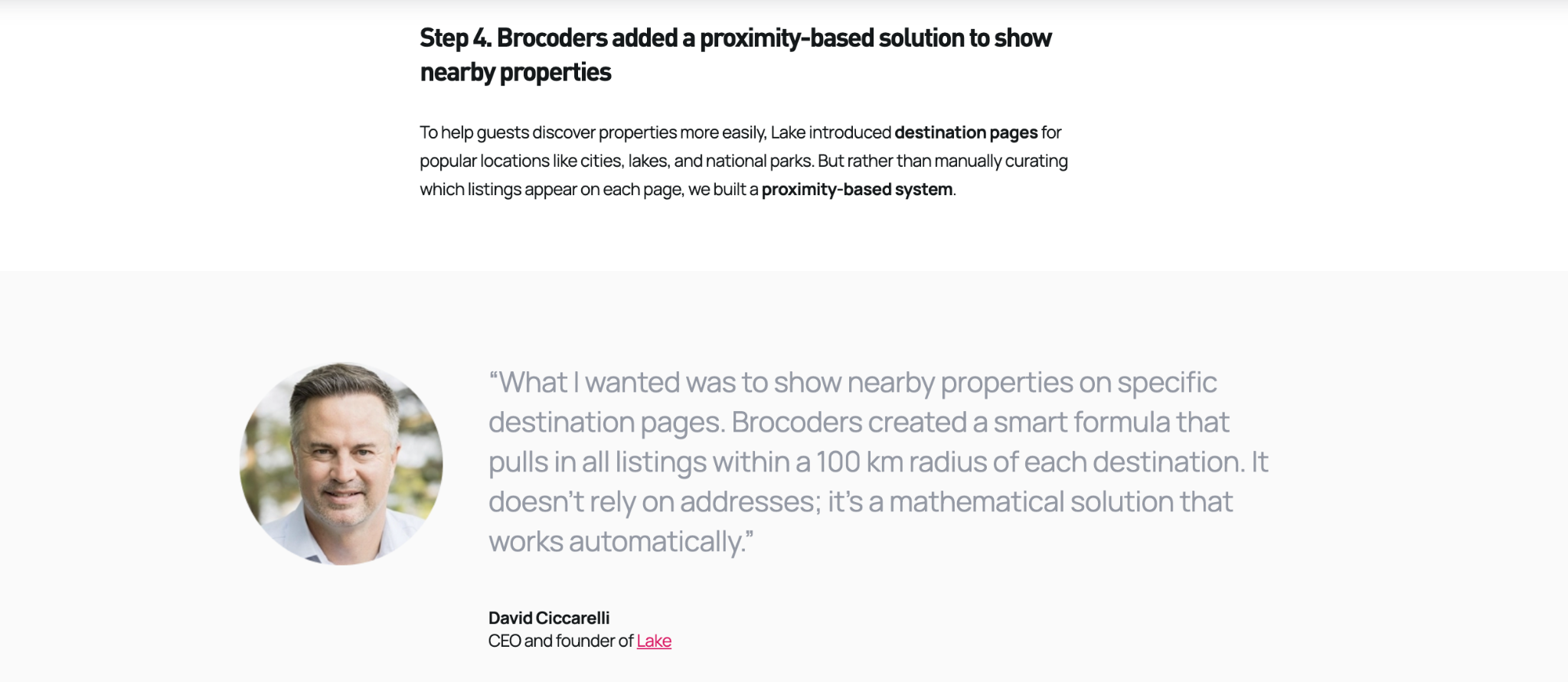
When a live interview isn't possible, the next best source is recordings. For the Lake case study for Brocoders, we watched client calls the team had and wrote the story from there.
Then we made the client “comment” on every claim in the case study - we put his quotes under sections to carry the narrative and build trust.
3. Make it useful to readers
A case study proves your expertise. But the reader has to see themselves in it, or that expertise means nothing to them.
Most case studies fail right here. The story is situational, it applies to one company at one moment and hands the next reader nothing they can use. Or worse, it's all about you: your process, your team, your cleverness, with the client's problem barely in frame. Either way the reader thinks, "So what does this have to do with me?"
Fix it by writing the case study as something the reader can learn from. You can take a specific problem you solved and show how you cracked it so anyone facing the same problem walks away with something.
Take the ROAR case study we wrote for Yalantis. ROAR runs an emergency panic-button system for hospitals and hotels, and as their device fleet grew, their AWS bill climbed right along with it. That's a problem every company scaling a cloud system knows too well.
So we wrote the case as a resource for anyone in that spot. It answers the questions the reader is asking:
- How do you cut cloud costs without hurting performance?
- How do you migrate thousands of live devices without downtime?
- How do you ship updates faster once the system is stable?
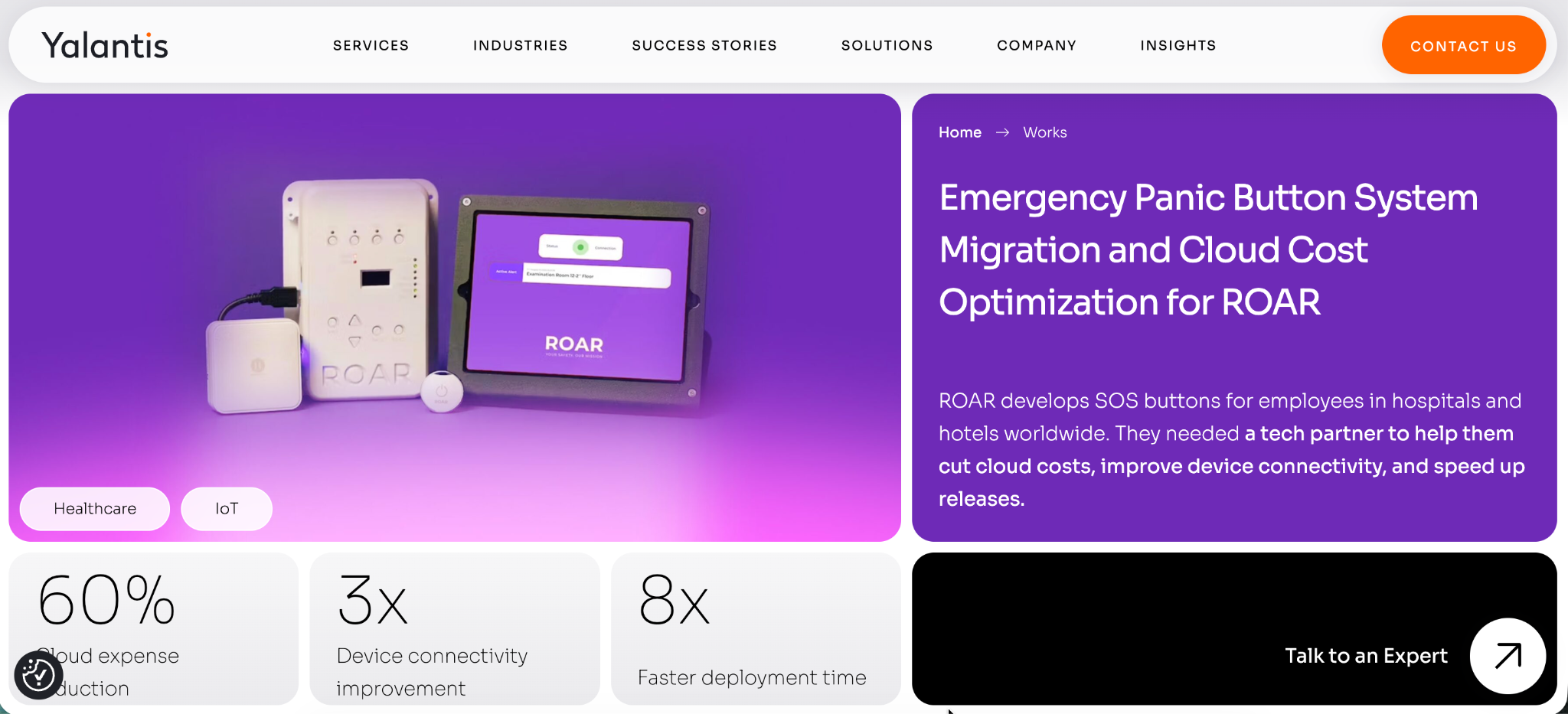
The ROAR case study leads with a 60% cloud-cost cut, then shows the reader how it happened: a re-architecture to a serverless AWS setup.
4. Start with "why," not with "what"
The goal of a case study isn't just about developing a solution or migrating platforms, although those can be part of the process. The real goal is to solve the client’s pain and this is what you should start with.
Instead of diving straight into solution development, begin by introducing the problem that prompted your client to seek help. This sets the stage for how your expertise can truly make a difference.
What made your client turn to you? This is something your readers may recognize as their own struggle. From there, naturally transition into explaining what actions you took (the WHAT and HOW) and why you chose those approaches. Simply put, focus on articulating the client's problem or goal (WHY) and how you addressed it (WHAT/HOW).
Sometimes the why is operational.
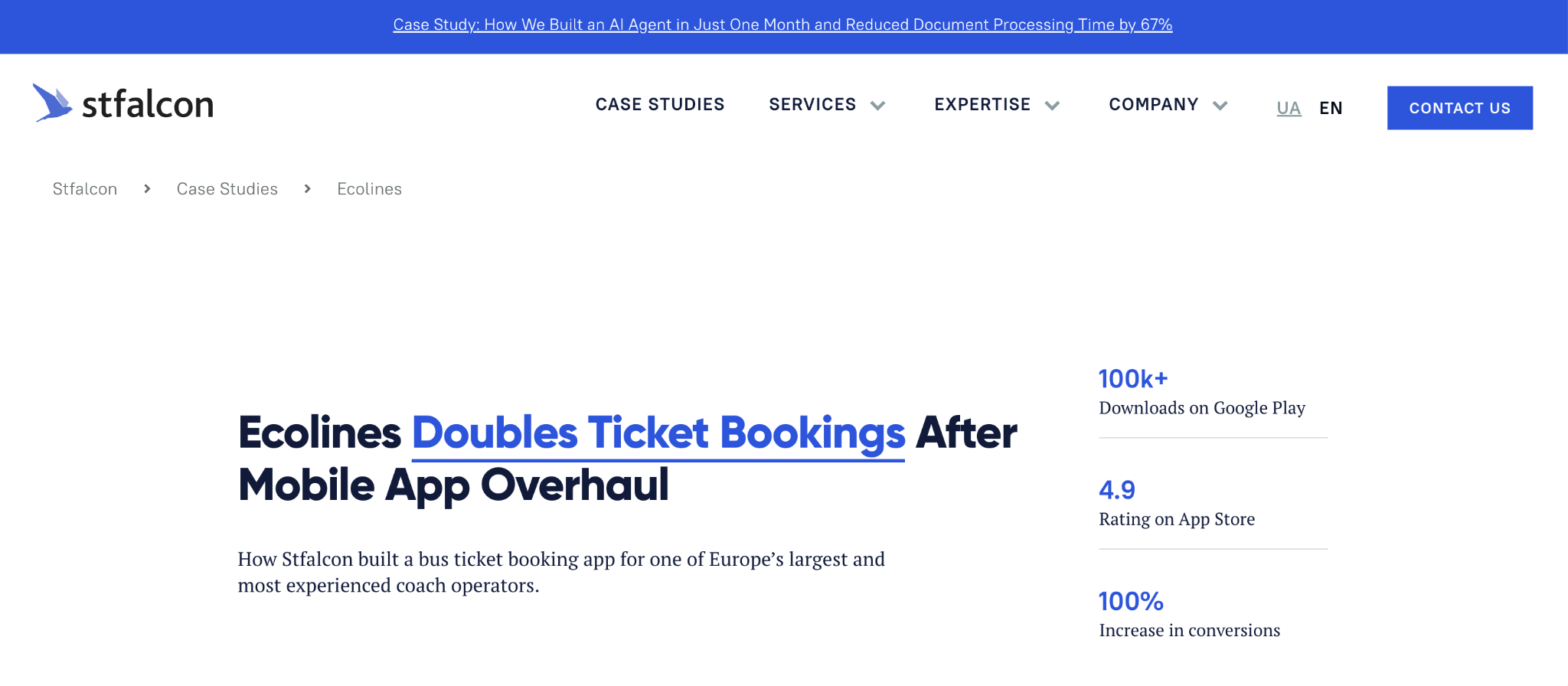
The Ecolines app was falling apart with crashes at checkout so one-star reviews started piling up. Stfalcon opened the case study there, then moved to the fix (a rebuild on Flutter) and the result – a 100% increase in conversions.
Sometimes the why is strategic.
Cyber Inc. had excellent security-awareness training content and nowhere to sell it. They had no platform of their own, and off-the-shelf tools like Moodle couldn't handle the multi-tenancy or scale and (worse), the cost climbed with every user.
That's where Academy Smart started the case study, then walked through the custom multi-tenant build, then the result: a 68% cost cut and 86 companies on the platform.
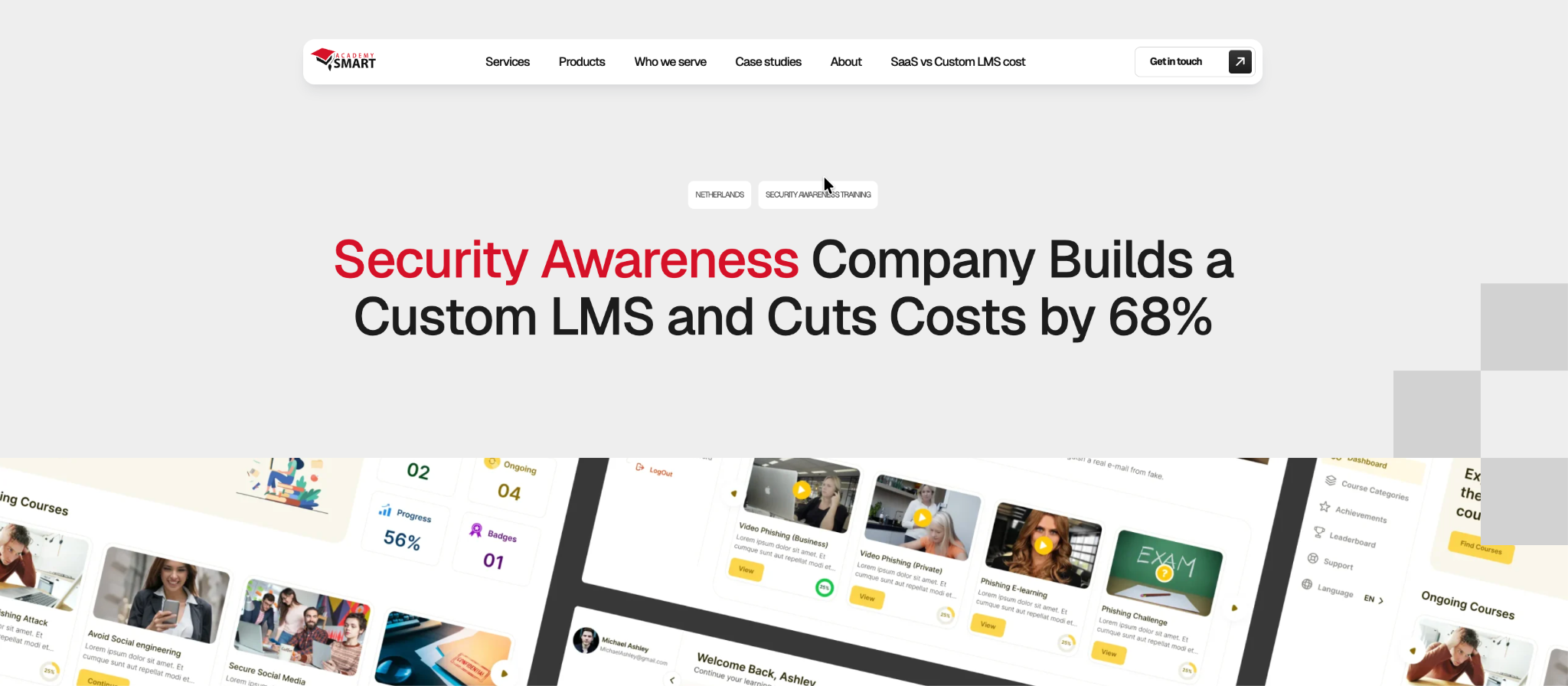
When you start with the client's problem, you tell the reader what kind of problems you solve, and let them decide, in the first few lines, whether they want to hire you to solve theirs.
5. Include your ups and downs
Let's be honest, the project you worked on isn’t interesting to readers. It's not that they find it boring; it's simply because it doesn't seem relevant to them. However, with a bit of storytelling magic, even the most mundane case study can transform into an engaging narrative.
Do you know what makes a story interesting? Ups and downs.
Don’t pretend the project was perfect from start to finish. Instead, show readers the client’s struggles, and your concerns during the project, including mistakes you've made if they contribute to the narrative. The solution wasn't immediately clear, but through perseverance, you discovered it and gained valuable insights along the way.
Take the Stfalcon case study for the Berlin bus startup. In 2011, there wasn't even a market to build for. Intercity bus travel was still banned in Germany, and the client was betting on a law that hadn't passed yet. Then the business model kept shifting under the team's feet. As the route network grew, the transit map had to be redrawn from scratch three separate times.
The case study leans into that instead of hiding it. The client's CTO put this in one line: the partnership worked because "we could keep the development flexible, even when our business model kept changing."
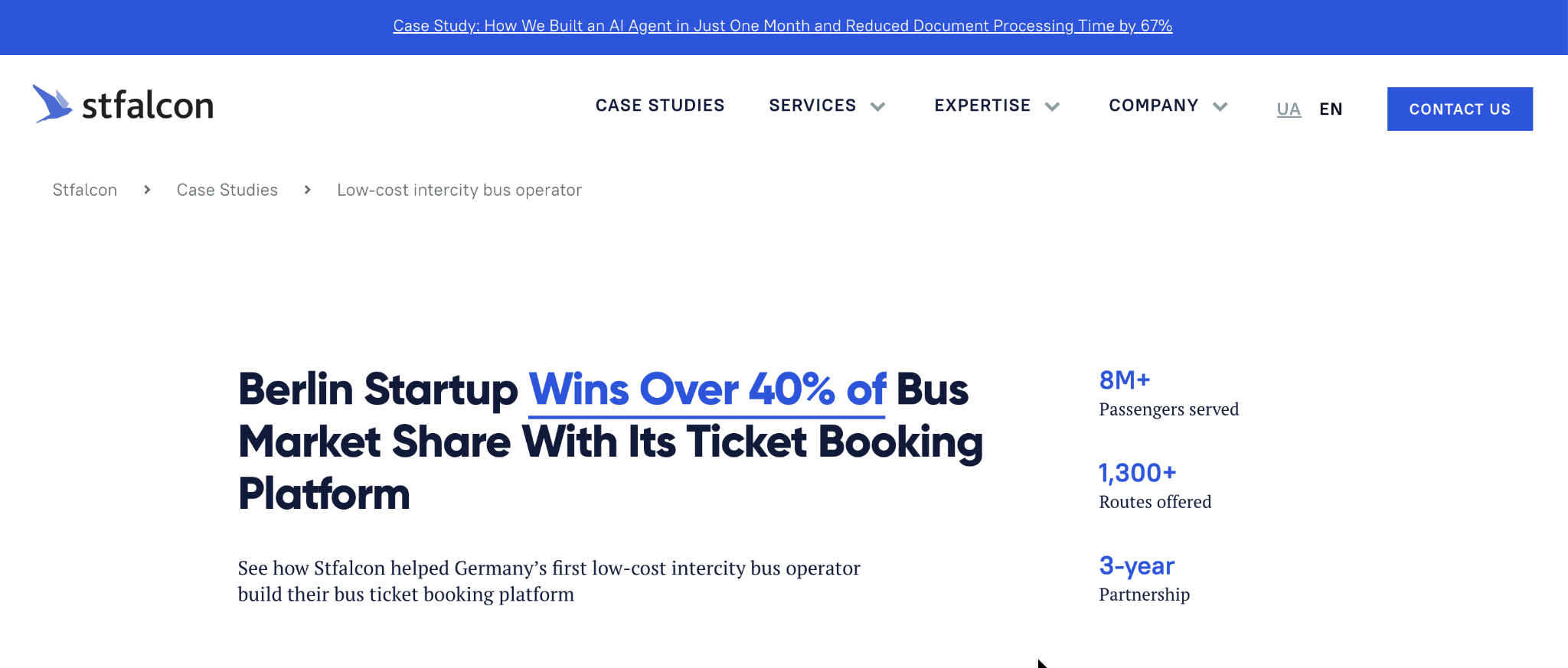
That case study reads as a journey from building before the market legally existed, to adapting through constant change to the payoff: from a single route in 2012 to 40% of the German market by 2014.
6. Focus on one thing
A case study needs to be focused. While you offer a diverse range of services across multiple industries and possess expertise in various technologies and platforms, it’s important to zero in on one area where you truly excel. Highlighting this in your case study will serve as compelling evidence of your value proposition.
Here's how you can spotlight the specific expertise a case is meant to prove.
Start with the client's own words.
The Flyaps case study on Yaana Technologies is, on the surface, about rebuilding a legacy platform. But the expertise worth highlighting came from the client's Clutch review:
"I'm particularly impressed by their web design and the UX they create. Both are better than the work we've seen from other companies. Their math skills are also exemplary, which is particularly beneficial for us in this type of solution."

The client told us what we needed to highlight in this case! All we needed to do was put this in a noticeable spot.
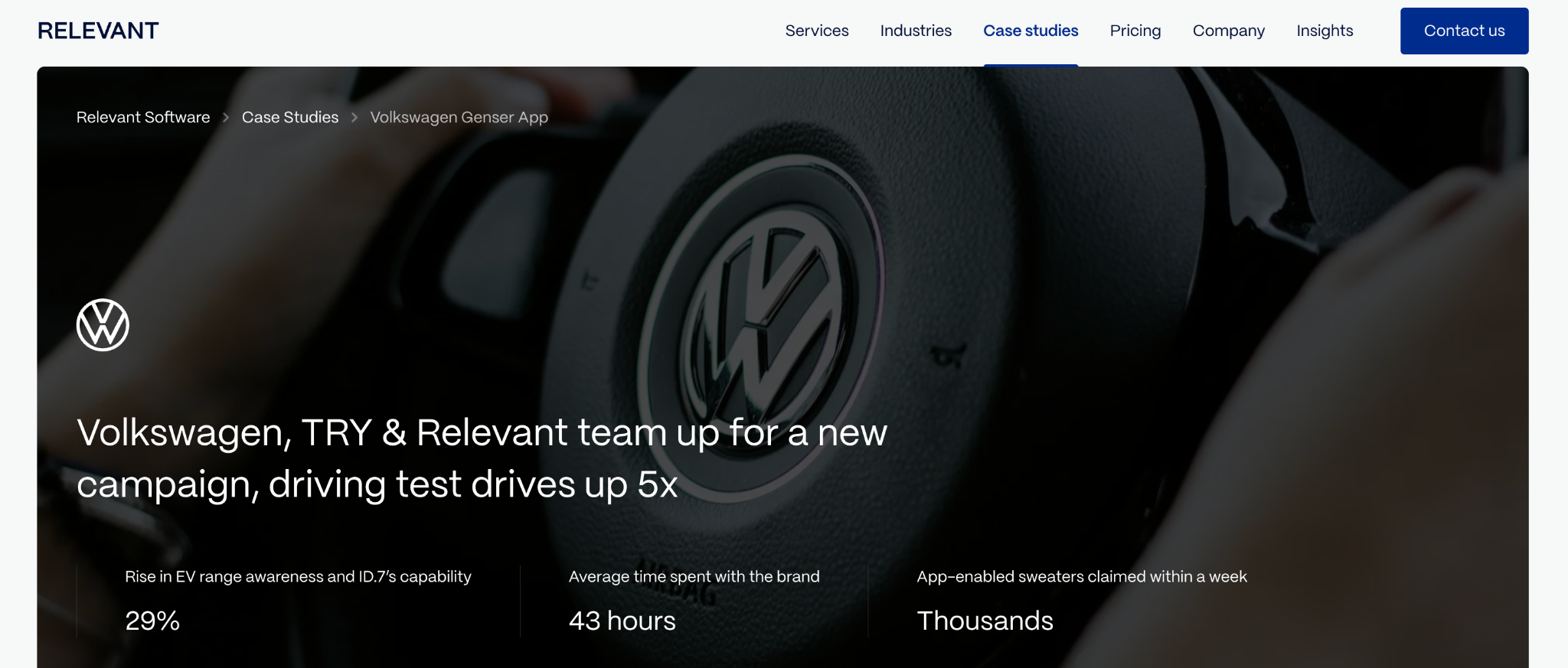
Sometimes the expertise is a capability. When Volkswagen and the agency TRY needed to prove the ID.7's 613 km range, they ran a campaign where people competed to walk that distance in branded sweatshirts, with motion sensors sewn into the fabric. Relevant built the app that connected to those sensors and tracked every kilometer in real time. The case study makes that the whole point, then backs it with the outcome: a 5X jump in test drives and a Silver at the Epica Awards.
The expertise can also be a credential the buyer requires. In software, some enterprise deals won't happen unless the vendor holds ISO 27001. Earning it is demanding, so companies looking for that proof want a partner who has done it before.
Protagonist did exactly that with their case study on helping Yalantis obtain ISO 27001 on the first attempt, walking through the six-month process that ended with the client reporting they "successfully passed external ISO audits with no major non-conformities."

Whatever the expertise, pick one, make it the spine of the case study, and prove it with the client's words.
Template of a case study
A template won't write the case study for you, but it will stop you from missing the parts that matter. Based on the case studies we've written for software development companies, we built a case study template that follows the Results-Forward order: the claim you're proving, the result, the story, the methodology, and the impact. Use the prompts in each block as a starting point, then fill them with the specifics.
Bottom line
Results-Forward comes down to one thing: stop writing about what you did, and start proving what you can do for the reader.
That means:
- Name the claim the case study has to prove. It tells you which result to lead with and which details to cut.
- Lead with that result. Your headline does 80% of the work.
- Tell the story and show the methodology — the client's problem, then your approach to solving it.
- Close on the impact, pointing straight back to the claim you set out to prove.
Get the claim right and the rest falls into place. Miss it, and you're back to writing about what you did and hoping someone cares.
If your case studies read like project logs and you want them proving something instead, contact us. That's what we do.


