


Let’s say it out loud: most B2B marketing teams are producing content that never shows up in their pipeline.
They publish regularly and have topics and keywords, but sales can’t name a single deal the content helped close. Some try to solve it with more content, but that doesn’t help much, and budgets keep burning for nothing.
The issue is deeper, and that’s a lack of understanding of what deserves to be published and why. Before creating any content calendar, you need to define what goal the content serves, which buyer it targets, and how it will move buyers toward a decision. This matters even more now that buyers ask ChatGPT and Gemini for a vendor shortlist before they visit a single website. AI recommends the companies it understands, and a calendar of random topics won’t make you one of them. That’s what a content roadmap is for.
At Zmist & Copy, every content program we run starts with a roadmap like this. It’s how we decide which pieces will influence buying decisions and bring in inbound pipeline, and which ones would only fill the calendar. In this guide, we’ll share the framework and the template we use with clients.
You produce content. So where is the pipeline?
There’s always something to publish. The usual routine for B2B marketing teams is to look for new keywords to target and copy what competitors do. But the pipeline isn’t growing.

If you target SEO keywords with lots of blog posts, traffic might grow, but visitors still leave without taking any action. And yet, the usual response is to keep publishing. Add more topics, increase the frequency, try another format. The team gets more work to do, but nothing changes.
At this point, you have to ask yourself whether you're creating the right content in the first place. Are these topics relevant to the people who might buy from you? Do they help potential customers understand your offer and its value?
If the answer is no, we are talking about filler content that has no meaning and only eats your time and budget.
There’s only one way to fix this: step back and decide what content is worth creating, who it's for, and what core messages it should convey. That’s what a content roadmap is for. If you’re not sure where your marketing stands right now, start with a marketing audit.
Content roadmap vs. content strategy vs. content calendar
A content roadmap sits between your content strategy and your content calendar: it decides what to create next and why. These three terms are often used interchangeably, but they mean different things:
- Content strategy defines the bigger picture: who you're targeting, what you want to achieve, and how you want the market to perceive your company.
- Content roadmap turns that strategy into priorities: what to create over the next months, what type of reader each asset is for, and why it deserves to be written.
- Content calendar organizes production: who is creating each asset, when it's due, and where it will be published.
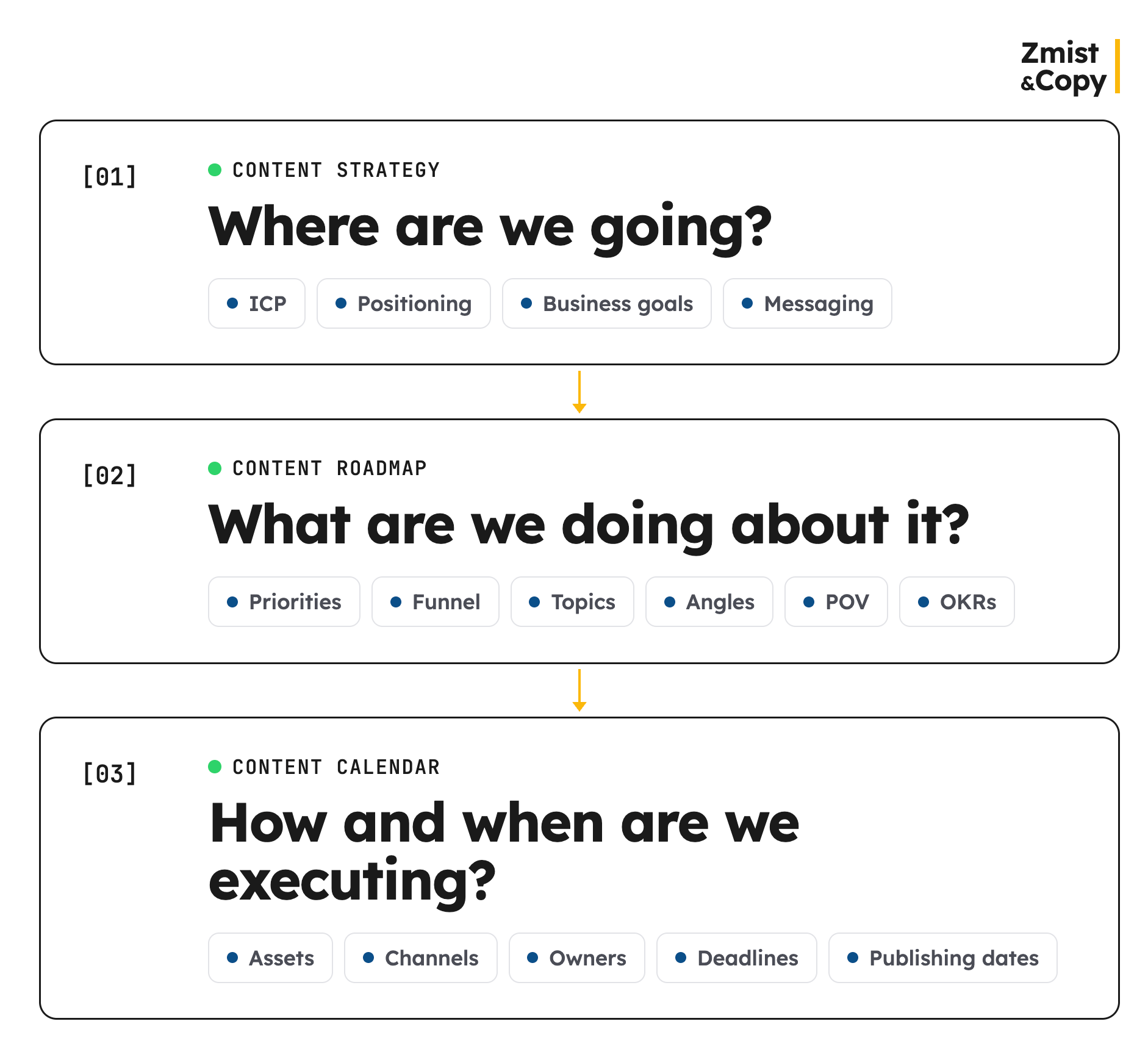
Most teams have a strategy and a calendar. What's often missing is the thinking that connects the two.
For example, a plan to publish four blog posts, one case study, and one webinar tells you what the team needs to produce. But it doesn't explain why those particular assets matter or which ones should come first. The same goes for a spreadsheet with 50 keywords framed as article titles.
So, how do you build your own content roadmap? Here’s our proven framework.
How to prioritize content: a 9-step framework
Instead of filling your calendar with whatever topic comes up next, start with the result you want to achieve. What does the business need, who are you trying to reach, and what kind of content could help?
Here’s how we approach these decisions when building a content roadmap.
1. Start with a business goal instead of a content idea
Before you brainstorm topics, decide what you want content to achieve. “More brand awareness” or “more organic traffic” sounds like a goal, but it's too broad to guide your decisions.
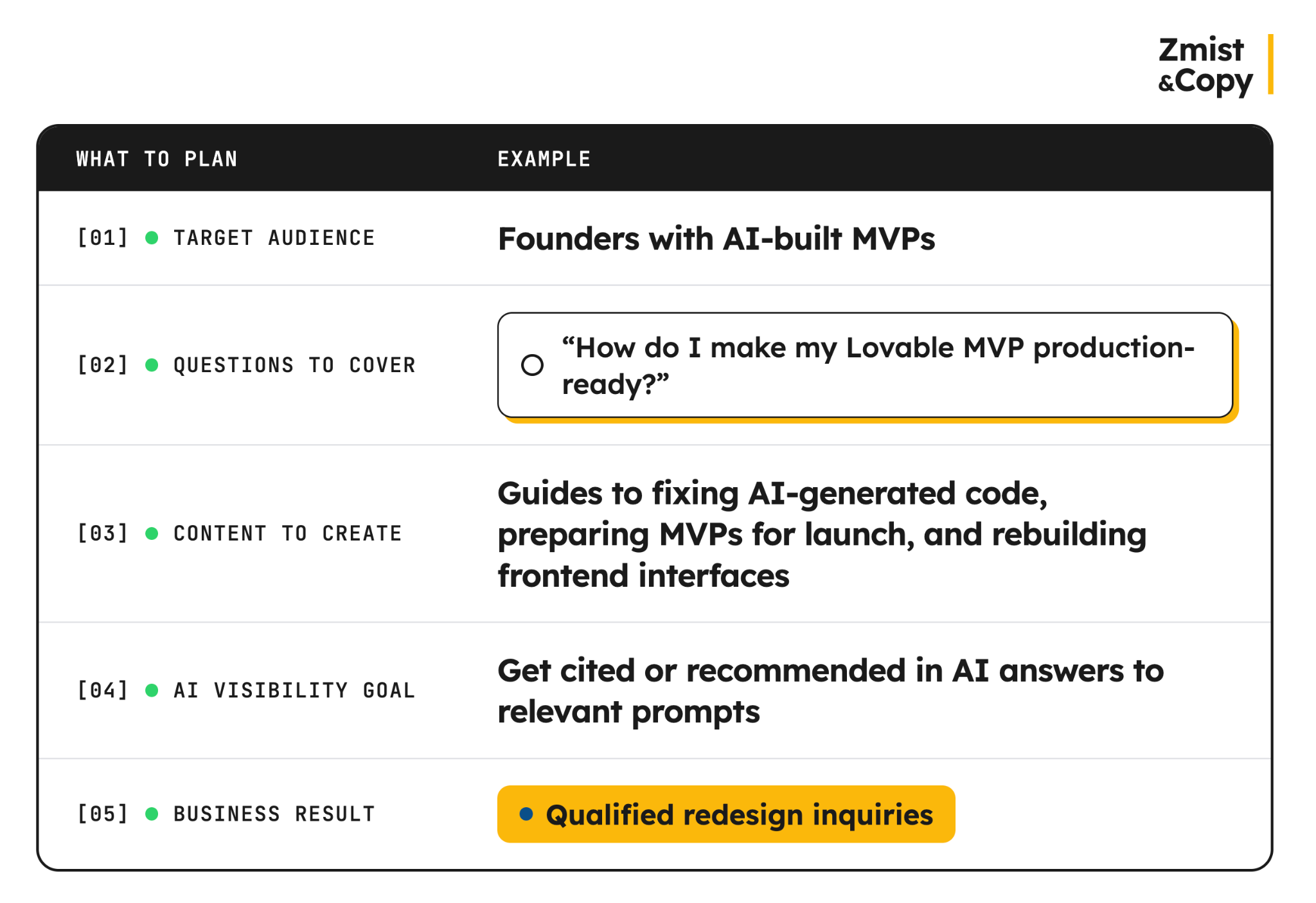
For example, a software development agency wants to attract startups with AI-built MVPs. These companies have a working prototype but need help turning it into a production-ready product.
The agency can build its content around the questions founders ask AI tools: “I built an MVP with Lovable. How do I make it production-ready?” or “Which agency can redesign my AI-generated app?”
To show up in those answers, the agency needs specific content that addresses these questions directly. Articles could explain common problems with AI-generated code, outline what it takes to prepare an MVP for production, and show how the agency approaches this kind of work. The goal is to become a trusted source that AI can find, understand, and reference when users ask for recommendations. Here’s how to build a prompt library from customer conversations.
2. Get specific about your buyer and ICP
Once you know what you want to achieve, think about the people who could help you get there. You need to understand who makes the buying decision and, more importantly, what makes them start looking for a solution.
Look at the industries and company sizes that are a good fit. Find out who researches solutions, who controls the budget, and what problems bring these people to your website. Pay particular attention to buying triggers: events or changes that make a company realize it needs help.
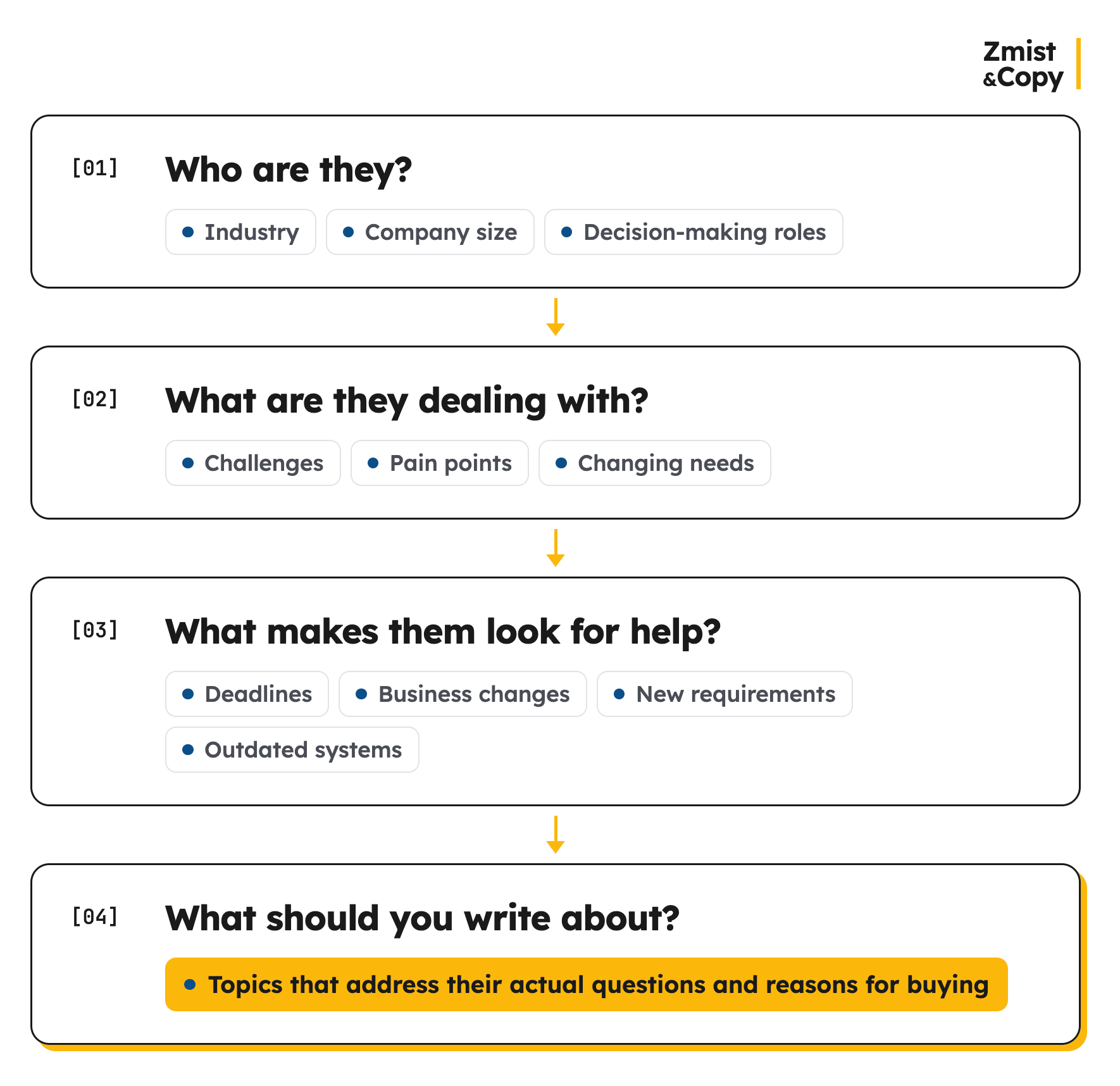
For example, Kentico Xperience 13 reaches end of support on December 31, 2026. Companies still using it have a solid reason to look into migration. This is the kind of buying trigger we explore with our client rtCamp, an enterprise WordPress development company. We work with their team to identify what their potential customers are dealing with and turn those insights into content topics, like migration planning.
This gives us a much stronger direction than simply targeting broad keywords like “enterprise CMS platforms.” We're creating content around a real reason why a potential customer might need rtCamp's services.
3. Make sure your content covers the whole buying journey
Not everyone who visits your website is ready to contact sales. Some people are still figuring out what's wrong; others know what they need and are comparing providers. Your roadmap should have content for both.
Think about someone researching AI-powered content operations. They're trying to understand the problem. Someone searching for Kentico alternatives is already comparing options, while a person looking for a Kentico migration agency is choosing a provider.
Your content should help people move between these stages. An introductory article to AI-powered content operations can link to a detailed CMS migration guide, which can then lead to a case study or a consultation page. That way, readers don't hit a dead end after finishing an article.
This also shows you where your website is falling short. If you have plenty of educational content but very few pieces that help people compare providers, publishing another beginner's guide isn't your best next move. Rather, focus on the middle and bottom of the funnel.
4. Find topics your buyers care about
Keyword research is a good method for finding topics with existing search demand, but it shouldn't be your only source of ideas. Talk to sales and customer teams, listen to sales calls, research competitors and identify gaps on your website. This will reveal topics that search data won't.
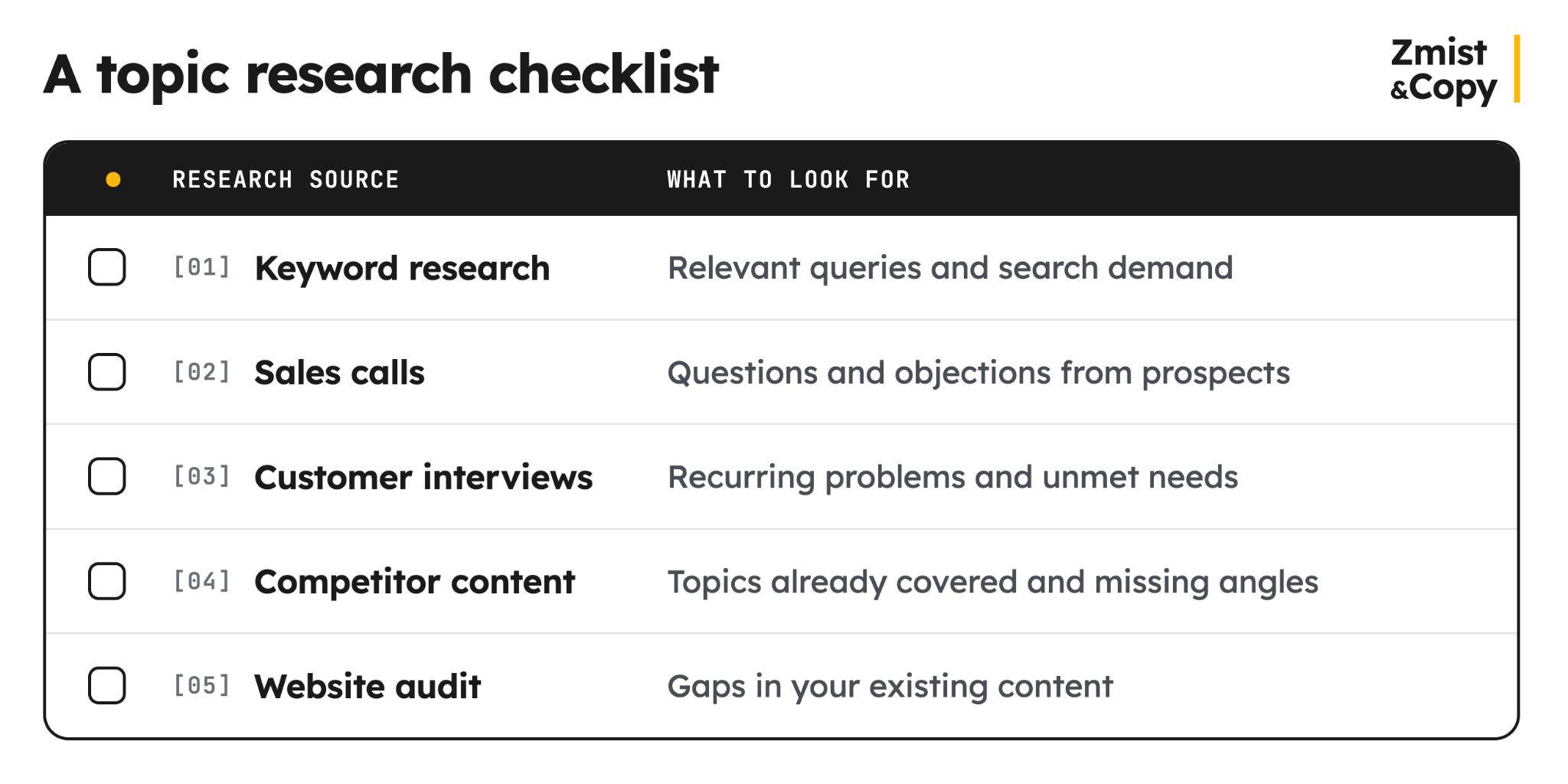
Group related ideas into content pillars: the main themes you want to cover. For example, for one of our clients, an LMS provider, content pillars include implementation, integrations, AI, and learning analytics. In our template, these themes go in the Topic column.
When you start defining specific content ideas within those pillars don't choose them based on search volume alone.
For example, the keyword “LMS integration” has around 800 monthly searches, so a list of popular LMS integrations seems like an obvious article idea. But when we listened to sales calls, we found that such a list won’t be as valuable as pieces focused on specific integrations named by clients. For example, several customers wanted their LMS to work with Microsoft Teams and Outlook. Without these integrations, coordinators had to manage everything in spreadsheets. One company had even been quoted an extra €5,000 a year for calendar integration.
That's a much more useful topic than another generic list of integrations because it comes from a real customer problem.
5. Write down the AI prompt each piece should answer
For every topic on your roadmap, write down the question a buyer would ask ChatGPT, Perplexity, or Gemini. That prompt tells you what the piece has to answer for AI to recommend you.
A keyword shows what people type into Google. A prompt shows how they ask AI, and it’s usually longer and more specific. Someone who searches for “LMS integration” might ask ChatGPT, “Which LMS works best with Microsoft Teams and Outlook for a 2,000-employee company?” The prompt tells you who’s asking, what they need, and which details your content has to cover.
Take prompts from the same place as topics: sales calls and customer conversations, written in your buyers’ words. Before you write, run each prompt through AI tools to see which companies come up and which sources they cite. That shows you what your piece needs to beat and where else your company needs to be mentioned.
6. Give each topic a reason to stand out
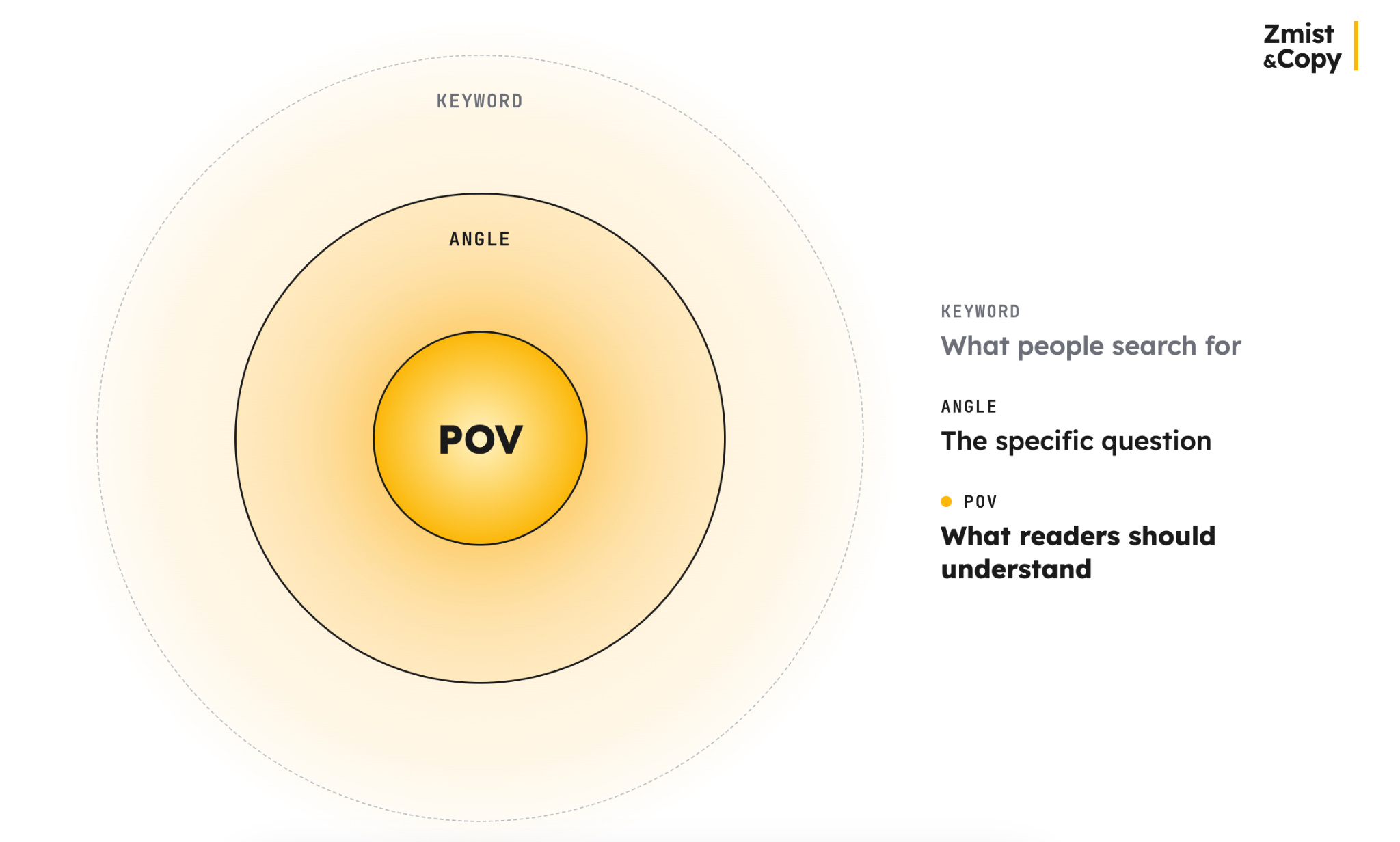
A keyword tells you what people are searching for, but it doesn't tell you what to say about it. To make your content more distinctive and build your brand's authority, you need an angle and point of view (POV).
Your angle is the specific aspect of the topic you choose to explore. POV is the idea or argument you want readers to take away.
Here’s how we did it for Pingle, one of Ukraine’s top game development studios, famous for their top-notch porting and remastering projects (they've worked on Tomb Raider, Life is Strange, The Lord of the Rings, Five Nights at Freddy’s, and more AAA titles).
We analysed existing content about remastering and noticed that many articles blamed disappointing results on outdated game engines. We wanted to offer a different perspective: a good remaster keeps what players loved about the original, fixes what frustrated them, and changes only what needs modernization.
We turned this idea into The Respectful Remaster approach. It starts with understanding how the original game works and why certain systems were designed that way before making changes. The team then decides what to preserve and what to improve.
This gave us a strong POV rooted in Pingle's experience that shows potential clients how the studio approaches its work.
7. Pick a format that makes sense for the topic
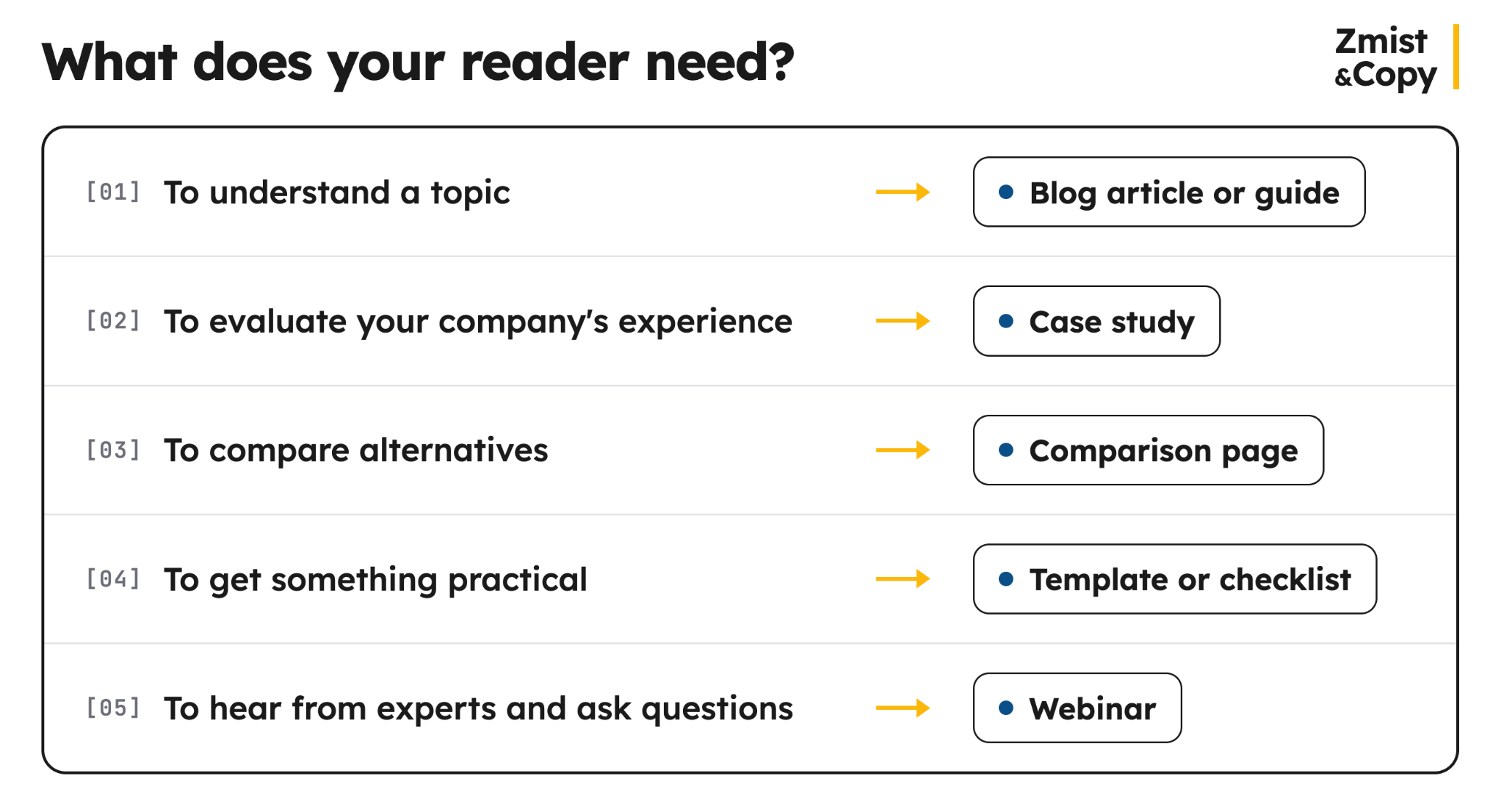
Not every content idea needs to become a blog post. Sometimes an ebook is the right format; sometimes readers need a case study, a comparison page, or something they can calculate with.
Think about what would help someone understand the topic or make a decision. A case study shows how a company solved a problem. A comparison page helps buyers weigh their options. A webinar gives them a chance to hear from experts and ask questions. The format should fit what the reader came looking for.
8. Add a logical and natural CTA
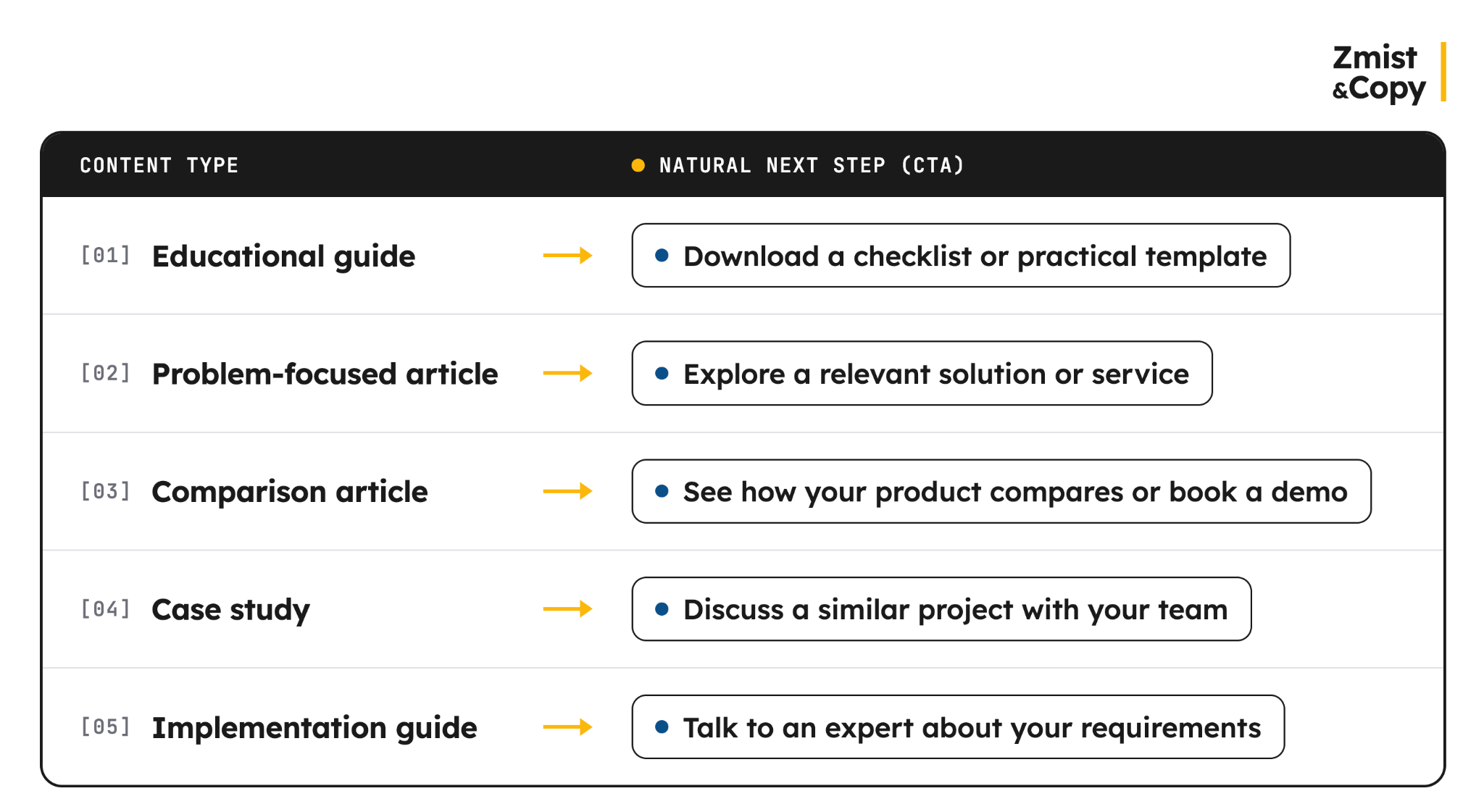
A piece of content shouldn't leave readers wondering where to go next. Before creating content, decide what action you'd like them to take and make sure it makes sense for the topic.
For example, a guide to CMS migration could point readers towards a migration service page. A comparison of LMS platforms could invite them to book a demo.
The same CTA won't work for every reader. Asking someone who has just discovered a problem to book a sales call is probably too much. Sending someone who's already comparing providers to another introductory article doesn't move them much further, either.
Also, don't judge content by traffic alone. Page views and rankings show that people are finding your website, but downloads, qualified inquiries, and demo requests tell you whether that content is bringing results. If it’s a topic you want to own in AI search, also check whether ChatGPT, Perplexity, or Gemini mention your company when buyers ask about it.
9. Define a content distribution strategy
Publishing an article doesn't guarantee that your audience will see it, so you have to think about content distribution strategy before content is live.
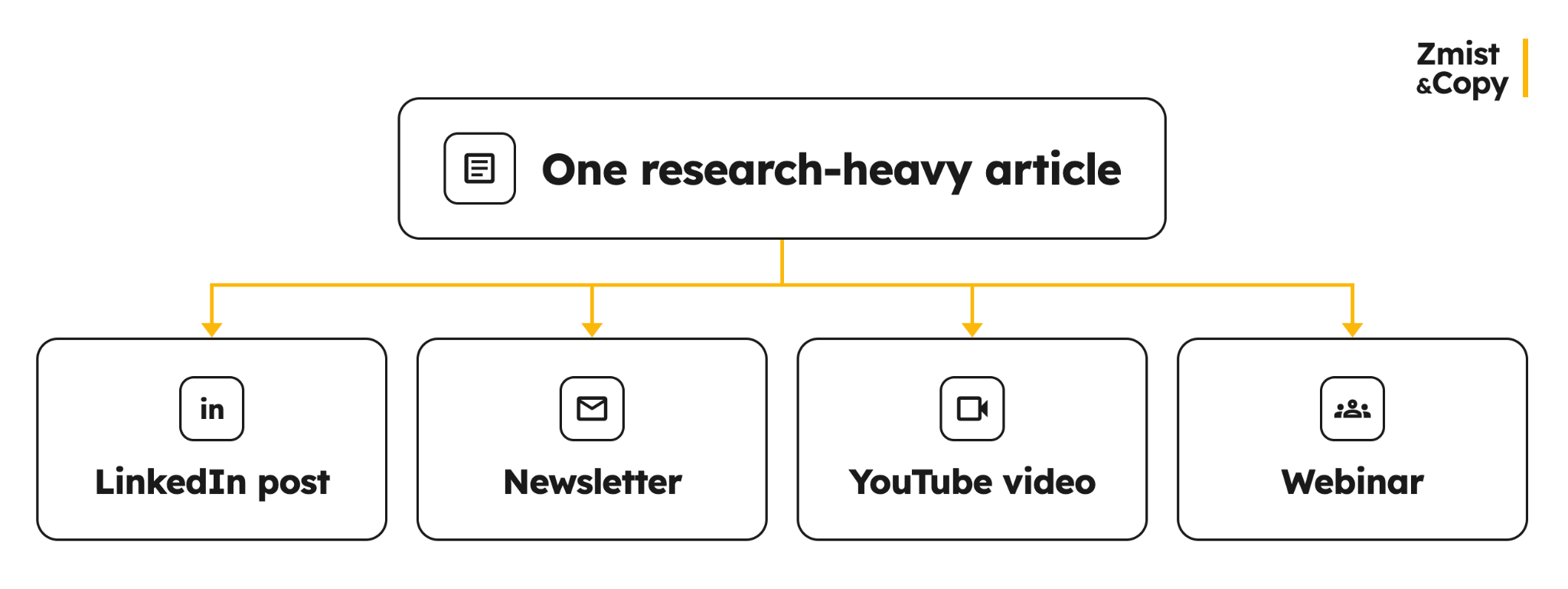
For some topics, organic search will do most of the work. Others might be better suited to LinkedIn, your newsletter, professional communities, or partner channels. If you want AI tools to recommend you, plan third-party mentions too: guest posts, listicles, and review sites are among the sources they read. You can also get more out of one asset by turning it into a series of posts, a short video, or a webinar.
For example, a research-heavy article could become a LinkedIn post series and a newsletter feature. You could also use it as the starting point for a webinar discussion. There's no need to come up with a completely new idea for every channel.
Choose channels based on where your buyers spend time and how they prefer to consume information.
The content roadmap template we use at Zmist & Copy
We could tell you how to build a content roadmap, but it's much easier to show you what it looks like. So we're sharing the actual template we use at Zmist & Copy to plan content for our clients.
It's a ready-to-use Google Sheets template that helps you plan the next 1–3 months of content, from the initial idea to publication and pipeline. And it goes well beyond a list of topics and deadlines.
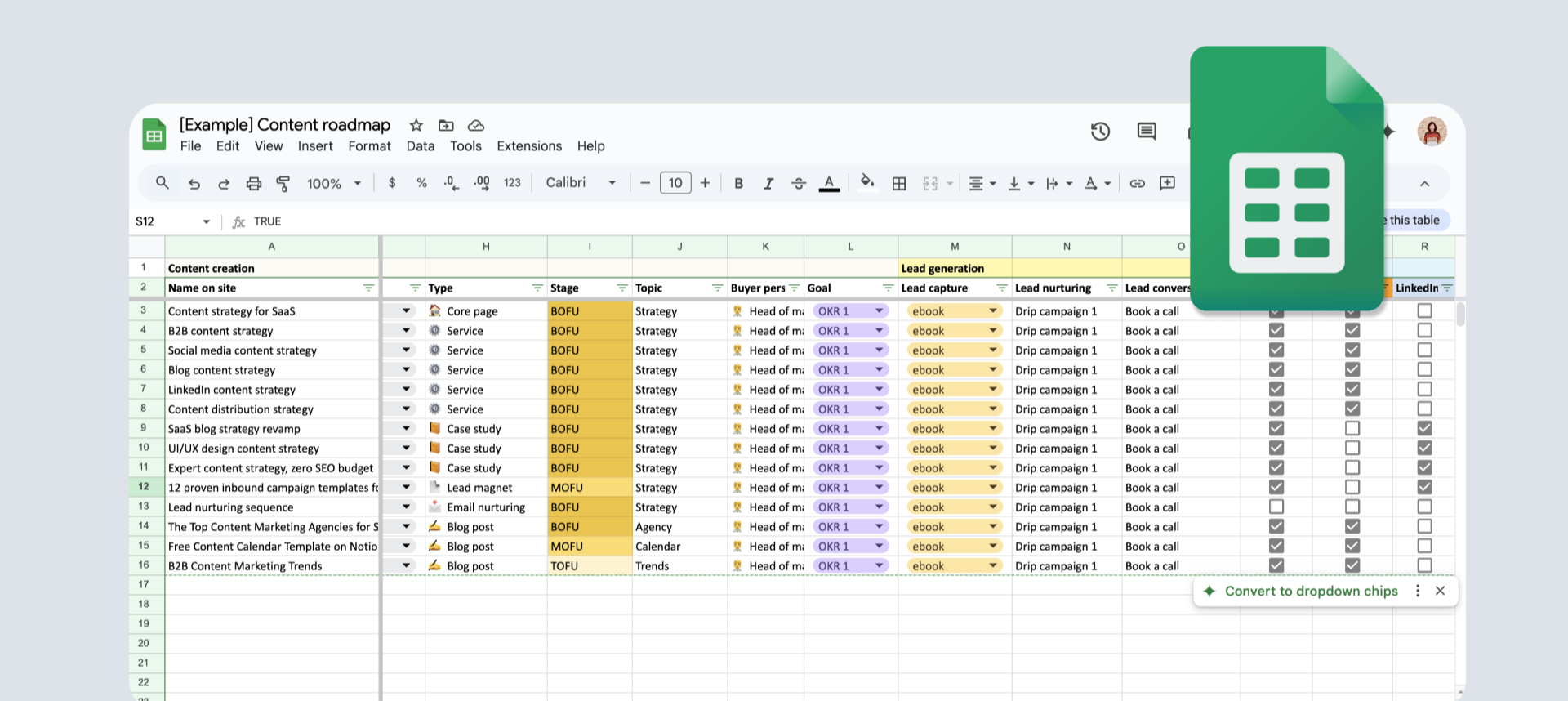
For every content piece, you can map out:
- Who it's for: your ICP, target buyer, buying trigger, and their stage in the buying journey.
- Why you're creating it: the marketing goal and the role it plays in your strategy.
- What to cover: the SEO keyword, target AI prompt, topic, messaging pillar, and angle.
- How it will turn into pipeline: lead magnets, conversion paths, and nurturing activities.
- Where to distribute it: the channels and platforms you'll use to reach your audience.
- How it performed: the URL, the conversions it brought in, and whether AI tools mention you for its target prompt.
You can also keep track of content types, owners, priorities, and publishing schedules, so the whole plan stays organized, and your team knows what to do next.
We've been using this template across our own projects, and now you can use the same framework without having to build everything from scratch.
How to fill in a content roadmap
Let's say you're an LMS provider that wants to build an inbound pipeline from mid-market and enterprise employers.
You have an idea for an article comparing LMS platforms that work with Microsoft Teams. Here's how you could plan it using our template:
The point is to think beyond the article itself. You're deciding who should read it, what you want it to achieve, and how to turn that reader's interest into a potential lead.
The template also helps you plan what happens after publication. You can map out lead capture, follow-up communication, and the next step towards conversion instead of leaving readers at the end of an article with nowhere to go.
And because the template includes content types, funnel stages, topics, and distribution channels, you can see how individual assets fit into your wider marketing plan. You can then use the same sheet to organize content priorities and keep track of what needs to be created and published over the next 1–3 months.
Start making better content decisions
A content calendar keeps track of what you're publishing and when. A content strategy sets the direction. Your roadmap brings them together and helps you decide what to create, who it's for, and what you want each piece to achieve.
Use our template to plan your next 90 days, set priorities, and make sure your content supports your business goals.
And if you'd like a hand with the strategy, we can help with that, too. At Zmist & Copy, we work with you to clarify your goals, define your ideal customer, sharpen your messaging, and decide what content is worth investing in.
Send us a request and let's schedule a call to discuss how we can make you visible in AI search and chosen by buyers.


