


"Contact us for a quote" is the most expected answer on a content marketing agency's website. Some agencies do better. They publish a "starting at" price, and a few do decide after all to list packages with numbers. But even then, budgeting isn't easier.
One agency's €2,000 monthly retainer might cover four blog posts. Another's includes content strategy, SEO, interviews with subject matter experts, distribution, and monthly reporting. Both call it "content marketing." But they could be talking about different services.
So don't get too hung up on the price. You need to figure out what the agency is promising to do for that money.
In this guide, we'll look at the pricing models content marketing agencies use, what they cost, and what each one means for you as the buyer.
TL;DR
- Most content marketing agencies keep pricing private, so "contact us for a quote" is still the default.
- Agencies that do publish prices use four main models: per-piece, hourly, monthly retainer, and one-time project, often mixing two or three at once.
- Published rates range widely: from $1,000/month retainers to $20,000+/month, and $150 to $2,500+ per individual piece, depending on scope.
- Freelancers use the same models at lower rates ($15–$80/hour on Upwork), but without a team's built-in backup, editing, or strategic oversight.
- The price tells you what you're buying, like articles, hours, or a scope of work. It doesn't tell you whether any of it will perform.
- We price the same way most agencies do, but stay accountable for the results after content is published.
What you're paying for, model by model
The truth is, agencies don't stick to a single pricing model. They mix and match, combining retainers, per-piece rates, and hourly billing depending on the type of work they sell.
Another thing we’ve noticed is that very few agencies publish their prices publicly. So I asked my all-knowing friend Claude to find content marketing agencies that do. There weren't many, but we'll use those examples to put a number behind each pricing model.
Monthly retainer
A monthly retainer gives you ongoing access to an agency's services for a fixed monthly fee. You agree on a scope of work, which might include content strategy, blog posts, SEO, editing, reporting, distribution, or a mix of those services.
Retainers pay off when content is an ongoing part of your marketing. They make budgeting predictable and give the agency time to plan.
Not all retainers are structured the same way, though. Some are built around a fixed number of deliverables, while others include access to a team or a set amount of capacity. That's why two agencies can charge the same monthly fee and deliver different services.
An example (or two)
One agency we looked at lists three content plans. Basic starts at $1,800/month and includes 3 content assets. Aggressive costs $3,600/month for 6 assets, while Market Leader is $6,000/month for 10.
Another agency also uses monthly retainers, priced around article volume and how much strategic support is bundled in. Launch costs $2,500/month for 2 articles. Enterprise starts at $6,500+/month for 4–6 mixed articles. Need more than your plan includes? Additional articles cost $700–910 each.
Take a look at how the two pricing structures compare:
One-time project pricing
Sometimes, you need a partner for a single project. It could be a research report, a content audit, a messaging project, or a complete website content overhaul. In that case, your obvious pick is a one-time project. You know what you're paying before the work begins, and both sides know what’s included. This model works best for companies that aren't ready for a monthly retainer, but need strategic support.
An example (it’s us)
We couldn't skip including ourselves here. Zmist & Copy also offers one-time projects for companies that need strategic direction before committing to ongoing content work.
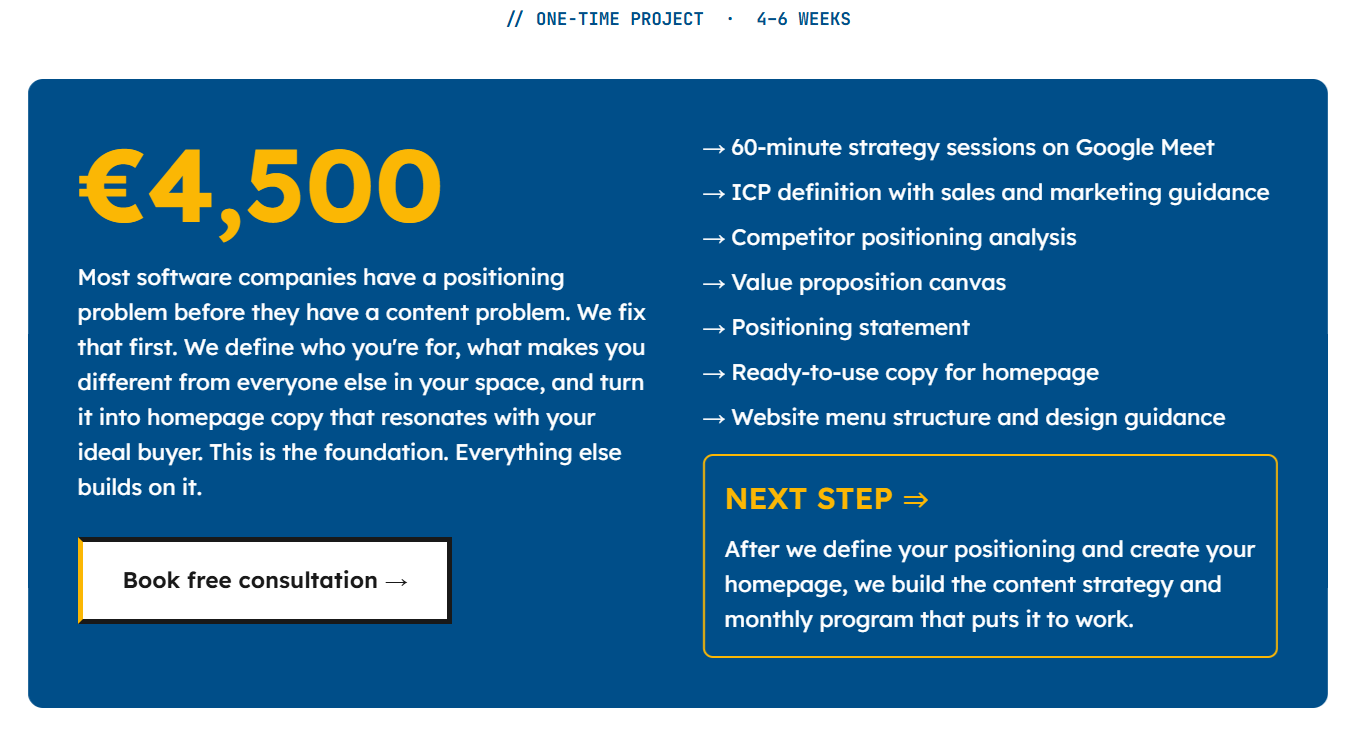
Our Strategy service follows this model: a positioning project costs €4,500 fixed and covers ICP definition, value proposition definition, competitive analysis, messaging, and homepage copywriting. If the project expands beyond the original scope, additional work is billed at €80/hour.
For companies that need ongoing support, we use other engagement models too. We'll get to those later.
Per-piece pricing
Per-piece pricing means you pay a fixed price for each deliverable. That could be a blog post, case study, landing page, whitepaper, email sequence, or another content asset. This model works well when you need content occasionally. You order the pieces you need, and don’t pay a retainer.
Because every deliverable has its own price, it's easy to budget and compare individual services. The trade-off is that strategy, distribution, performance reporting, or ongoing optimization may be priced separately or not be included at all. If those services are not included, the agency isn't accountable for results, and that means it's up to you to develop the brief, edit the draft and make sure whatever you outsourced is performing.
An example
One boutique agency publishes a straightforward rate card for its content marketing services. A blog post costs $1,000 (up to 500 words), while a custom infographic starts at $500 and includes two rounds of revisions.
At Zmist & Copy, we also offer per-piece pricing. An article costs €650, a case study €950, a landing page €650, a newsletter €300, and a data report €2,800. These costs are higher than the cost of production of the same content pieces but within an ongoing content program.
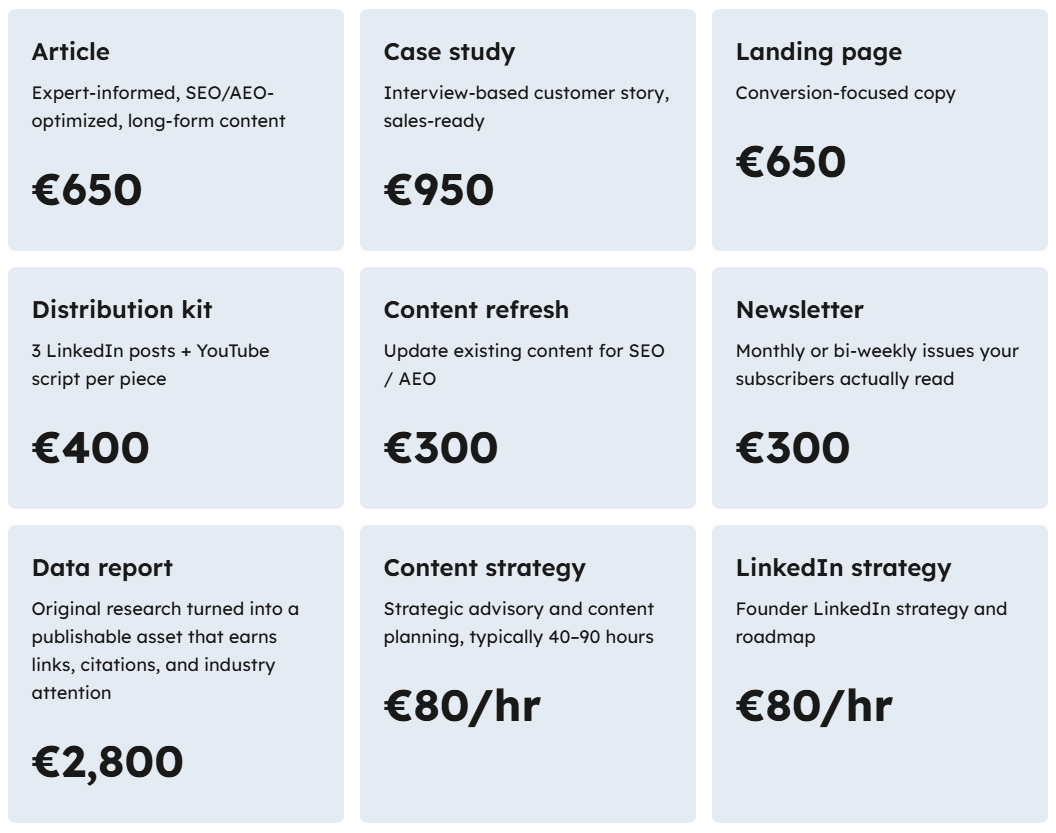
Here's how the two rate cards compare, side by side.
Hourly billing
With hourly billing, the clock determines the cost. The agency tracks the time spent on your project and invoices you based on an agreed hourly rate. This approach is common for work that's difficult to scope in advance, such as content strategy, workshops, consulting, editing, or content audits.
It's worth noting, however, that this model has been shifting recently. AI can now handle research, outlining, and first drafts faster than humans. If the same result takes half the time, should it also cost half as much? That's one of the reasons agencies are moving away from hourly billing for content creation. And why more people are asking if AI tools can just do this instead. Check out our take on that.
An example (actually two)
The same boutique agency charges $200/hour for on-demand content like white papers, case studies, FAQs, ad copy, and sales materials. Another agency we came across has a similar setup, with a published rate of $200/hour for content projects from blog posts to research reports. It turns out both agencies charge the same hourly rate:
We've looked at pricing models and real agency examples, and you might still think the numbers are confusing. They are. Why can two agencies charge different prices for the same thing: 'content marketing'? Because they're not selling the same thing. The final price depends on what happens before, during, and after the writing itself.
What's baked into the price
Before we dive in, let’s look at more numbers. WebFX surveyed 350 digital marketers in 2026 and found that monthly retainers range from $1,000 to $20,000. Blog posts alone run $150 to $600 each. Long-form guides go for $500 to $2,500. Ebooks and whitepapers climb as high as $10,000+. And once more, that's a wide range, so what's behind the number?
- Strategy shaping the content → Are you getting a writer, or a team helping decide what should be written in the first place? Keyword research, messaging, audience research, content planning, and editorial direction all add time. And time adds up on the bill.
- Depth of research → A writer working from publicly available information is a different process from creating content based on expert interviews. Research calls and expert input take more time and coordination, but they're also why nobody else can copy the result.
- Industry complexity → A beginner-friendly marketing article and a piece explaining cybersecurity architecture may have the same word count but require different levels of knowledge. And the price reflects that.
- Frequency and volume → The more content you need, the more you pay overall. But buying content in larger volumes might lower the cost of each piece because the agency doesn't have to repeat the setup work each time. A monthly package with four articles will cost less per article than ordering those same four pieces separately.
- What happens after publishing → Some agencies stop at delivery. Others include distribution, promotion, and monthly reporting on what the content did. Guess which one increases the price?
So far, we've only talked about agencies. But there's a cheaper lane right next to it — freelancers.
What about freelancers? Are they still in the running?
Freelancers price the same way agencies do: hourly, per word, or per project. The numbers are different, since there's no team overhead to cover. On Upwork, content writers charge $15–$40/hour, while writers with specialized knowledge can go up to $80/hour. More on this in our content marketing agency vs. freelancers comparison.
When freelancers price by the word, rates can range from $0.05–$0.10 per word for beginners to $1–$1.50 per word for advanced writers. That means a 1,000-word article could cost anywhere from around $50 to $1,500.
By piece, a 1,000-word blog article averages $50 to $175. More research-heavy articles fall in the $75–$250+ range. Short white papers (1,000–2,500 words) may be priced around $500. Longer versions that require interviews and deeper research reach $5,000+.
The rates vary quite a bit depending on how the freelancer charges:
For a company with a clear brief, a freelancer makes sense. You already know what to make. You just need someone to make it. But what if your content needs more than writing? Research, angle, expert interviews, editing, distribution, and all that stuff? A skilled freelancer can handle a few of these, but one person has a narrower capacity than a team that combines strategy, writing, editing, and project management. And only such a team can stay accountable after the content is live.
Freelancers aren't the only alternative to an agency, either. Some companies take the in-house route. We broke down in-house teams vs a content marketing agency, and how to make the decision.
Want to weigh agencies against other options? Here’s how to choose between a content marketing agency and an SEO agency.
What the price doesn't tell you
Every pricing model we've covered tells you how you pay for the work. You're paying for articles, hours, or a defined scope. Do those prices tell you whether the content will perform? Of course, they don’t.
That's not a knock on all freelancers or agencies. Plenty offer reporting, distribution, or optimization as part of the deal. But this is the first thing you should pay attention to when you compare content marketing vendors or pricing. You need a partner that takes responsibility for how every piece performs. We do.
Curious about the red flags to watch for when hiring an agency? Read The Ugly Truth About Content Marketing Agencies.
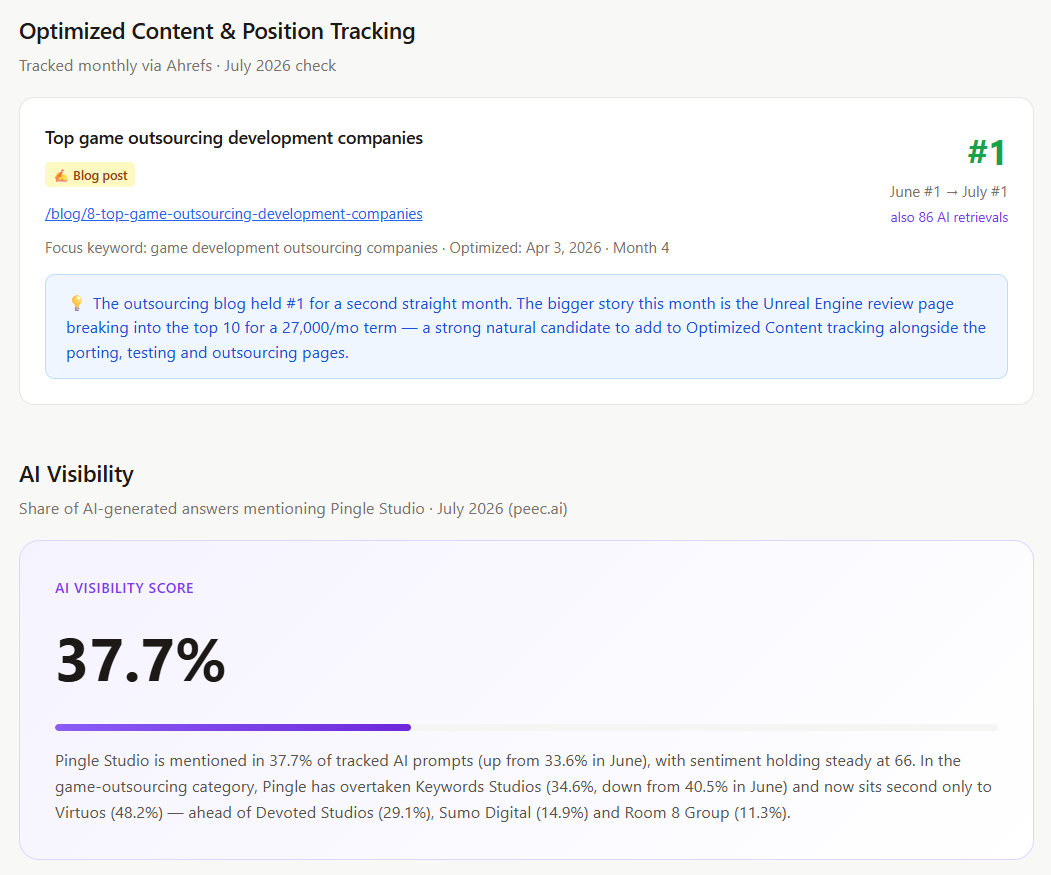
At Zmist & Copy, we create a content strategy and report on the results. In our monthly reports for clients, we track organic traffic and keyword rankings, measure AI visibility across tools like ChatGPT and Perplexity, monitor lead volume and how well those leads qualify, and check which specific pieces of content earn their keep. These results inform our next steps. And we're upfront when the results aren't so good.
How we price it at Zmist & Copy
Unlike most content marketing agencies, we don't hide our pricing. We have three monthly retainers, a one-time project and a set of per-piece rates we’ve covered earlier. No "contact us" required before you know what you're getting into.
Here are our content programs:
- Visibility → €1,500/month, no minimum. Two SEO/AEO-optimized articles (or a case study plus a landing page), one content refresh, strategy embedded in every brief, and a monthly performance report.
- Growth → €2,700/month, three-month minimum. Everything in Visibility, plus a distribution kit per piece (LinkedIn posts and a YouTube script), subject-matter-expert interviews for every piece that needs them, and bi-weekly strategy calls.
- Authority → €4,800/month, three-month minimum. Four articles (or a mix of articles, a case study, and a landing page), two content refreshes, a monthly newsletter, weekly distribution kits, and a quarterly content roadmap.
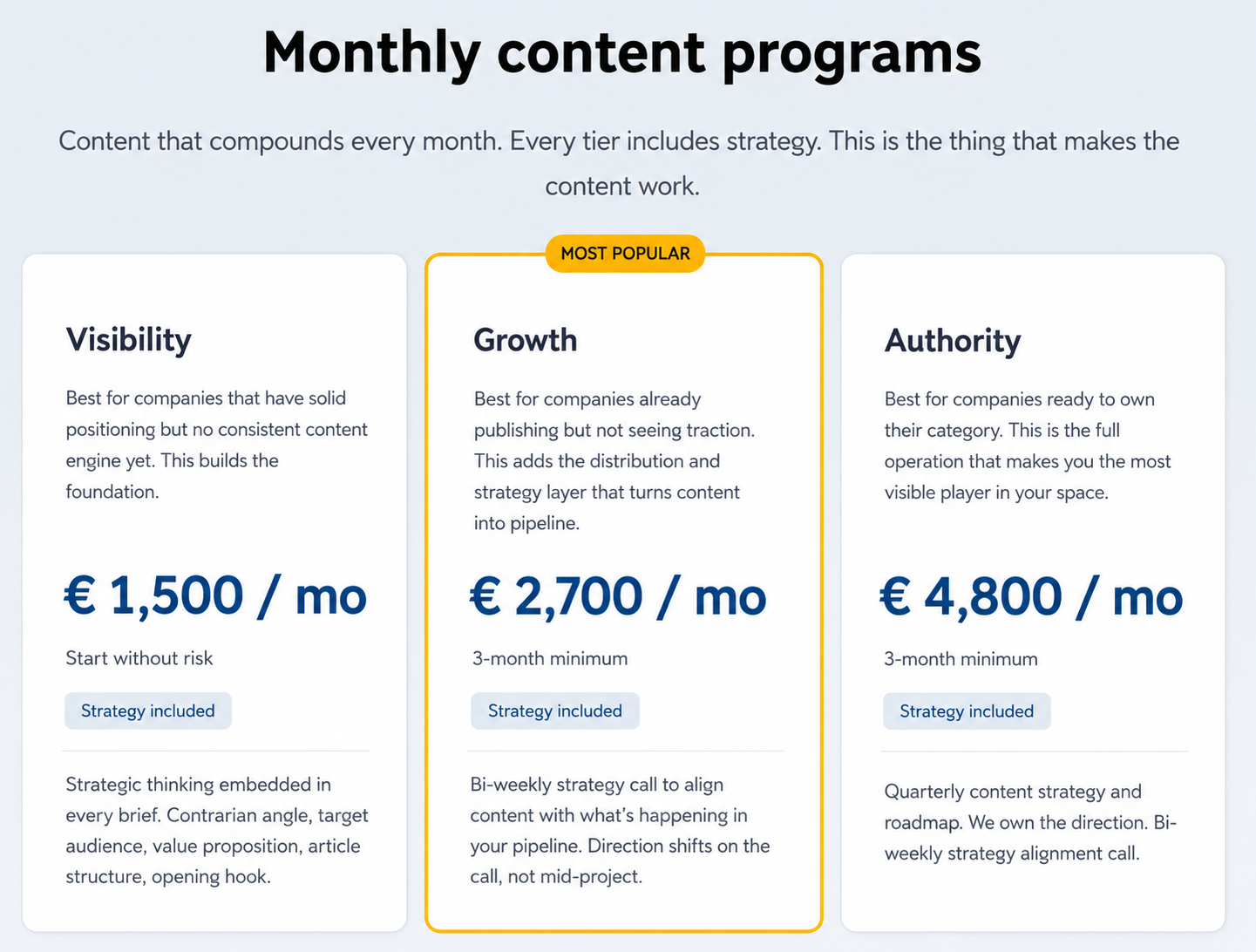
Zmist & Copy's three monthly content programs
Our pricing itself is nothing unusual. It’s a flat monthly fee, same as most agencies charge. But we are responsible for the results. And those are hard to argue with. 1LIMS went from zero organic traffic to 4,500 monthly visits and 30-plus conversions a month in under a year. Eleken generated 20+ MQLs a month within three months of work. Modeso's AI visibility reached 26%, the highest of any competitor tracked, once we narrowed their strategy.
Partner with an agency that owns the outcome
At Zmist & Copy, strategy comes first. If your positioning or ICP needs work, we fix that. From there, we build content around that foundation and monitor how it performs over time. We measure our work by what it changes for our clients.
Want a partner that treats your numbers as its own responsibility? Book a free consultation, and we'll show you where we'd start.


