


A few weeks ago, we took on a new client, a healthtech company, for a positioning project. After our ICP workshop, the founder dropped a link into our Slack channel. It was a Y Combinator post on Linkedin about a company called Plena. This, he said, was the kind of company he wanted to become.
Plena is a startup that targets medical clinics, but it doesn't sell software the way startups normally do. It argues that clinics don’t need more software. What they need is someone to do the work. Plena delivers exactly that: a platform that runs referral handling, fax intake, scheduling, and other operational workflows inside the systems clinics already use. So the pitch isn't "buy our software." It's "we do the work."
I'm not going to talk about Plena's metrics (even though they do look impressive). What made me curious was the shape of the product. It is showing up everywhere now, and it overrides the last 15 years of how software was sold.
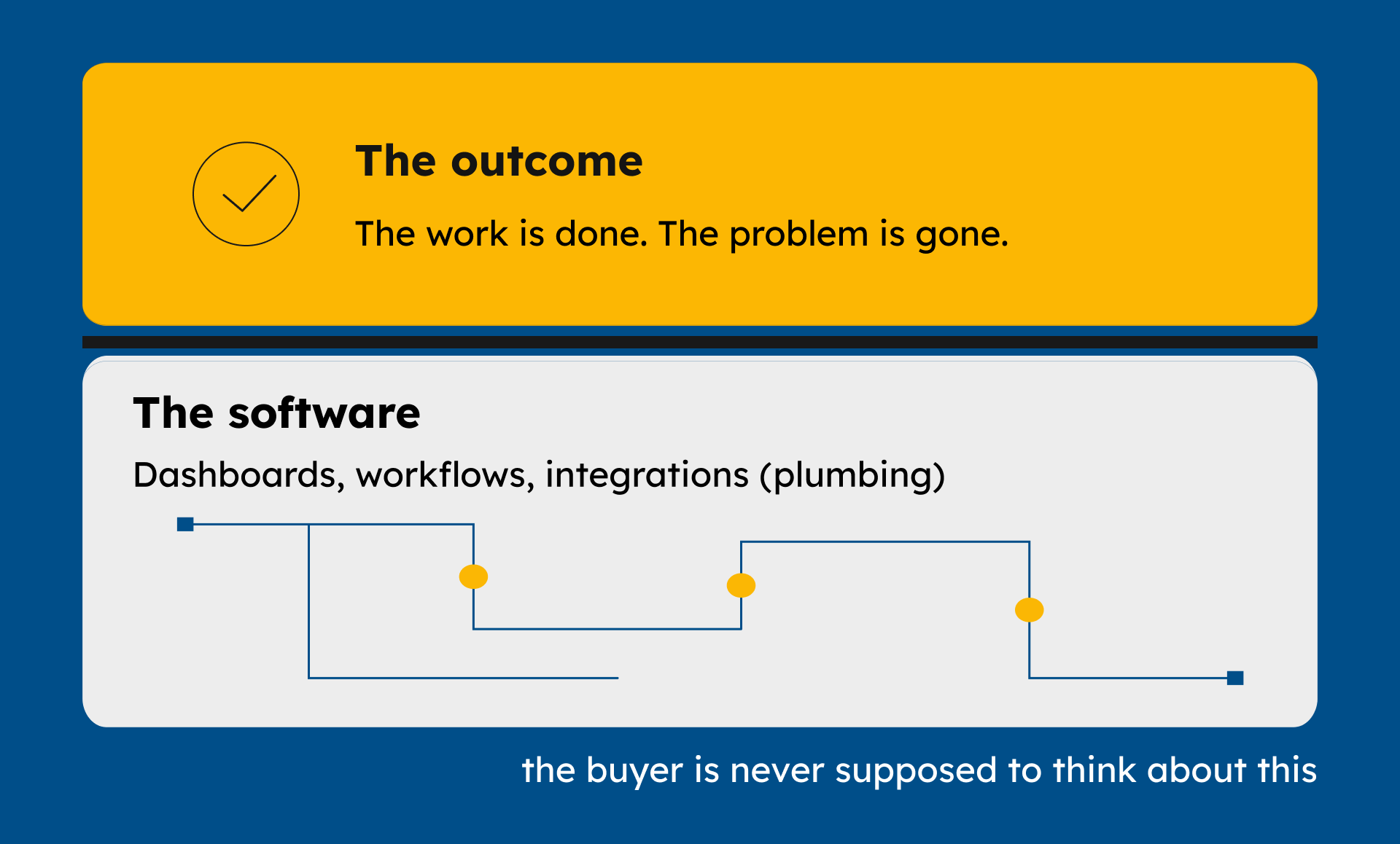
The dominant model was to hand a customer a tool, a seat, and a login. The language stayed tool-centric: dashboards, automation, workflows, integrations.
Plena is selling the absence of a tool. The product is the outcome. The software is plumbing the customer is never supposed to think about.
I'm not going to talk about agentic workflows and how SaaS is dead now. You already know that. I want to talk about positioning. Because once you say “we do the work,” you’re no longer competing in software categories. Your messaging moves from describing capability to describing responsibility.
I run a service business. And where software is going isn't a software story at all.
The unit of value changed
For a long time, the two worlds were separated. Software sold you a tool and you operated it. Service did the work and handed you the result. You bought Salesforce or you hired an agency; one gave you a system, the other gave you an outcome. That line is dissolving.
The market already has a name for the new shape: "services as software." ServiceNow paid around $2.85 billion for the AI-agent company Moveworks in early 2025. That's a legacy incumbent buying its way into the new model rather than waiting to be eaten by it.
Service businesses don't charge you per seat. So the whole industry is repricing itself around the outcome:
- IDC expects pure seat-based pricing to be obsolete by 2028, with 70% of software vendors refactoring pricing around consumption or outcomes.
- Intercom prices its support agent, Fin, per resolution which means you pay when the problem is solved.
- Salesforce's Agentforce is priced by the conversation and the action, not by the user. The pricing page itself now describes an outcome.
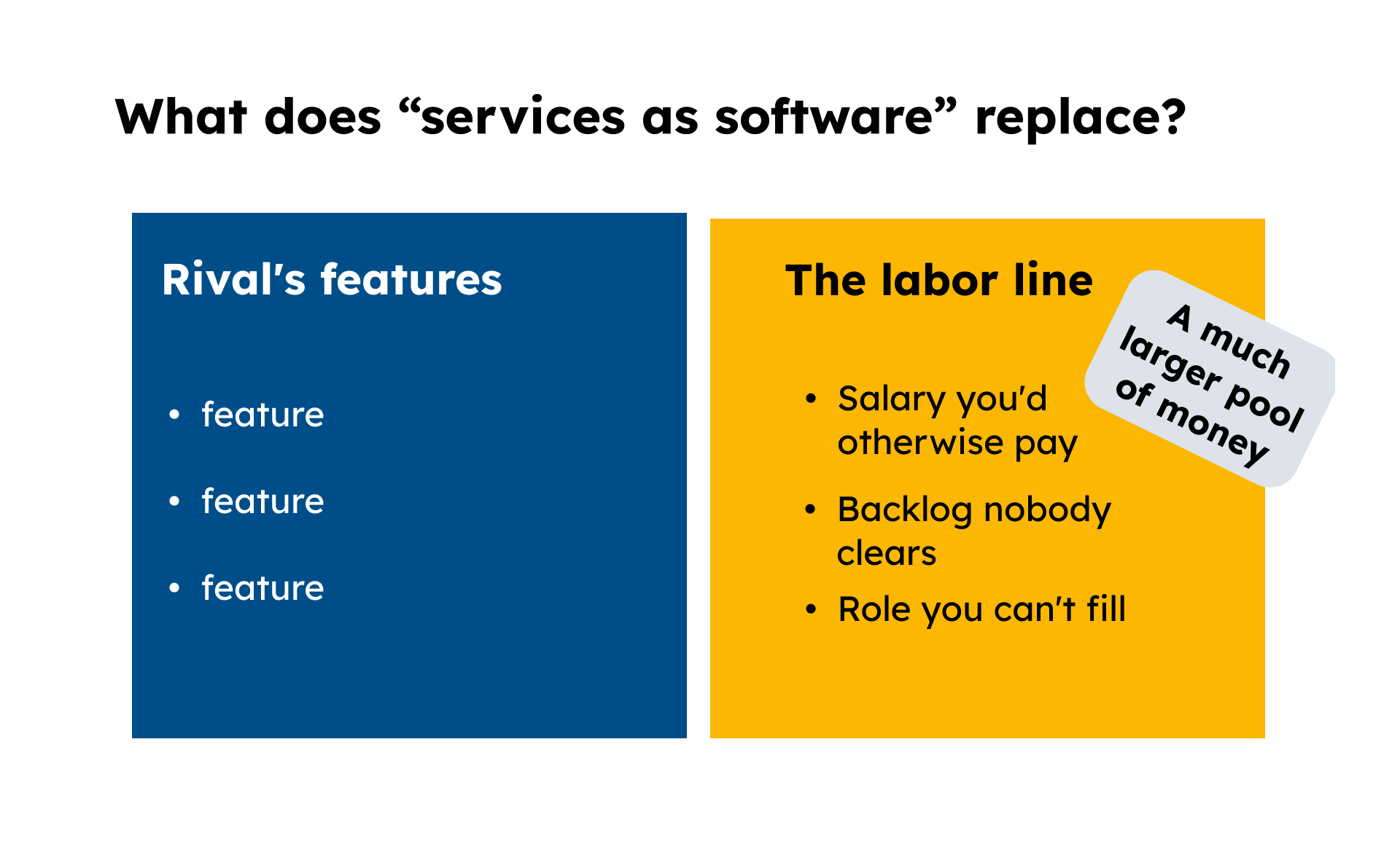
You're now being measured against the labor line. A clinic doesn't compare a "do-the-work" vendor to its software subscription. It compares it to the salaries of people it would otherwise have to hire. That's a much larger pool of money.
This rewrites positioning
Let me be precise about what this changes. Positioning is the set of decisions that come before the copy. What is your product, who is it for, how is it different, what does it replace? The unit of value (outcome) changes the answers.
"What does it replace?" used to be answered with a competitor. Now it's answered with a salary, a backlog, an unfillable role. If your homepage still positions you against the other tools in your category, you're fighting on the wrong battlefield. The buyer isn't choosing between tools anymore, they're choosing between operating a tool themselves and having the work done.
"What is it?" used to be a software category: a CRM, an appointment scheduling tool, a project management software. Now the answer is an outcome, and the software is the part you're supposed to hide. Selling features positions you as a tool, but you're an outcome now.
So what do you do? Rewrite your homepage to say "we deliver outcomes"?
Enter Palantir
I'd been hearing founder after founder name Palantir as the gold standard of marketing. Then I saw something that made me curious: Alex Karp, Palantir's CEO, in Ukraine (where I'm from) meeting Zelensky, and giving an interview about how glad he was that his company was helping Ukrainians kill Russians.
I wanted to understand a company whose chief executive shows up in my country and says that out loud. So I went digging into Palantir and found a positioning lesson for "services as software."
Accenture versus Palantir: you can't claim an outcome you don't own
Accenture built a business doing custom software development work. The client provides the spec, they agree on a price, Accenture builds what was requested. The whole software development industry works like that. They provide a service. But Accenture can't really sign up for an outcome, because the solution is dictated to it.
When the software gets built to spec and the spec was wrong, the result disappoints and everyone blames the builder, even though the builder built exactly what it was told to. You cannot own a result you didn't get to design.
Palantir isn't a services company. They sell a platform. But they aren't SaaS either. They can’t generalize their product to solve customer problems out of the box. That's why they invented the Forward Deployed Engineer. The idea is to send your best developers into the customer's environment to learn the problem deeply enough to own it, then deliver the outcome and fold what you learned back into a platform so the next customer's solution is faster. That's a very different approach than: "Tell us what you need, or here's the software to do it."
For years, B2B messaging assumed that the buyer knew both the problem and the solution. The vendor's job was to explain why their product was the best implementation of that solution.
In Palantir's case, the message becomes: Here's the outcome. We'll own the work required to get there.
If you want to position on the result, you first have to earn the right to design it.
I feel this one personally. The agencies that stay order-takers ("tell us what content you want and we'll write it") can never promise a result, but they get blamed for results anyway. The ones that own the outcome have to take responsibility for the strategy. And they need to earn the right to build it, with their reputation and their case studies.
Software is now entering the same world service businesses like mine live in.
The new differentiation is operations
Here's where I get a little smug. I think I've earned it.
The companies that win in "services as software" will look less like classic high-margin SaaS and more like exceptionally well-run business operations. Because once your product is the outcome, your differentiation is whether you can deliver reliably, at scale. That's an operations discipline. (Feel how different this is from features?)
I've never had any other kind of moat. A service business has no seat-based margin. The product is the delivery. You're only as good as your hardest client, your messiest project.
"Services as software" is software finally becoming outcome-oriented, more aligned with what customers want. True. But it also means inheriting all the problems service businesses have been dealing with forever.
And I know exactly where the bodies are buried. It's the ugly 15%.
The ugly 15% is the whole game
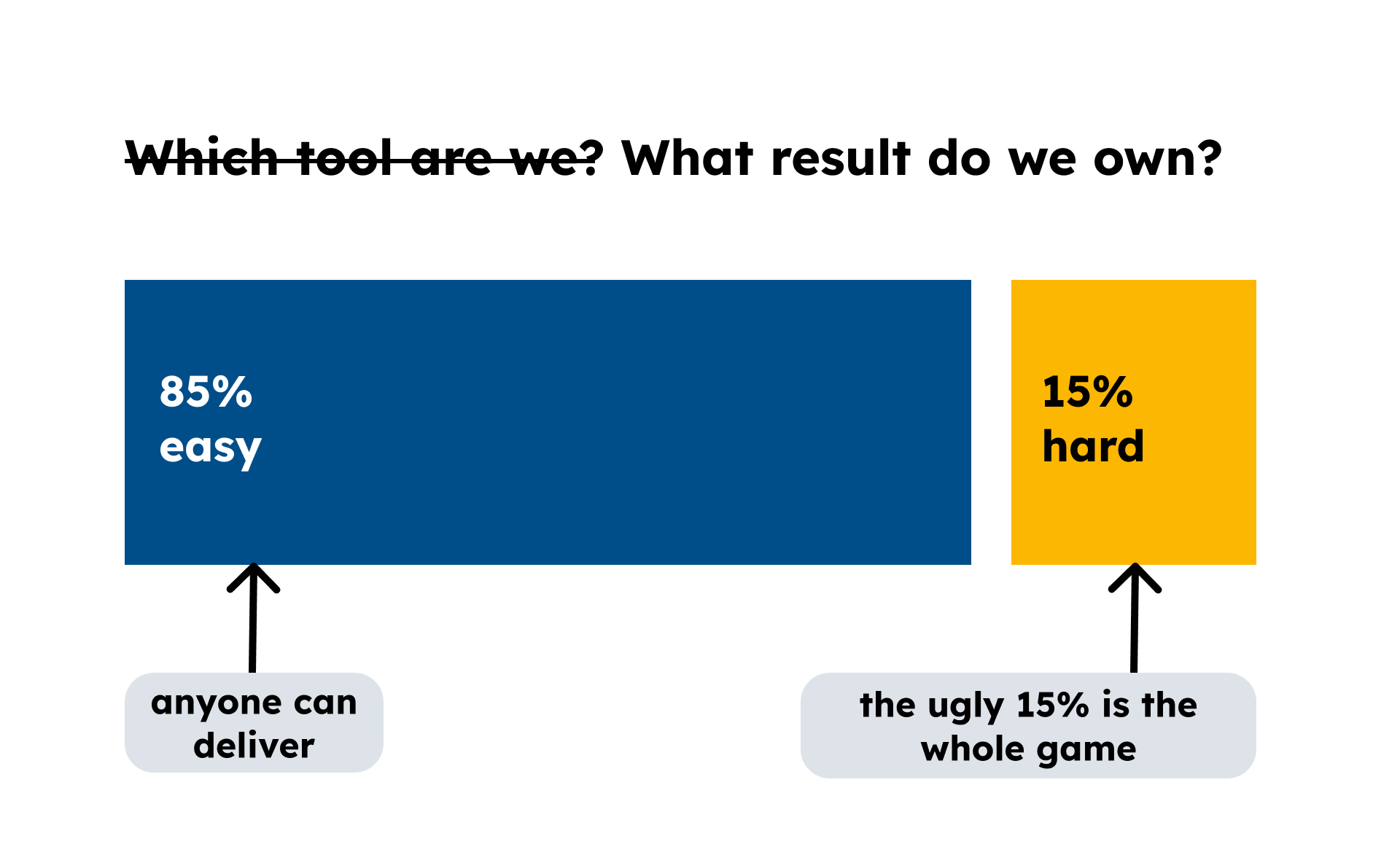
An agent handles 85% of the work beautifully (the easiest work that a human can handle just as beautifully and pretty fast too). What's the other 15%? That's the weird, the ambiguous, and the genuinely hard. If you're not careful with those 15%, you haven't reduced the work. You’ve made it worse.
In a service business the ugly 15% is the job. Anyone can deliver a brief or write a blog post. The entire reason a good service firm exists is the other 15%. In our case, that's the strategy that's muddled, the positioning the founder can't articulate, the project where getting things done is taking forever.
Delivering quality at scale is an operational discipline.
So the positioning consequence is this: in an outcome economy, differentiation is the proof of delivery. Outcomes are expensive to deliver and cheap to promise. Your whole positioning has to be built around proof.
"We do the work" is only as good as your exception rate.
How to reposition
If you're a software company watching your category turn into service, the work comes down to re-answering the five questions positioning always rests on:
- What is it? It's an outcome. Lead with the work that gets done. The plumbing stays under the floor.
- What does it replace? It can replace a salary or a backlog. Position against the labor line, because that's what the buyer is weighing you against.
- How is it different? There are two angles. The first one is “Every vendor sold you a tool you have to operate. We do the work.” And the second one is proof of delivery. Can you prove reliability at scale?
- Why should they care? It's the result: the work that disappears, the headcount they don't have to chase, the 15% that no longer haunts them.
One caution for a tool company growing into an outcome company, or a service firm productizing what it does. Don't position for where you'll be in 18 months and make claims your operations can't hold today. Lead with the outcome you can already deliver reliably, and build the bigger claim as the proof accumulates. The market forgives a narrow promise kept. It does not forgive a big one broken.
“Which tool are we?” vs “What result do we own?”
For years, software got to be the glamorous business, and service got to be the unglamorous one. High margins versus hard work, platform versus people, the thing that scales versus the thing that doesn't. And now the most interesting companies in software are racing to become more like a service: to do the work, own the outcome, win on operations, and hide the software under the floor.
I find that good news because it's true to how value gets created. Nobody ever wanted the tool. They wanted the thing the tool was supposed to produce and were willing to operate the tool themselves only because no one would do the work for them. That's changing.
Which tool are we? This question is no longer what your positioning strategy needs to answer.
Instead, your question is the same one service businesses have always had to answer: what result do we own, what work do we make disappear, and can we prove we'll deliver it (including the ugly 15%)?
I've been answering that question my whole career. It's nice to have company.


