


Most B2B email newsletters are built around one objective: keep the company visible, so people remember you exist. Which sounds reasonable until you realise that "reminding people you exist" is not a reason for anyone to open anything.
Readers make a series of micro-decisions every time they open an email. Do I keep reading? Do I scroll? Do I click? Each of these is a separate question, and most newsletters answer none of them deliberately. They just produce content and hope attention follows.
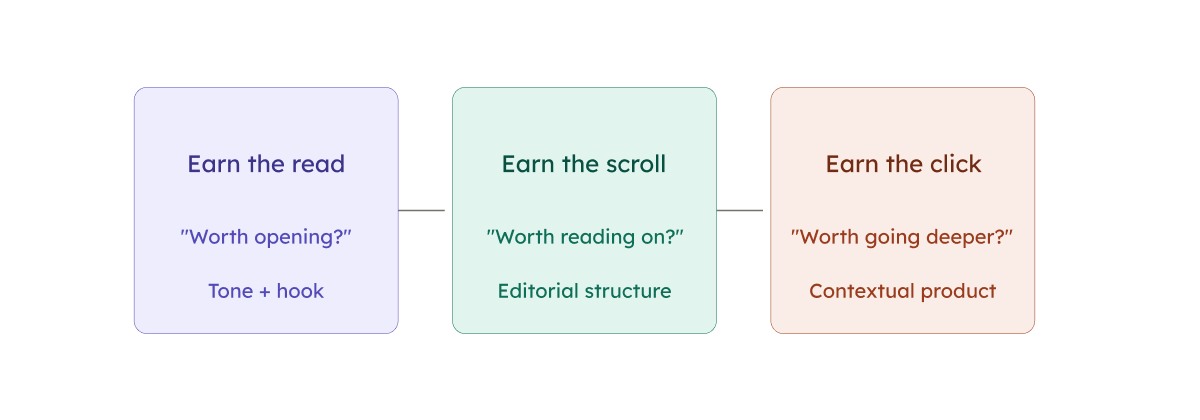
We took a different approach. Instead of building a newsletter around what to communicate, we built one around three goals: earn the read, earn the next scroll, earn the click. Each goal maps to a distinct reader behaviour. Each requires a different type of content, placed in a specific position in the issue, designed around what makes people stay.
The result, for one of our clients, was a newsletter with 60–66% open rates, click-through rates hitting 100% on select issues, and 22% of sessions driven to the website over nine months from a channel that hadn't existed at all.
In this piece, I’ll walk through exactly how we structured it, section by section. The framework is applicable to any B2B product, including those operating in the most boring industries.
The problem with "reminding people you exist"
Ask most B2B marketers why they send a newsletter and you'll hear some version of the same answer: nurture leads, remind customers about your company or product, drive traffic.
These are company goals. But why would a reader open it?
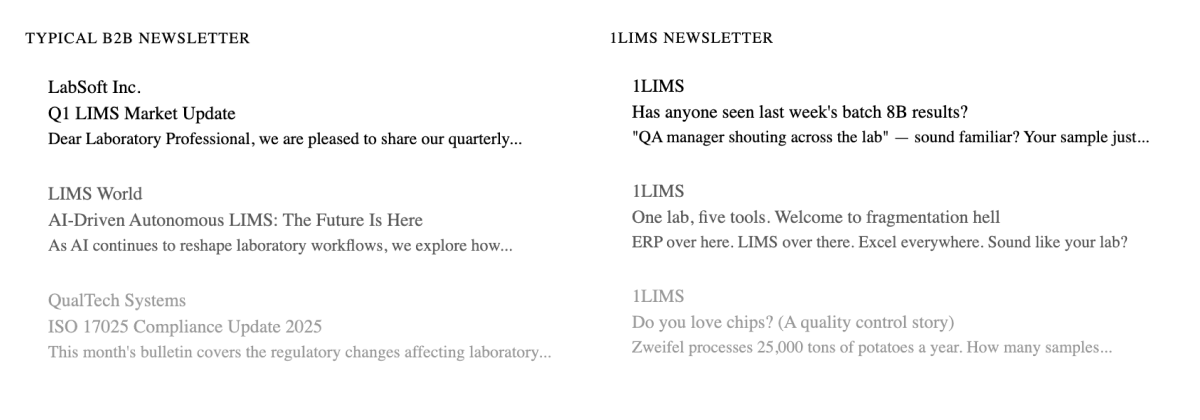
B2B newsletters from the technical industries are the worst. LIMS vendors, compliance platforms, enterprise software like to send newsletters with industry updates in a report-like format, technical articles about regulations, thought-leadership pieces about whatever AI trend is currently unavoidable. All formal and boring.
We ran into this exact problem when building a newsletter for 1LIMS, a Switzerland-based laboratory information management system. The LIMS market is crowded with lookalike vendors, and the content is serious, technical, and interchangeable.
Before writing the first issue, we studied what lab professionals talk about in public. We found across Reddit threads, LinkedIn discussions, and industry forums that the conversation was anything but boring. Lab professionals joked about spreadsheets, shared memes about databases and audits, and made fun of software promises. The tone was nothing like the content flooding their inboxes.
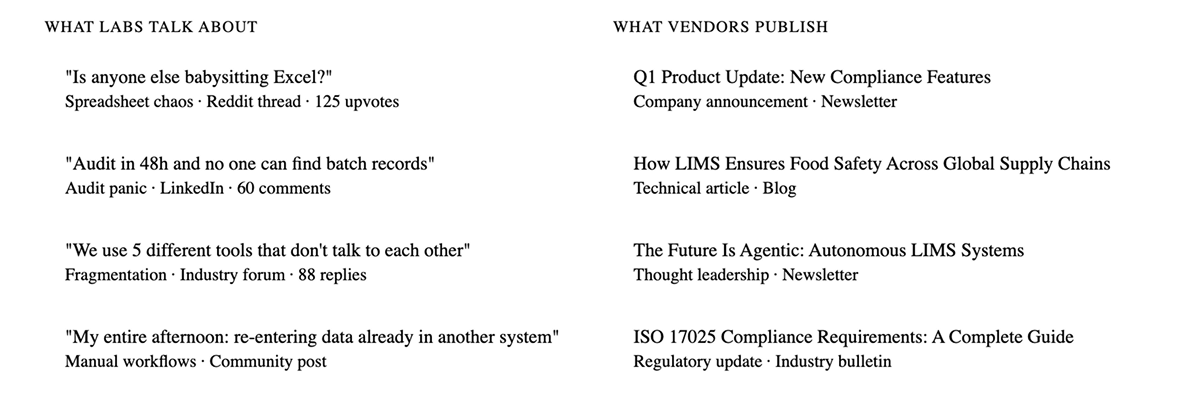
That gap was our insight. Most vendors were talking at their audience. Nobody was talking like them.
Stop aiming for visibility, start earning it
Instead of asking "what do we want to communicate this week?", ask three questions:
- How do we earn the read?
- How do we earn the next scroll?
- How do we earn the click?
Earn the read: Write like someone who understands the problem
The first goal in your newsletter strategy is getting opened. You can experiment with hooks in your subject lines, but what really matters is building a reputation for being worth your reader’s time.
That reputation gets built through one thing: tone.
Most B2B newsletters explain features, announce updates, and position their company in every paragraph. They're written by the vendor with the vendor's interests in mind. Readers can feel that. The moment someone senses they're being talked at rather than talked to, the read is over.
The alternative is writing like you actually understand the reader's reality. This is what earns the open, not a catchy subject line.
For 1LIMS, that meant writing like someone who understood what it actually feels like to run a quality control lab. Like someone who's sat in the same rooms, filed the same audit reports, and has an opinion about spreadsheets.
One early issue opened with a question: "Do you love chips?" It went on to explain how Swiss manufacturer Zweifel processes 25,000 tons of potatoes every year, then asked readers to estimate how many samples could disappear in paperwork at that scale. We didn't mention the product until much later.
That issue opened at 66%.
Tone is a decision about whose side you're on. If your newsletter reads like it was written for the company's benefit rather than the reader's, no amount of good content will save it.
Earn the next scroll: Our behavioral editorial framework
Getting opened is the first problem. Keeping the reader moving is the second. And most newsletters fail here because they're structured for the writer's convenience, not the reader's behaviour.
We built a five-section editorial framework for 1LIMS that treats structure as a behavioural problem. Each section is designed around what people do when they read email.
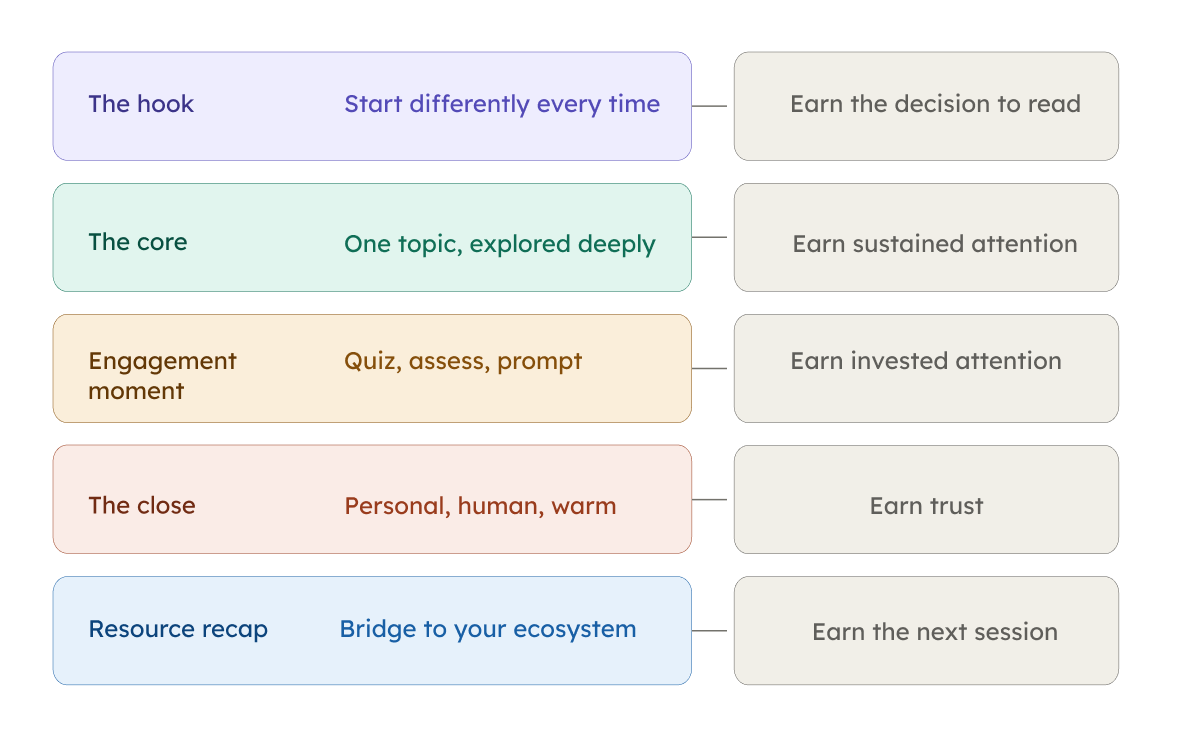
Section 1: The Hook - earn the decision to read
The hook is the argument for why this email deserves the next thirty seconds.
Most B2B newsletters open with context: "This week we're talking about X." They describe what's coming. But the hook needs to create some tension. This can be the feeling that something is slightly off about what you thought you knew, or that a problem you recognise is about to be addressed more honestly than usual.
There are a few ways to do this:
- The surprising number (something that unsettles what the reader already believes). Intercom famously opened a product blog post by noting that most features they'd ever built were used by fewer than 10% of customers. That number makes you stop. It implies everything you thought you knew about product development might be wrong.
- The relatable scenario. Describe a specific, recognisable moment. The 1LIMS newsletter opened one issue with a situation: “Has anyone seen last week’s Salmonella results for batch 8B?” the QA manager shouts across the lab.” It works because it drops the reader into a concrete moment before making any argument.
- The contrarian take. A direct challenge to something the reader accepts as true. Morning Brew built a large part of its early identity on this – taking a financial or business story and explaining why the conventional reading of it was incomplete.
- The uncomfortable question. "How many of your lab workflows are still running on spreadsheets you built in 2017?" forces the reader to answer honestly, which means they're already engaged before you've made a single point.
The job of the hook is to earn the first scroll.
Section 2: The Core - earn sustained attention
The instinct in B2B content is to cover everything. Mention all the relevant angles, include all the caveats and end with a balanced summary. The result is an issue that technically addresses a topic but doesn't say anything.
The core works best when it goes deep on one thing.
The structure that works: problem → explanation → insight.
Start with the problem in a form the reader recognises from their own experience. Then explain what's causing it, going one layer deeper than the obvious answer. Then reframe it: what does understanding this change about how you'd approach the situation?
Lenny's Newsletter does this particularly well. A typical issue takes one question, usually something specific enough that you'd expect a generic answer, and goes deep enough that you finish feeling like you understand something you didn't before. The depth is the product.
problem → explanation → insight works better than advice → rationale → example.
Most B2B newsletters are built on the second structure because it feels authoritative. The first structure is more effective because it meets the reader where they are before asking them to follow you somewhere new.
Section 3: The Engagement Moment - earn investment
This is the section almost no B2B newsletter includes, which is part of why it works so well when you do.
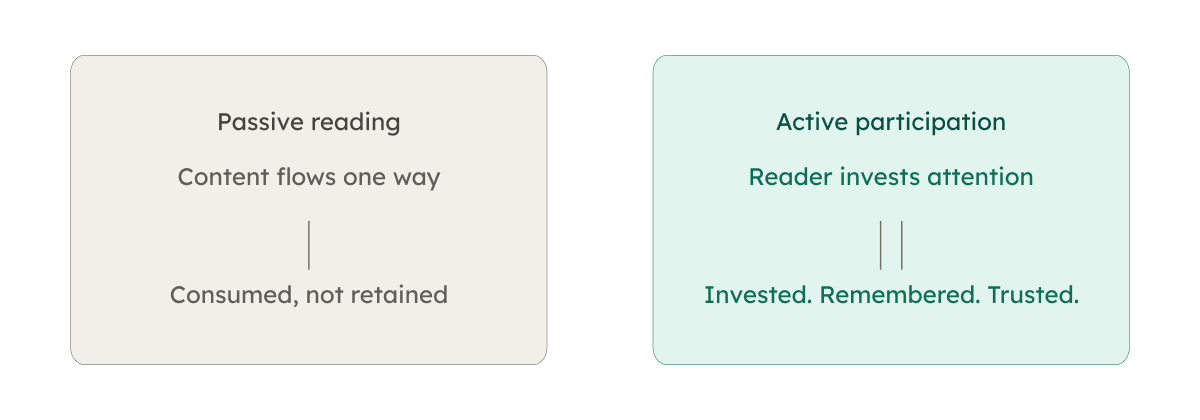
Reading is passive. The moment a reader does something, such as answers a question, makes a choice, or rates their situation, they become a participant. Participation creates investment. Investment creates memory.
You remember things you engaged with more than things you consumed. A newsletter that creates one moment of active participation per issue is building a fundamentally different relationship with its readers than one that only delivers information.
The formats that work in email:
- Self-assessment. "How many of these apply to your team?" followed by a short list. The reader scores themselves, which makes the content feel personal. The 1LIMS newsletter used this to address audit readiness. We asked readers to check off which processes they still ran manually. The exercise made the problem concrete in a way that a paragraph about manual workflows never could.
- Prediction. "Before you read on, what do you think is the biggest reason X happens?" Let them answer mentally, then give your take. When your answer differs from theirs, it creates a memorable moment of surprise. When it matches, it creates validation, which is its own form of engagement.
- Forced choice. "Which of these would you prioritise first?" with two or three options. The choice itself doesn't need to have a right answer. The act of choosing focuses attention and makes the subsequent explanation feel personally relevant.
- Opinion prompt. End the engagement moment with a question and invite replies. Not "let us know your thoughts!" but a specific question that you'd want to read the response to. Morning Brew, Lenny's, and most of the high-engagement B2B newsletters do get replies. So ask questions that make the reader feel like their answer matters.
Section 4: The Human Close - earn trust
Most B2B emails end formally. There's usually a CTA, sometimes a PS, but nothing that feels like it was written by a person.
The human close is a deliberate break from that pattern. It's short and its job is to remind the reader that there are people behind the product. People have opinions, find things funny, and sometimes get things wrong.
This can be something specific that happened this week, a small frustration or observation, an honest admission about something you're still figuring out. The specificity is what makes it land.
"We've been thinking a lot about X" is a brand speaking.
"I spent an hour arguing with a spreadsheet on Tuesday and lost" is a person.
The Hustle built a significant part of its early identity on this. The sign-offs were personal, slightly self-deprecating, and specific enough to feel real.
For B2B newsletters in technical industries, this section carries extra weight because it contrasts so sharply with everything else in the category. When every competitor sounds like a compliance manual and you sound like a colleague, the difference is noticeable.
Section 5: The Resource Recap - earn the next session
The last section is a bridge.
A newsletter that ends with "book a demo" or "check out our latest feature" is a newsletter that ends with a transaction request. A newsletter that ends with "if this resonated, here's where to go deeper" is a newsletter that ends with an invitation.
The distinction matters because it changes what the reader does next. A transaction request creates pressure. An invitation creates curiosity.
The resource recap connects the issue to your broader content ecosystem: a blog post that goes deeper on the topic, a case study that shows the principle in action, a guide that gives the reader something they can use immediately. The link should feel like a natural extension of what the issue just covered, not a redirect to something the company wanted to promote.
For 1LIMS, the resource recap connected every issue outward to a relevant case study, buyers guide, or blog post. Some of our issues scored 84% and even 100% for click-through-rates.
Earn the click: Make the product not feel intrusive
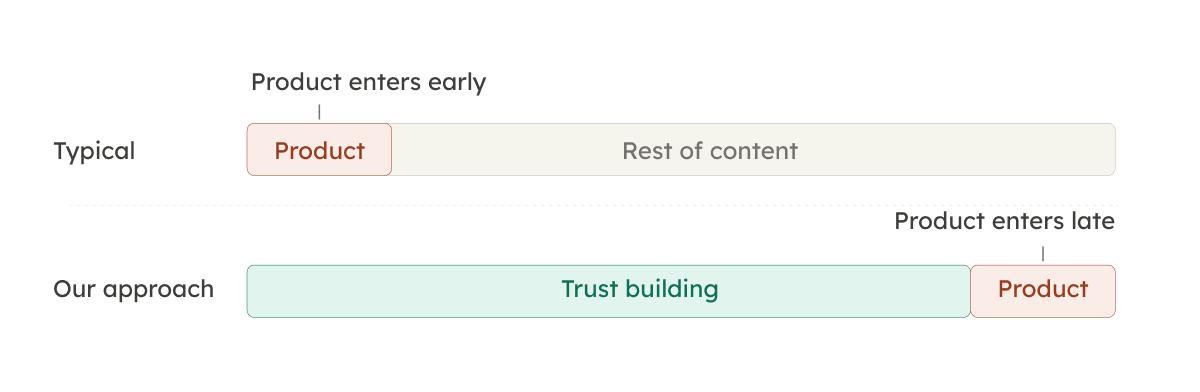
The third goal is the most misunderstood. Most B2B newsletters spend 80% of the issue earning trust…then throw it away in the final paragraph with a random “Book a demo” button that has nothing to do with what came before.
The product entered each 1LIMS issue the same way a good recommendation enters a conversation – after the problem was already sitting in the room.
An issue about spreadsheet chaos didn't pivot to "1LIMS can fix this." It walked the reader through exactly what breaks down when a lab runs on Excel, let them feel the weight of it, and then showed what a different workflow looks like. By the time 1LIMS appeared by name, the reader had already arrived at the conclusion themselves.
Our goal wasn't to close in every email. It was to make the brand the obvious answer whenever the reader was ready to look for one. A lab manager who reads six issues about audit failures and manual workflows doesn't need to be convinced. They've already done it themselves.
What to steal from this
If you're running a newsletter for a B2B product — especially in a "serious" industry where everyone sounds the same — here's where to start:
Research the conversation. Before you write anything, find where your audience talks publicly. What are they complaining about? How do they describe the problem? The language they use in forums and comment sections is almost never the language their vendors use. That gap is your opportunity.
Set three goals, not one. For every issue you send, ask: what earns the open? What earns the scroll? What earns the click? These questions require different answers. Most newsletters only think about the third one.
Build a repeatable structure. Random stories don't compound. A consistent editorial framework builds a habit. Habit builds a relationship.
Introduce the product after the problem. The product shouldn't be the reason the reader opens the email. It should be the natural conclusion they reach after you've helped them understand the problem. If the product feels like an intrusion, it's in the wrong place.
End like a human. One personal paragraph at the end of a corporate email does more for trust than five hundred words of thought leadership. Use it.
Good newsletters to learn from
If you want to see these principles in action, a few newsletters worth reading:
From Reads to Leads - Kate's newsletter on positioning, content strategy and writing for B2B tech companies.
Our own Zmist & Copy newsletter on content marketing without the SEO-first playbook. Subscribe here.
Our Anna Daiko also put together a list of her favourite newsletters from writers who've figured out how to make professional content feel human. Worth checking out.
Every one of them makes you feel like someone actually sat down and thought about what you'd want to read this week.
That's the whole trick. It's also the hardest part.


