


AI made content cheap like instant noodles, but it didn't make it work better.
We surveyed 53 B2B tech content professionals in Q1–Q2 2026. 85% increased their content volume in the last twelve months. Among those who increased it significantly, nearly half saw no change in results at all. 77% now say their content feels generic.
So everyone suddenly started publishing more, but it gave almost zero results.
To see the bigger picture, we analyzed 9 other reports and surveys. This article aggregates statistics from 10 sources (Gartner, Deloitte, Ahrefs, and more), and focuses on the two main problems of content marketing: creating content and making it work. Where sources contradict each other, we show the spread instead of averaging it away.
Here are the key numbers we’ll focus on:
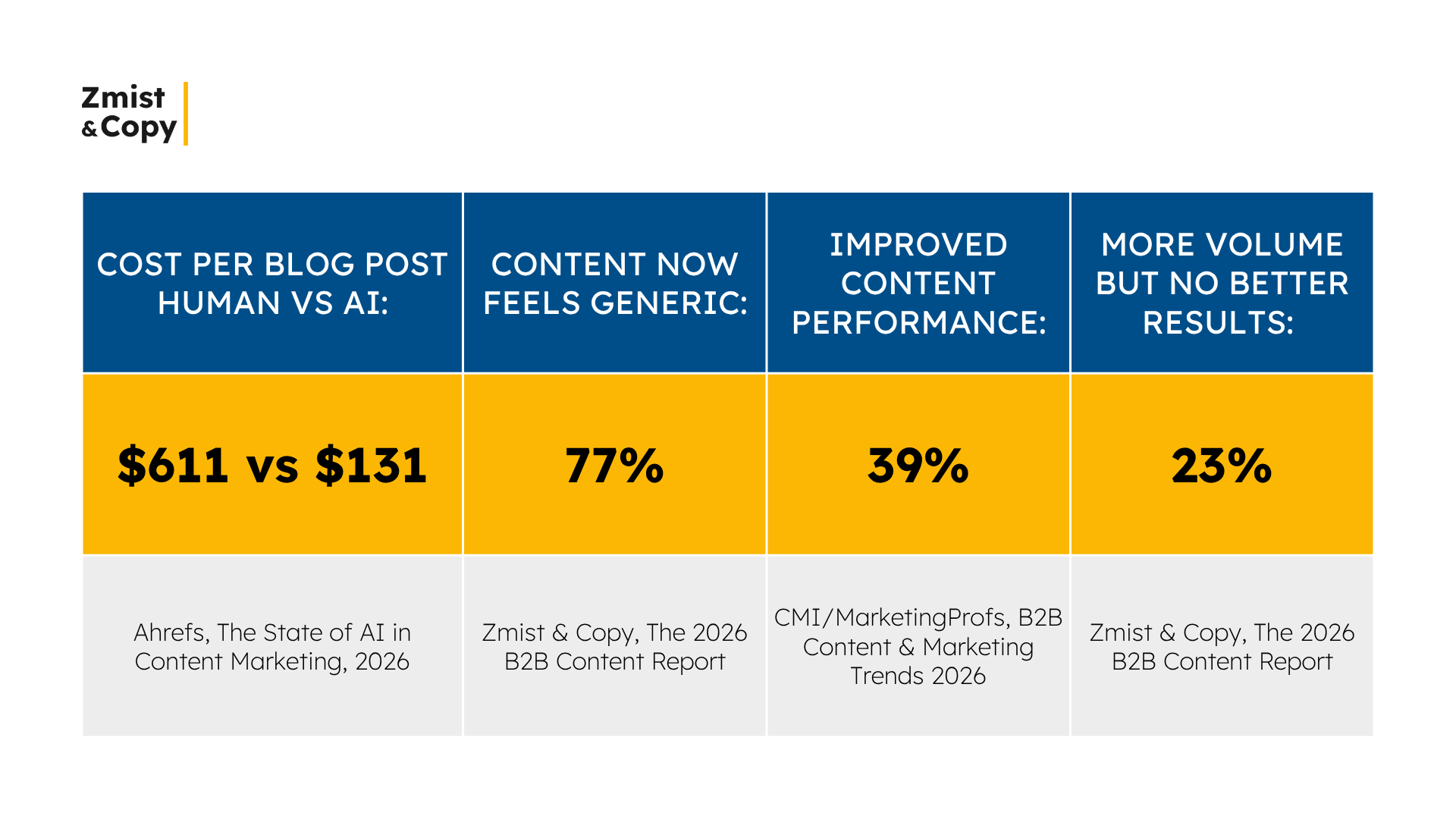
KEY TAKEAWAYS:
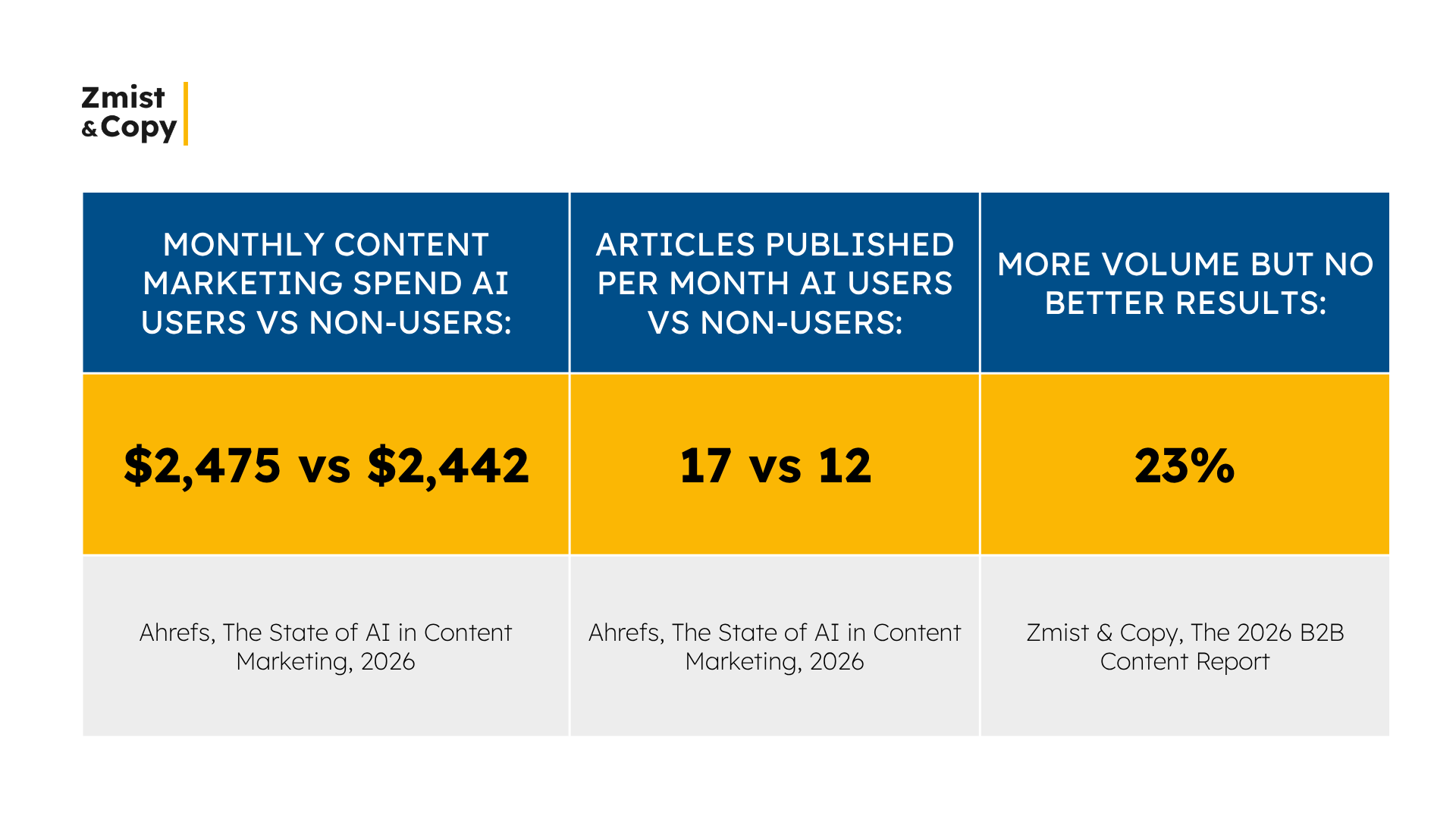
- Cost per piece fell 4.7× ($611 → $131), but monthly content budgets barely changed ($2,475 AI users vs $2,442 non-users).
- 85% of B2B tech teams increased publishing volume. Nearly half of those who increased it significantly saw no change in results. 77% now say their content feels generic.
- 74.2% of new English-language webpages already contain AI content.
- AI significantly improved productivity for 42% of teams, but only 6% report a significant improvement in content performance.
- 97% of marketers edit every AI draft. Only 6% of them have custom tools, agents, or GPTs for brand alignment. Most still paste guidelines into prompts or rely on pure human review.
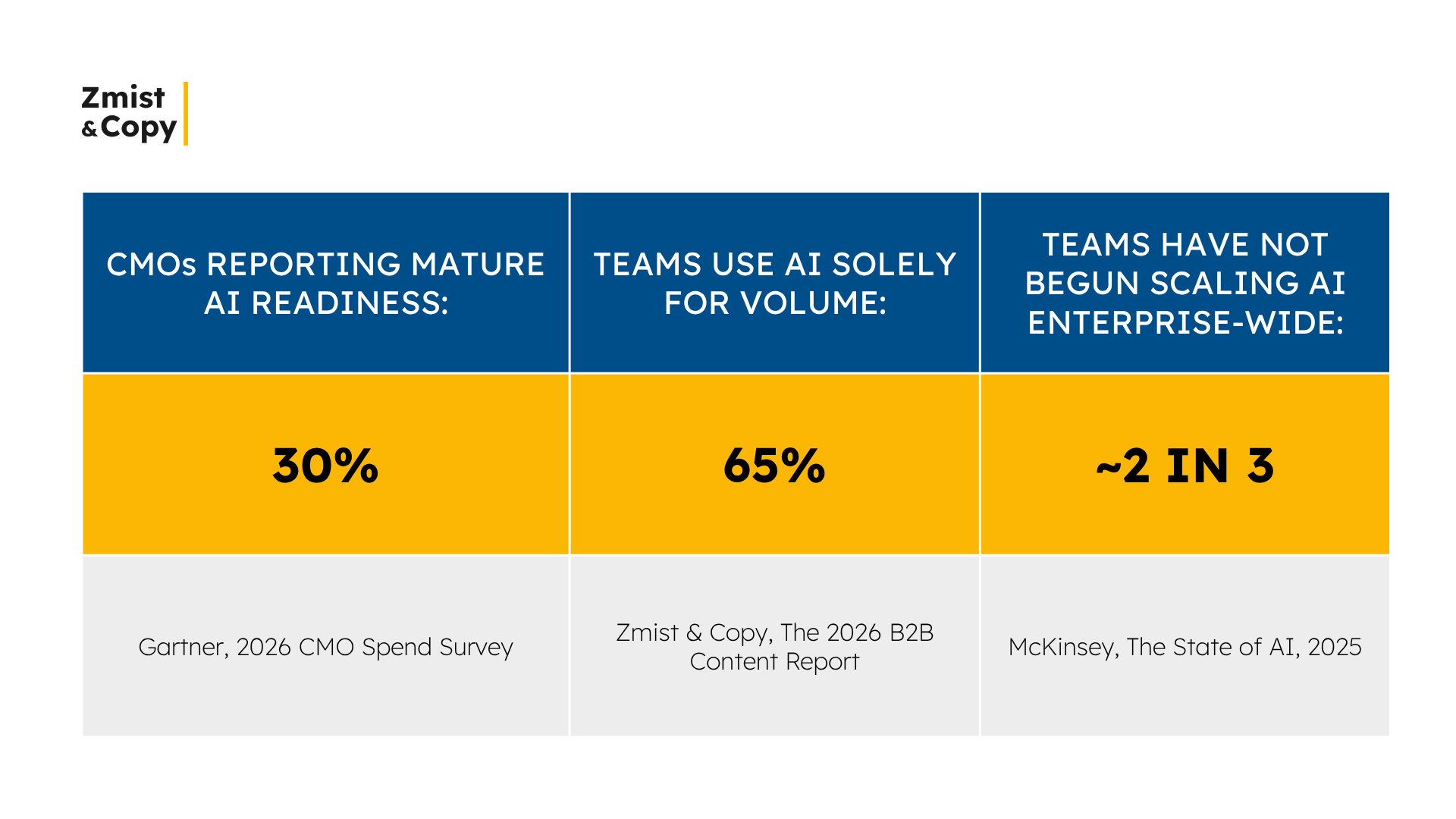
- Between 91–95% of marketing teams now use AI. Only 30% of CMOs report mature AI readiness.
- Roughly 35% of teams use AI to pressure-test ideas and find angles before writing. The other 65% use it mainly to produce content faster.
Takeaway #1: Cost per piece fell 4.7×, but budgets dropped only 1.4%
Cost per piece dropped dramatically, obviously. Yet, total content budgets barely changed.
Ahrefs found that an average human-written blog post costs $611. The same post produced with AI assistance costs $131. That's a 79% reduction in the unit cost.
Now the budgets. Monthly content marketing spend among teams using AI: $2,475. Among teams not using AI: $2,442. The AI users spend slightly more.
So where did the discount go? Into output. In the same report, Ahrefs found AI users publish 42–47% more content per month — a median of 17 articles against 12 for teams without AI. A 79% discount on your largest content input is real money. It could have funded original research, expert interviews, a data study, distribution, or design. Instead, it funded more articles.
Deloitte's data shows the same pattern from the operations side. GenAI saves the average employee 11 hours per week, and 41% of users report reduced content production costs, up from 32% the year before. The same data shows that content demand nearly doubled between 2023 and 2024.
Cheaper production met rising demand, and demand won.
🟢 The advantage: production capacity is no longer a function of headcount. A team of three can now put out what used to take a department.
🔴 The risk: the money teams are saving on content production is being spent on creating more content, but more content doesn't equal better results.
The market is locking it in
CMI asked 1,015 B2B marketers where they plan to increase investment in 2026. AI-powered tools came first, named by 45%. Human resources (salaries, training, development) came last, named by 9%.
That is the same choice as the 2025 budget, formalised for another year. More capacity to produce, less capacity to judge.
Takeaway #2: 85% of teams published more, into a web where 74.2% of new pages are already AI-generated
AI removed the production ceiling and raised the quality bar at the same time. Most teams only solved the first problem.
We found 85% of B2B tech content teams increased volume in the last twelve months — 58% slightly, 27% a lot. Canto and Ascend2 found 82% of 434 content marketers published more. In the same study, 75% attributed the increase specifically to AI.
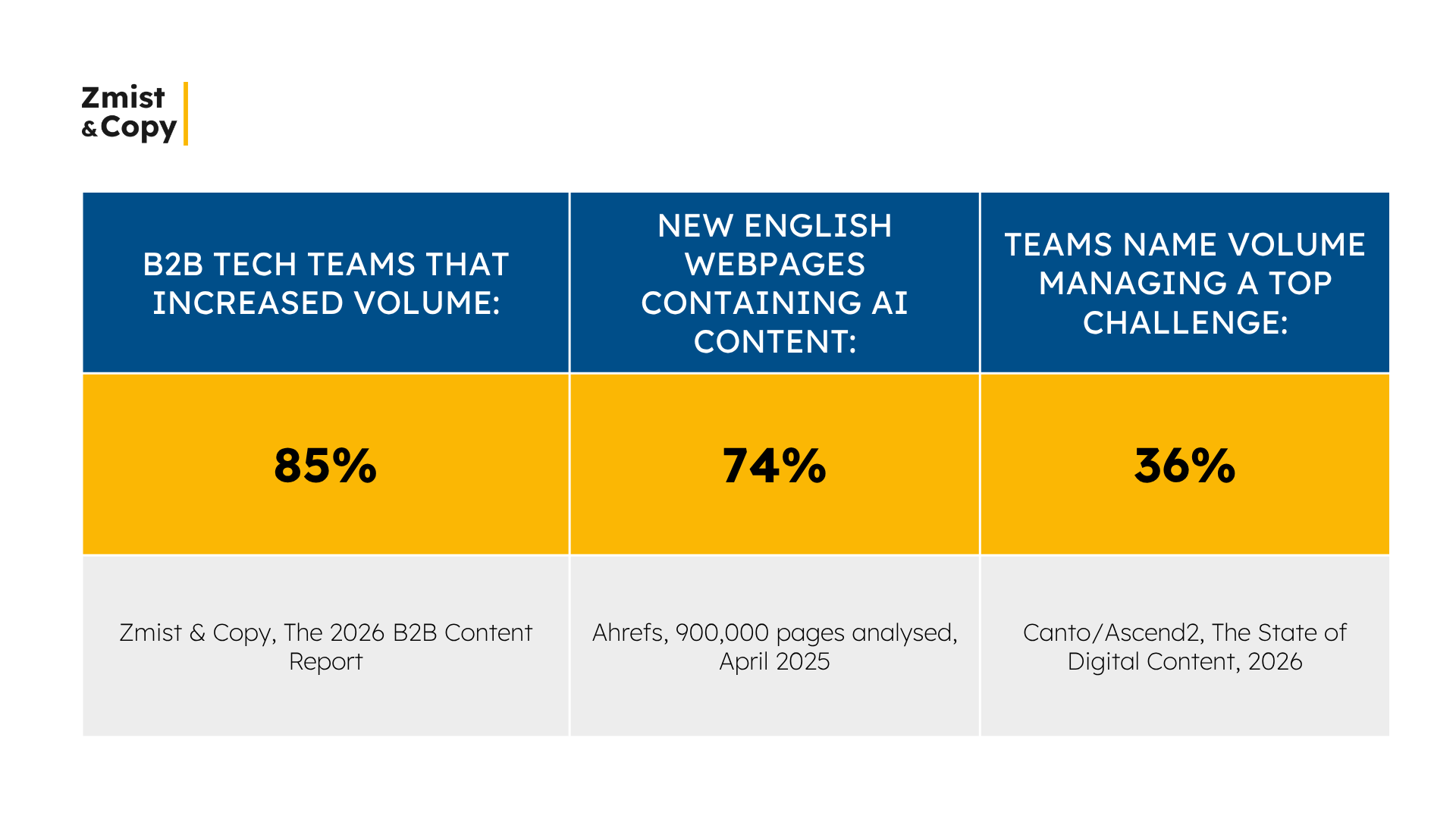
Ahrefs discovered that across 900,000 new English-language pages, 74.2% contained AI-generated content. The thing is, when three-quarters of new pages are AI-touched, just publishing more AI-assisted content no longer gives you an edge.
The same study from Ahrefs found that only 2.5% of pages are pure AI. 25.8% are pure human. The majority — 71.7% — are mixed.
Almost nobody is publishing raw AI output. The problem is that a human editing an AI draft produces content that is correct but indistinguishable from competitors.
🟢 The advantage: you can publish at a cadence that used to require a department.
🔴 The risk: so can every competitor. And 36% of teams now list “managing the growing volume of content” as one of their biggest problems, which barely existed three years ago, before AI made it so easy to publish more.
Takeaway #3: 77% call their own content generic, but only 24% call differentiation a top challenge
77% of the B2B tech content leaders we surveyed say their content now feels generic. But in CMI's survey of 1,015 B2B marketers, only 24% name “differentiating content from competitors” as one of their top three challenges.
Why such opposite answers in the same market?
The difference is mostly due to how the question was asked. We asked people who own the content directly: “Does your content feel generic?” They answered honestly.
CMI, in turn, asked marketers to rank their biggest challenges. The top answers were the ones that show up in monthly reviews: conversion (40%), resource constraints (39%), and measurement (33%). Differentiation came in at only 24%, below even “creating enough quality content” (28%).
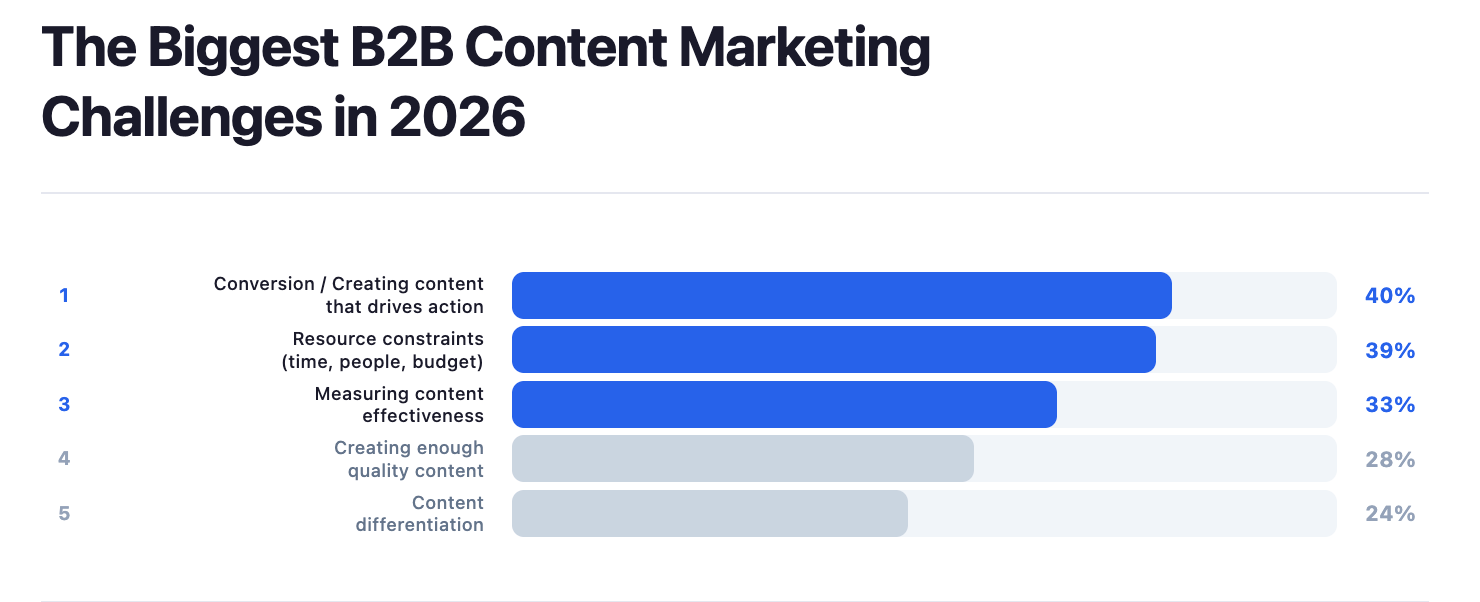
Teams are not likely to name “our content sounds like everyone else’s” as a top problem (even when it is) because they are held accountable for volume, cost, and attribution. Nobody is asked whether their content sounds just like competitors.
🟢 The advantage: if your team names sameness as the problem, you're working on it while most of the market is still optimising conversion rates on undifferentiated pages.
🔴 The risk: differentiation stays invisible on the scoreboard, which makes it the hardest problem to get funded.
Takeaway #4: 42% say AI significantly improved productivity. Only 6% say it significantly improved results
CMI asked the B2B marketers whose companies use AI tools how it has impacted their marketing operations:
Significant improvement falls from 42% to 6% as the question moves from how fast do we work to does the work produce results.
The more a number means actual business results, the harder it is to claim that AI improved it.
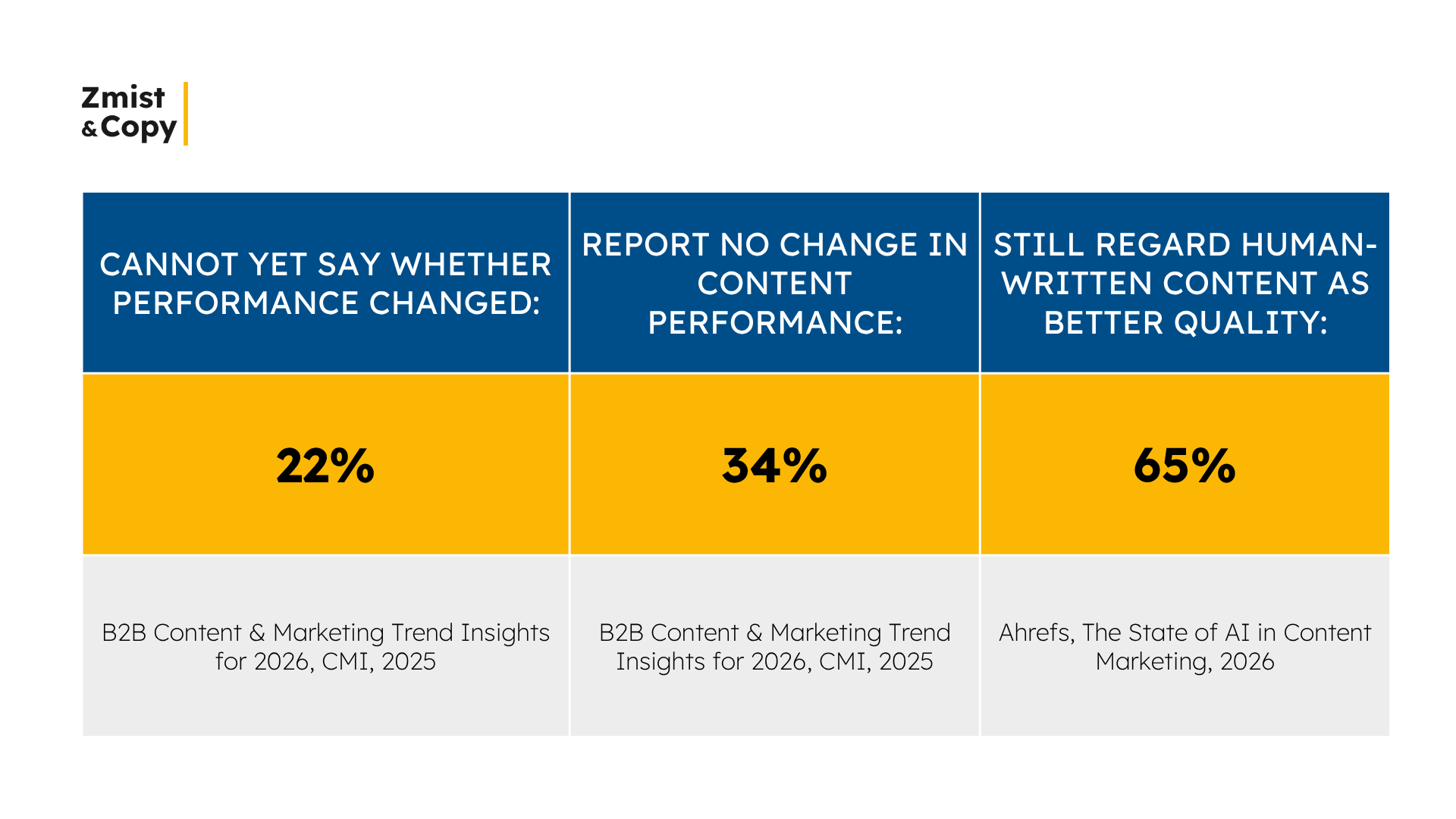
34% report no change at all. So the typical result of AI-assisted content production is zero improvement.
Our own data shows the same: 23% of the B2B tech teams we surveyed report more volume and no better results, and among those who increased volume significantly, nearly half saw no noticeable change.
22% of content marketers can't say whether performance changed with AI — 7% unsure, 15% saying it's too soon to tell (CMI). Teams know that they are faster, but a fifth of them have no idea whether it's working.
Ahrefs surveyed 879 marketers, 87% of whom use AI to help create content. Among them, 65% still regard human-written content as better quality. Only 4% publish mostly pure AI content.
AI improved the speed, but it didn’t raise the ceiling of what a good writer produces.
Naturally, when output rises and review capacity doesn't, the average piece gets less attention than it used to. The result is a body of content that is acceptable but never excellent.
🟢 The advantage: teams that used to ship one weak piece a month now ship four adequate ones.
🔴 The risk: AI didn’t improve anything, but budgets keep flowing.
Takeaway #5: 97% of marketers edit every AI draft. Only 6% have tools for that
Our team asked how teams keep AI output aligned with their brand. 43% rely on human review and editing alone. 33% paste brand guidelines into prompts. 18% rely on prompting techniques. 10% have a human write first and use AI to assist. 6% use custom AI tools, agents, or GPTs. 6% involve subject-matter experts.
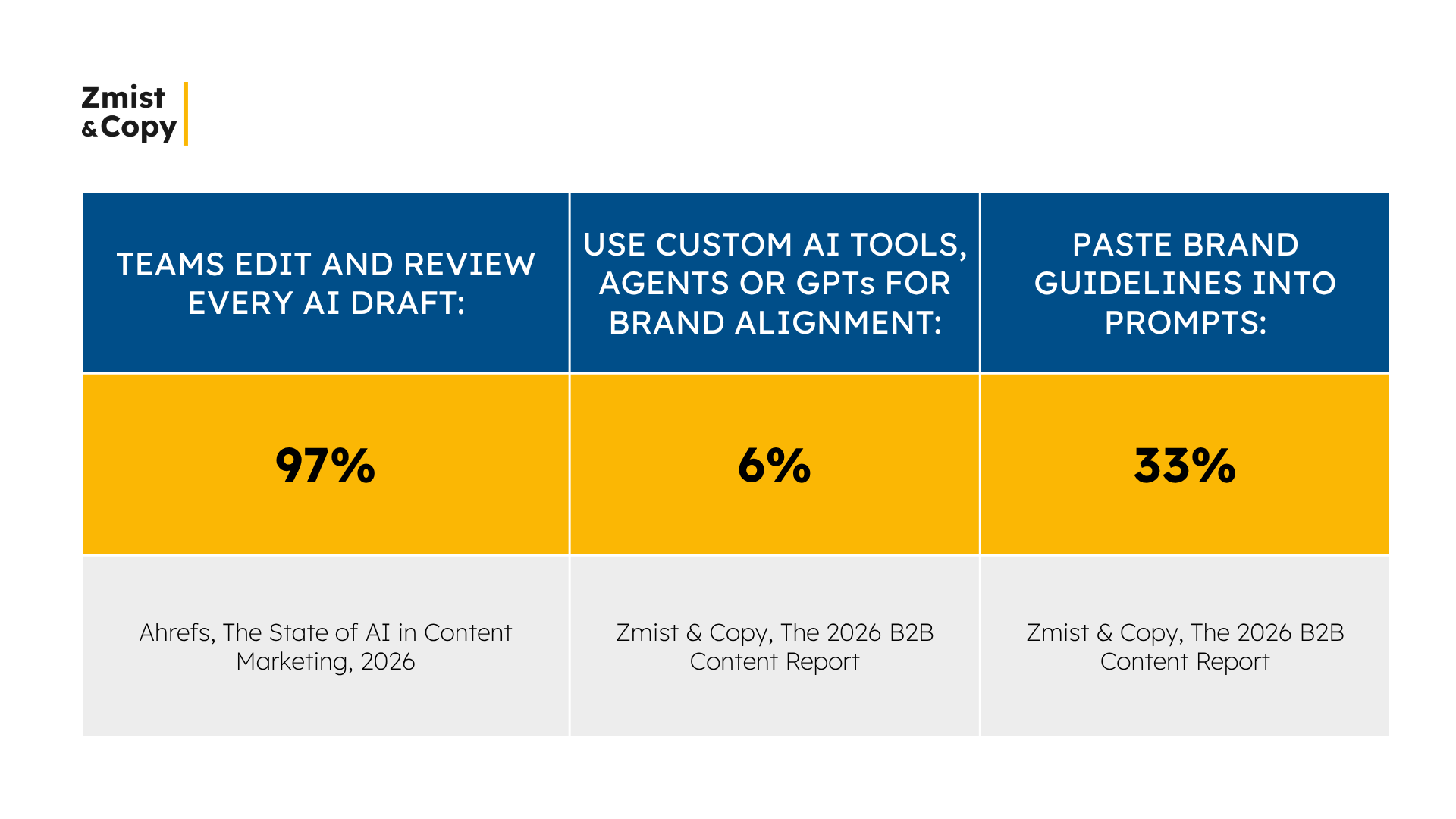
Pasting brand guidelines into a prompt means the brand gets re-explained from scratch, every session, by whoever happens to be writing. Nothing accumulates, and the tenth brief is no better informed than the first.
33% of teams are in this situation and only 6% have built infrastructure.
To top it all off, Orbit Media found the teams that let AI write the full draft are the ones least likely to see strong results. The use case that performs best is asking AI only to suggest edits.
The irony in these numbers is that teams producing the most content have the least infrastructure to make their content expertise-led.
The market is finding this out expensively
Jasper surveyed 1,400 marketers and found legal, compliance, and brand-governance concerns rose 3.4× year over year; now that’s the top blocker to scaling AI.
🟢 The advantage: the manual approach works immediately, costs nothing, and requires no buy-in.
🔴 The risk: it works until the person doing it leaves, or until volume outruns attention.
The key finding: AI adoption is universal, but maturity isn't
Between 91% and 95% of marketing teams now use AI (Jasper; CMI). Everyone has access to AI, but still, almost nobody has the system.
Gartner surveyed 401 CMOs and found they allocate 15.3% of marketing budgets to AI, while only 30% report mature AI readiness, and 70% call becoming an AI leader a critical 2026 goal. They are spending ahead of capability, by their own assessment.
McKinsey finds the same pattern at company level: nearly two-thirds of organisations haven’t begun scaling AI enterprise-wide.
Roughly 35% of the teams we surveyed use AI primarily to pressure-test ideas, synthesise research and find angles before anything gets written. The other 65% use it mainly to produce more of the same, faster.
AI can't answer for you what's actually worth saying. You have to know your buyer, your position, and what you have that your competitors don't. This is why teams with the least clear positioning got the least out of AI.
The last word
AI removed the excuse of capability and showed us the real problem: lack of content quality.
A team of three can now out-publish a department, which means volume is no longer evidence of effort or of strategy. What's left is the core question: do you have something worth saying, and can you prove it's yours?
That was always the job. AI just made it impossible to avoid.
See our full 2026 B2B Content Report with all 53 responses if you'd like to dive deeper.
Or, if these findings confirm what you already knew, it's time to create expertise-led content your competitors can't replicate. That's what we help companies do. Drop us a message, and let's see what we can do for you.
Sources:
- Zmist & Copy – The 2026 B2B Content Report
- Ahrefs – The State of AI in Content Marketing
- Ahrefs – 74% of New Webpages Include AI Content (900k pages study)
- CMI / MarketingProfs – B2B Content & Marketing Trends: Insights for 2026
- Canto / Ascend2 – The State of Digital Content 2026
- Deloitte Digital – GenAI in marketing content production
- Jasper – The State of AI in Marketing 2026
- Gartner – 2026 CMO Spend Survey
- McKinsey – The State of AI in 2025
- Orbit Media – 2025 Blogger Survey / AI Uses for Content Marketing


