


Comparison articles have a bad rep. Boring listicles written to please search engines – the kind readers skim, eye-roll at, and forget in seconds. Truth be told, I treated them the same way in my first in-house role: write fast, get it over with, never ask if this format actually… works.
And it does work – when done right.
Below, I explain why comparison articles (“best/top X alternatives,” “A vs. B,” you know the kind) are strategically valuable today – and how we write them at Zmist & Copy so they actually help buyers instead of making them cringe.
TL;DR
- Comparison content is strategically valuable. LLMs cite it heavily, and LLM-generated traffic converts much better.
- Boring comparison content is a positioning problem: no POV = safe, generic, forgettable.
- When you’re unsure what sets you apart, you default to keyword-chasing, forced “neutrality,” or feature lists no one remembers.
- Many teams avoid the format altogether because saying nothing feels safer than being honest.
- Our approach at Zmist & Copy: build a narrative → own the bias → highlight true differentiators (“best for…”) → compare everyone using the same criteria → repurpose for distribution.
- When you’re clear about who you’re for (and who you’re not), comparison articles stop feeling salesy and start helping buyers make confident decisions.
P.S. At the end of the article, you’ll find 4 great comparison pieces from other companies – helpful inspiration for structure and tone.
Why comparison articles are strategically useful today
Lots of folks seem to dislike comparison articles:
“We’ll be too self-promotional, no one will take us seriously.”
“What if this article makes us look worse in comparison?”
“Why would we promote competitors?”
So they simply avoid the format, or treat it like a necessary evil.
I get the ick: it feels awkward to talk about yourself, let alone your competitors.
But your buyers are comparing solutions anyway (with an average of 4.4 options on their initial vendor list, Gartner). The question isn’t “Should we compare ourselves to competitors?” It’s “Do we want to help shape the narrative around our product, or leave it entirely to Gemini, ChatGPT, and competitor content?”
This is where comparison articles become strategically powerful. Here’s why.
- Because they boost your brand visibility in the LLM era
To shape your product’s narrative, show up more often where buyers are researching.
Right now, a promising lever is LLM visibility. Good news – LLMs love comparison content:
- Josh Blyskal, AEO Engineer at Profound, shares that comparison pages are the most cited content in LLMs – 32.9% of all citations across 177M datapoints.
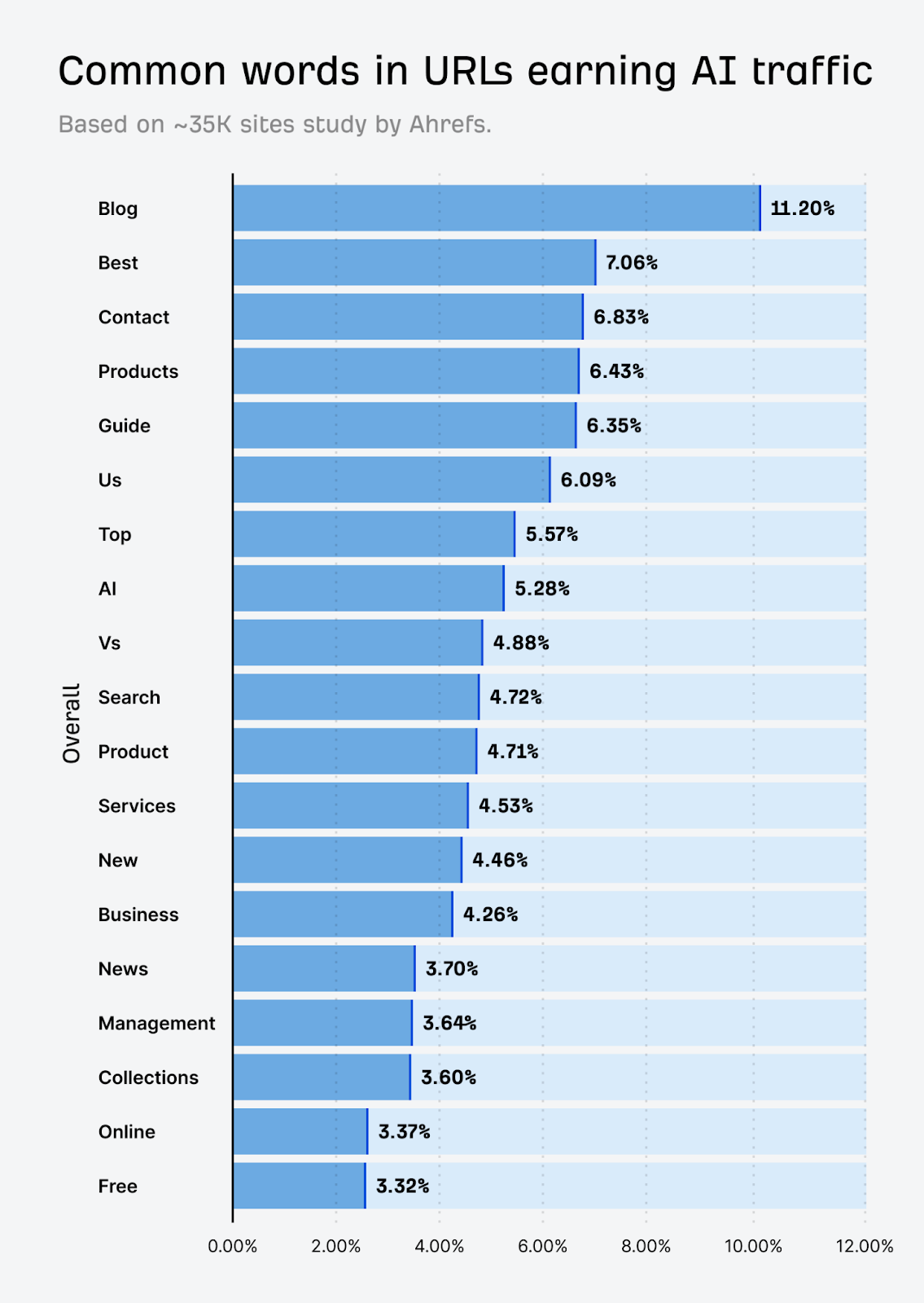
- Ahrefs' data shows “best” is the second most common word in URLs getting AI traffic. “Top” and “vs” follow closely.
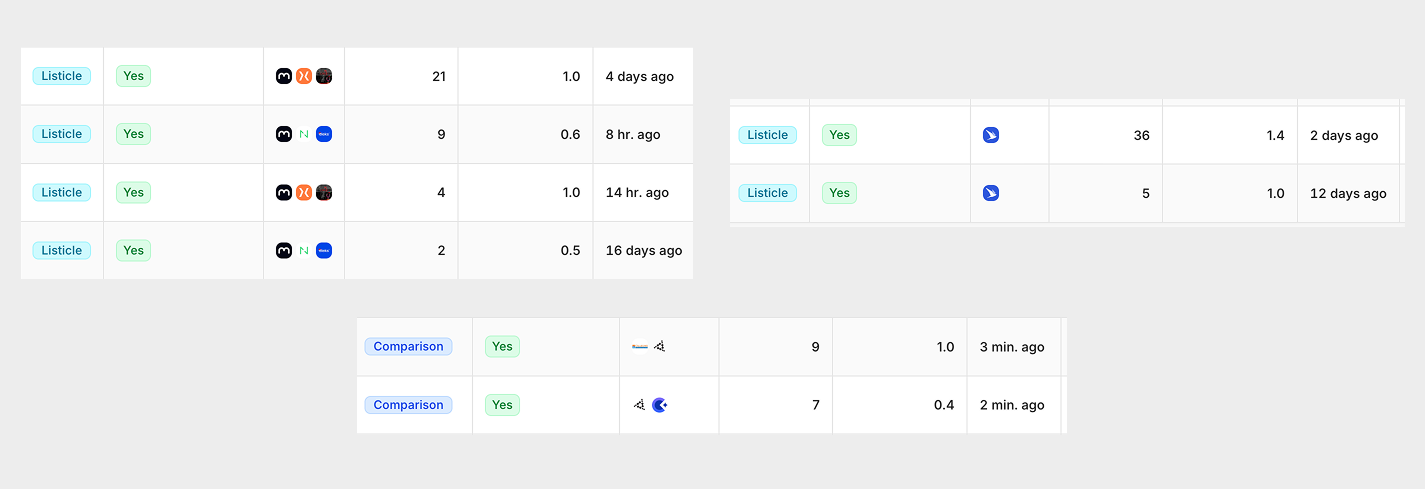
- We’ve started tracking AI visibility across client work, too. Comparison articles are often the pages that get cited first by ChatGPT, Perplexity, and other models.
LLMs tend to cite pages that provide consensus (the shared basics of a category) and information gain (something extra and uniquely useful). Patrick Stox, Technical SEO expert at Ahrefs, explains that the most cite-able pages do both: they reflect what everyone agrees on and add something the rest of the web lacks.
Good comparison articles do this by design: they outline the landscape, then differentiate.
They also benefit from the Matthew effect: once a page gets cited, it's more likely to be cited again. If you care about LLM visibility, comparison content is a strategic advantage.
- Because the AI traffic they bring converts
Yes, AI citations don’t automatically equal clicks, and AI search drives a meager <1% of total website traffic today. But people who do click through convert 3x better than Search, Direct, or Social, Microsoft Clarity found. Ahrefs has seen conversion from LLM traffic as high as 23x.
Why? Because someone clicking from ChatGPT, Perplexity, and the like is already informed, primed, and evaluating options. So even though the volume is tiny, intent is massive.
- Because they help prevent AI hallucinations
Some people are discovering that LLMs like ChatGPT share incorrect information about their product when comparing them to competitors.
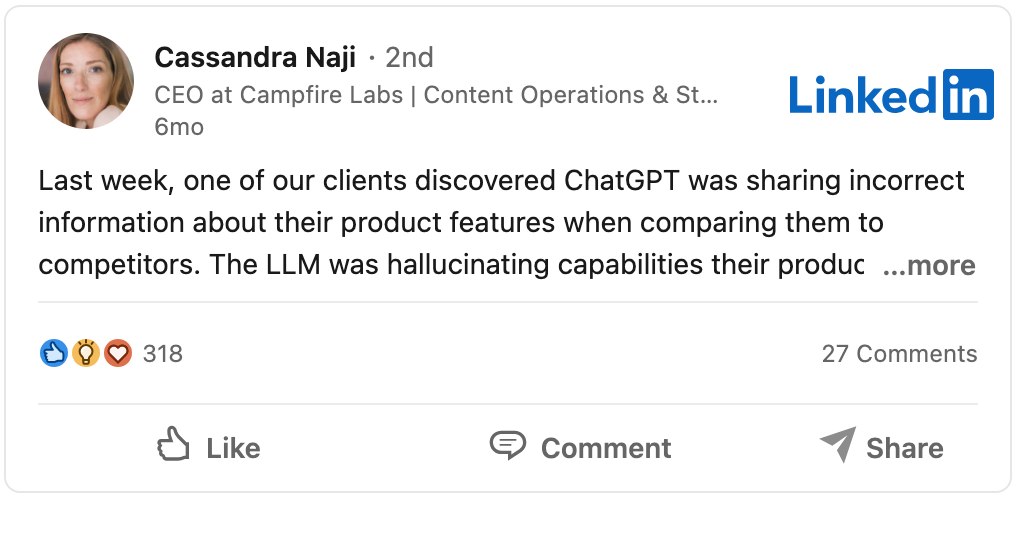
Models “fill in the blanks” based on what’s available across the web. And if you don’t supply the right framing, they’ll make up their own. A good comparison article gives LLMs the correct one to reference.
So the question isn’t: “Should we do comparison articles?” But rather: “How should we do them better?” Because the truth is, most comparison content makes you believe B2B does stand for “boring-to-boring.”
Why most comparison articles are a snoozefest (It’s not the format, it’s the lack of POV)
This brings us to another common misconception around comparison articles: “Aren’t they just boring SEO listicles?”
Fair question. Because most of them are.

The format isn’t the problem. Most comparison articles feel bland because the companies writing them don’t have a POV. And that usually happens when their positioning is fuzzy.
See also: Positioning done right (Eleken’s story)
When you’re unsure what you can confidently claim, you slip into “safety mode”, which creates two predictable loops:
- Chasing any keyword that seems rankable (because you’re trying to be everything to everyone)
- Fear of sounding biased or “promoting competitors” (because you’re not sure what you can safely claim)
Let’s break those down.
→ Chasing every keyword leads you away from your real strengths
If you’re not sure what sets you apart, your “strategy” quickly becomes: rank for something… anything. So instead of writing the article you’re actually qualified to write, you chase whatever keyword looks winnable in Ahrefs, even if it has nothing to do with what you’re good at.
Yes, you might get traffic. But then what? Lashay Lewis, a BOFU queen, notes that “companies are more worried about ranking than serving the customer. That leaves space and opportunity for us to do this the right way and not just rank, but make sure that content drives real pipeline.”
Take a software development company that mainly works in Go as an example. They see “Top Python development companies” trending, so they decide to go after it – even though they’ve only built one small Python-based CRM. It ranks, maybe. But it has nothing to do with their strengths, and nothing to do with what a Python buyer actually needs. So keywords are there. Common sense isn’t.
→ Fear of sounding biased leads to overly safe, watered-down content
On the opposite end, teams panic about looking too self-promotional – or “giving visibility” to competitors.
So they over-correct. Messaging gets watered down. Tone becomes overly safe and painfully generic. Casey Hill, CMO at DoWhatWorks, nails this dynamic:
“Brands are scared to give competitors their flowers in a real way and not the dismissive ‘They are great for super enterprise, 10000+ customer brands, so if you have infinite money, then go for it’ type of way.”
When you can’t communicate your strengths, you assume any comparison will make you look weak – which brings us to these three common problems.
3 red flags of comparison content that put off your prospects
1. Defensive tone: treating comparison articles like a race you must win. Instead of helping readers understand trade-offs, you present yourself as the automatic winner, highlighting your strengths, downplaying competitors, and calling it “objective.” Readers detect this instantly and lose trust.
2. Fake neutrality: Switching into a forced analyst voice, using a third-person POV:
Vendor A is best for enterprise.
Vendor B works for small teams.
Vendor C (you) is ideal for everyone!
But the article is on your blog. No amount of third-person “neutrality” will make you unbiased. Come on.
3. Feature dumping with no differentiation: Providing checklists of features without:
- prioritization
- guidance
- trade-offs
- or context
…leave your reader just as confused as before.
But: Because so much comparison content is bad, the bar is low.
The job is to figure out who you’re for, how you differentiate, and then build the article around that. That’s exactly how we approach comparison content at Zmist & Copy.
How we write comparison articles at Zmist & Copy
Our approach includes 5 steps:
- Build a narrative
- Own your bias
- Focus on differentiators
- Use the same evaluation criteria
- Repurpose for distribution
Build a narrative
The goal of this step: Create a trust-building intro that explains your intent.
Before we compare companies or products, we set the stage:
- Who we’re writing for
- What situation they’re likely in right now
- Why us: why we’re a credible voice in that situation
We do it in three beats:
→ Anchor the intro in a real scenario a reader is dealing with
→ State your intention clearly
→ Establish your credibility without bragging
We start by scanning existing content on the topic and spotting the gaps. From there, we anchor the intro in a realistic scenario our ICP faces to then enter the conversation, explaining why we’re adding our voice.
For example: We recently wrote a “Top Python development companies” article for Flyaps. Dozens of articles existed, but most simply listed generalist software dev companies – firms where “Python” lived somewhere between “Java” and “Front-End” on a long service list. Flyaps, meanwhile, has been a Python-first team since 2013.
And that’s exactly how we framed our intro:
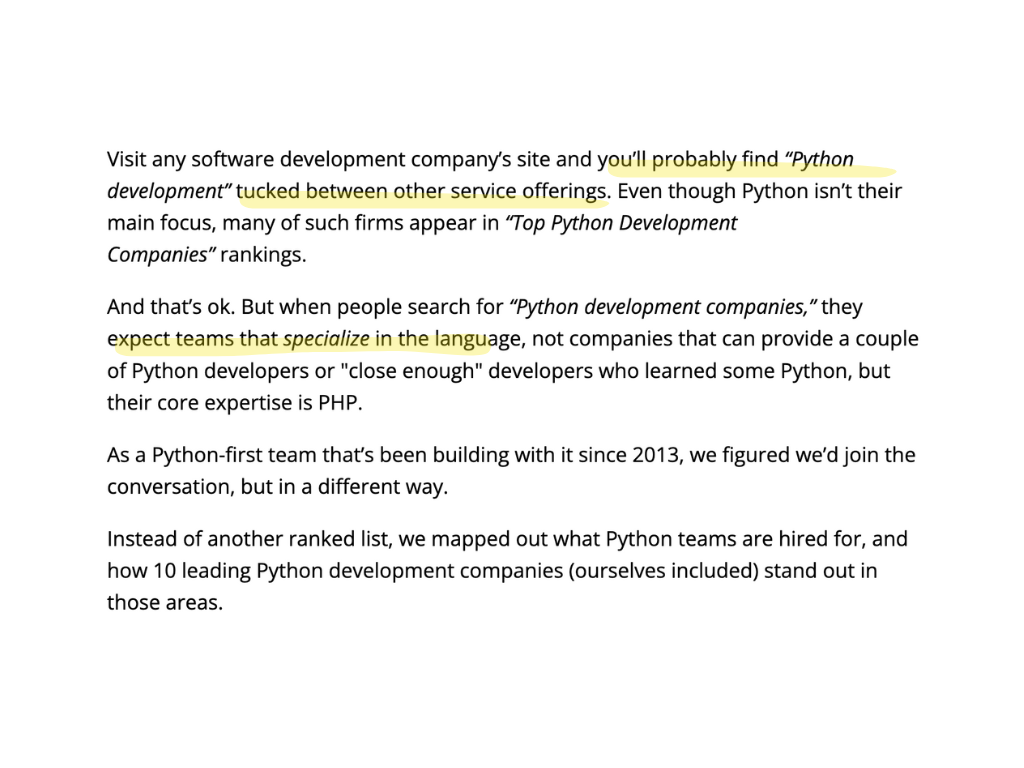
This framing:
- Calls out the gaps in existing content
- Shows the reader you understand what they’re looking for
- Signals your angle: what this article will do differently
This builds trust immediately. You set a helpful direction and are transparent about your stance. And (attention, serious B2B research incoming) transparency is one of the seven key trust levers for B2B buyers, according to Forrester.
Once this intro is set, the rest of the article flows naturally: Owning your bias and focusing on differentiators doesn’t feel awkward, but expected.
Own your bias
The goal of this step: Take an honest stance – you’re a vendor with a POV, not a neutral judge.
This is the simplest, yet most overlooked thing. Just think about it:
You’re a vendor comparing yourself to competitors. In an article that sits on your site.
You WON’T come off unbiased. There’s no point in a “fair third-party analyst” mode.
Instead of faking neutrality, we own the bias upfront. Here are some examples you can use throughout the article:
→ “We’re on this list too, so we won’t pretend to be objective. But we do want to be honest about where we fit, and where we don’t.”
→ “We’ll start with our own solution since that’s the one we know best.”
→ “If you need X, we might be right for you. If you need Y, [vendor B] might be better.”
→ “Here’s where we stand out. Here’s where others do.”
Buyers don’t expect you to be unbiased (they can see your logo at the top). But they do expect you to be honest. Once you are, you stop competing in a vague “best overall” category – and start helping readers self-qualify. 👇
Focus on what sets each company apart
The goal of this step: Help readers self-qualify by showing what each vendor is best for.
The next move is treating the comparison less like a beauty contest – and more like a helpful guide.
The simplest way to do that?
→ Use a “best for/best known for” structure
Instead of ranking vendors or implying one universal winner, we highlight what each company is specifically good at.
This shifts the article from ❌ “Who wins?” to ✅ “Who is right for whom?”
It’s a win-win-win:
- You’re upfront about strengths instead of forcing a fake “best overall”
- You filter out unqualified prospects and save the sales team time
- You don’t diminish competitors, but explain where each one shines
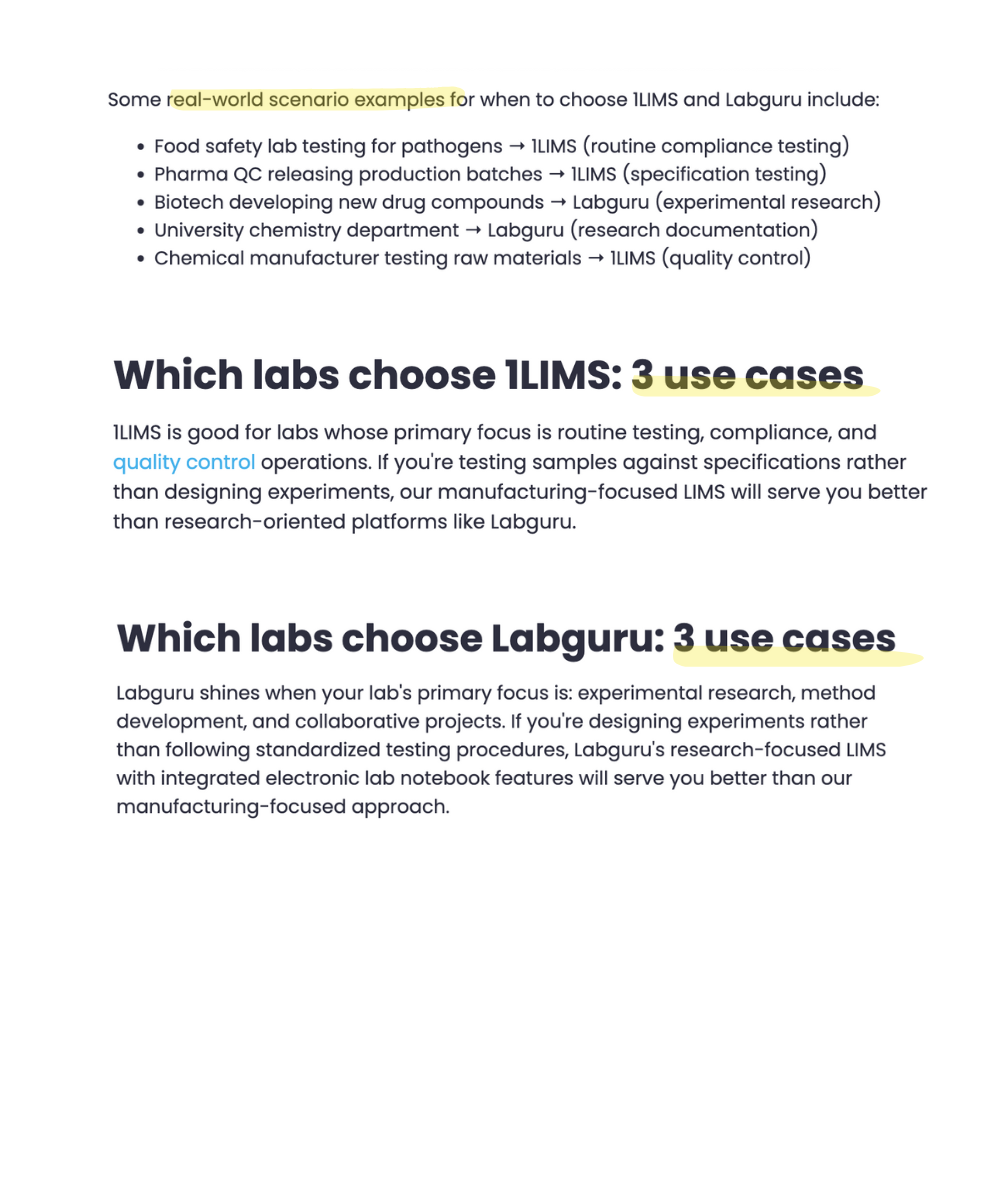
For example, in a comparison article we wrote for 1LIMS, a LIMS provider, we got upfront from the title alone: “1LIMS vs. Labguru: The First Honest Comparison (And When You Should Choose Our Competitor).” Instead of stacking feature lists, we centered the entire comparison on use cases. We backed each section with real-world scenarios and customer stories, so readers could instantly see where each platform fits.
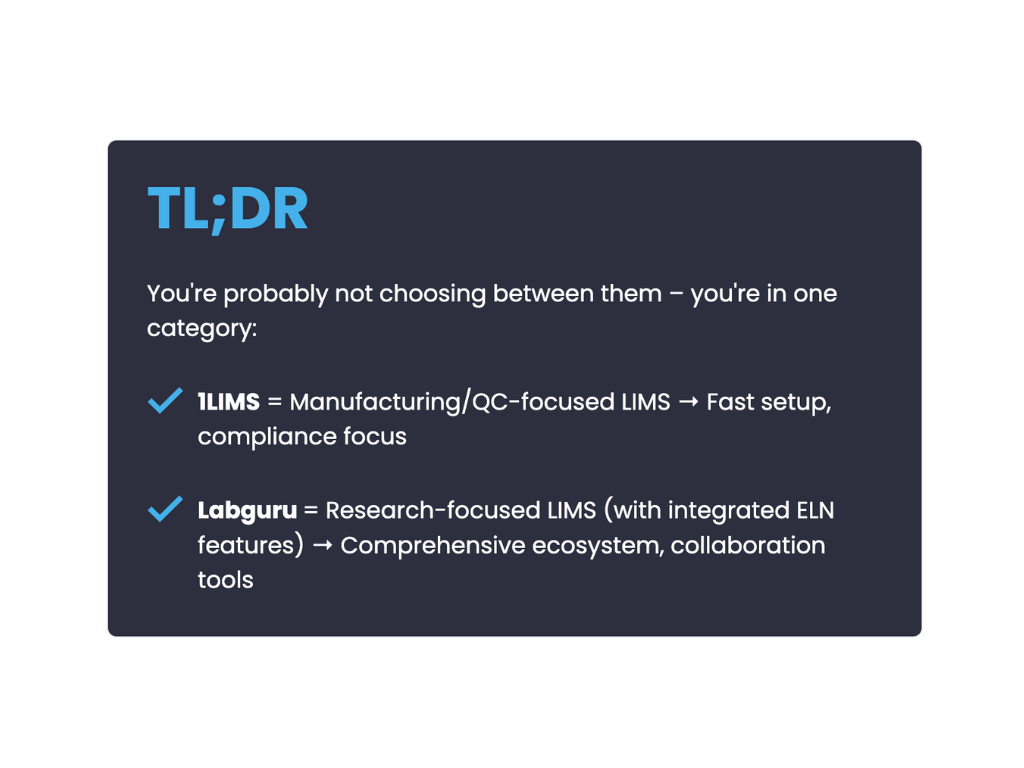
Another little thing we love to do is add a TL;DR block right after the intro. It helps two audiences:
- Humans, who appreciate the quick orientation
- LLMs, which rely on early structural signals to understand and cite content
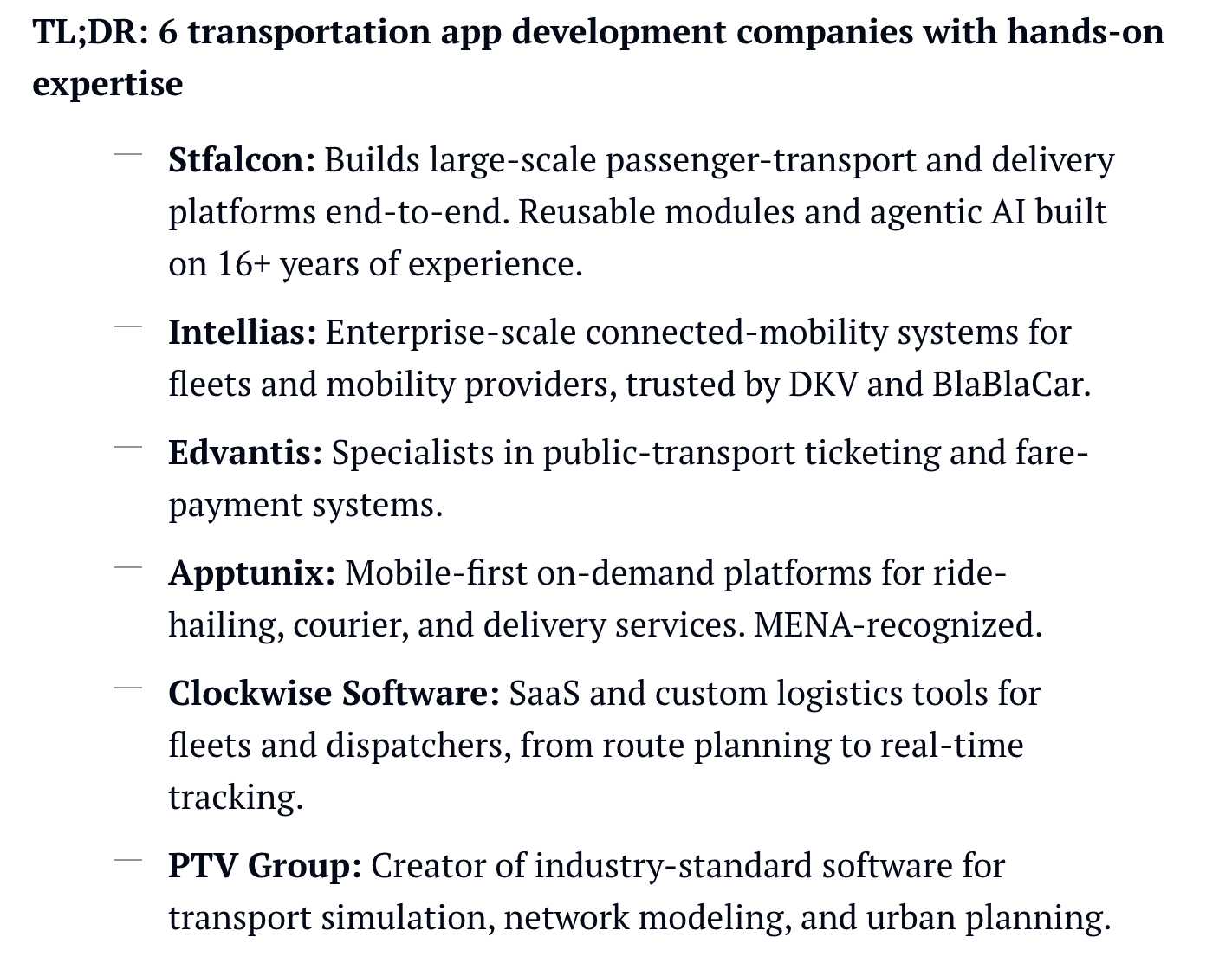
This format works beautifully for service companies too. Here’s what we usually structure the TL;DR for each vendor:
- vendor name
- what they’re best known for
- (optional) a credibility proof like industry, region, or flagship projects
A good TL;DR isn’t “the intro again”. It’s a quick skimmable map of the landscape: who’s who, who’s best for what, and what your reader should know before scrolling.
Note: A pros-and-cons format can work here, too. It’s great for SaaS, where you have tons of user reviews and specific feature sets. But it’s much trickier for service companies, where the “product” is people + process, both of which can vary from project to project. That’s why, for service clients, we usually skip the pros-and-cons approach entirely and focus on “best for…” scenarios grounded in domain expertise and verifiable case work.
Use the same evaluation criteria for all vendors
The goal of this step: Make the comparison fair, consistent, and easy to scan
At the start of the article, we also explain our methodology:
→ criteria we’re using
→ why these criteria matter
Then we apply the exact same criteria for each vendor.
Example: In the “best construction dispatch tools” article we wrote for a fleet management software provider, we used the following criteria structure for all platforms:
- Best fit/who it’s for
- Pricing
- Setup/onboarding
- Key dispatch features
- What customers love
- Limitations (not “cons”)
- Features that matter most for construction teams
…while also highlighting why we excluded popular vendors (that other articles included).
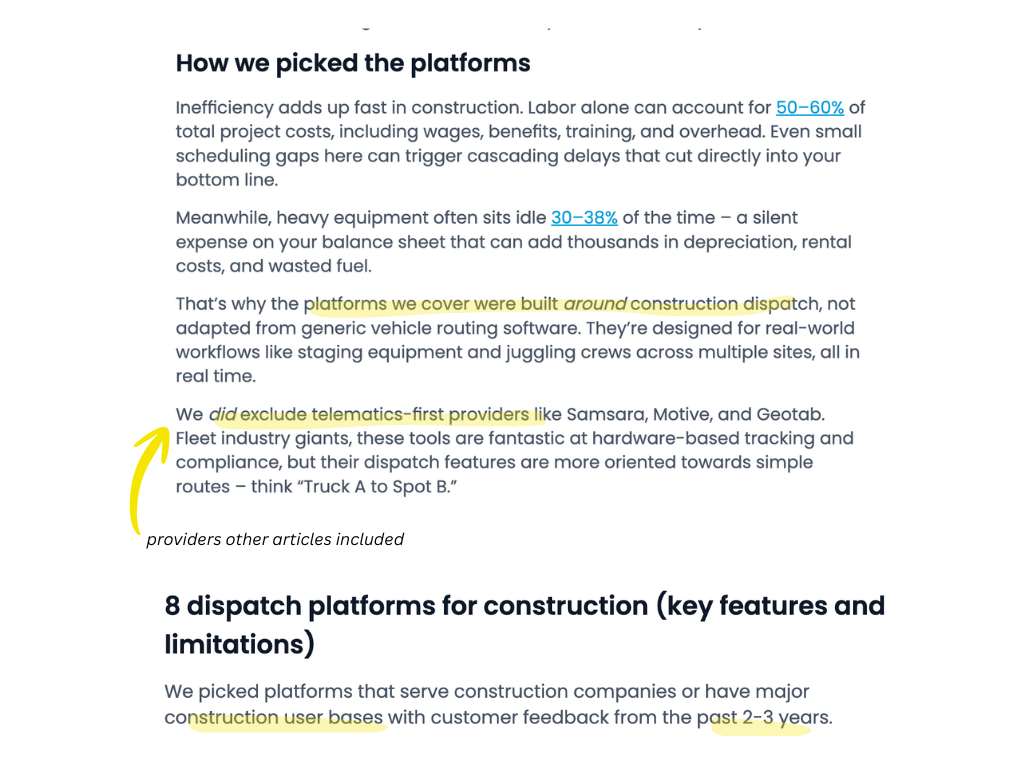
This gave readers a like-for-like comparison while keeping the tone factual, helpful, and grounded in real use cases.
Why this works: Because it’s simply fair. Also, when you force yourself to evaluate every vendor using the same criteria, you can’t hide behind vague descriptions like: “They’re an innovative company” or “They have robust features.” You must instead answer concrete, buyer-oriented questions for each vendor, such as:
- Who is this tool actually best for?
- What specific features matter most in this category?
- What limitations really matter for a buyer?
This also creates a structure LLMs can understand easily, improving your chances of being cited accurately.
Repurpose it for maximum visibility
The goal of this step: Make the most out of a high-intent piece.
Finally, we repurpose the article into a few other formats:
- YouTube video (great for long-tail search and building trust through voice/face)
- LinkedIn posts or a short article (spotlighting key insights or the TL;DR)
- Carousel or infographic (visualizing the “best for…” breakdown).
We also recommend sharing the article with featured vendors. Many will happily reshare – free visibility, no extra effort.
It’s all positioning, really
Buyers don’t need you to be neutral. They need you to be honest about:
- what makes you different
- what you genuinely excel at
- where your competitors are a better fit.
When your positioning is clear, you can speak plainly about your strengths and evaluate other vendors without worrying you’ll look “weak”. Then, the comparison stops being cringe and starts being helpful, actually guiding buyers toward the right choice. And yes, sometimes that choice won’t be you. That’s fine. Because for the right buyer, your honesty is exactly why they’ll trust you.
→ P.S. Need a hand clarifying your brand’s positioning? We can help – just drop us a line.
If you want some extra inspo in the meantime, here are four comparison articles from other companies that do this format great. Each has a smart detail worth borrowing.
Bonus reading: 4 comparison articles worth learning from
- Postmark: “5 Mailgun alternatives, recommended by... a Mailgun competitor?!”. Postmark owns their bias from line one (“yes, we’re a competitor — here’s why we’re writing this anyway”), which instantly disarms the reader. Worth taking inspiration from: A public comparison spreadsheet with a “last updated” date. It turns the article into a living resource and signals: we did the homework so you don’t have to.
- Shopify: “Salesforce Commerce Cloud Alternatives”. This could’ve been another dry “alternatives” post, but writing it was actually fun for its author, Brinda — because it’s grounded in first-party data Shopify owns. Worth taking inspiration from: Choose comparison topics where you have real insight. For Shopify, it was internal customer behavior, partner data, and migration patterns.
- Float: “11 of the best resource management tools”. Float organizes options into clear categories (“best-of-breed,” “enterprise,” “all-in-one”) with little “Scroll to →” links that help readers self-select. Worth taking inspiration from: A perfectly placed lead magnet. Their “Bonus tip: use our resource planning templates until you pick the right tool” is contextually relevant, low-pressure, and adds immediate value.
- PostHog: “The most popular PostHog alternatives”. PostHog treats competitors honestly: quoting how they position themselves and using real reviews in a “what people like” section. Worth taking inspiration from: Let competitors’ own words and customer feedback do the talking.


